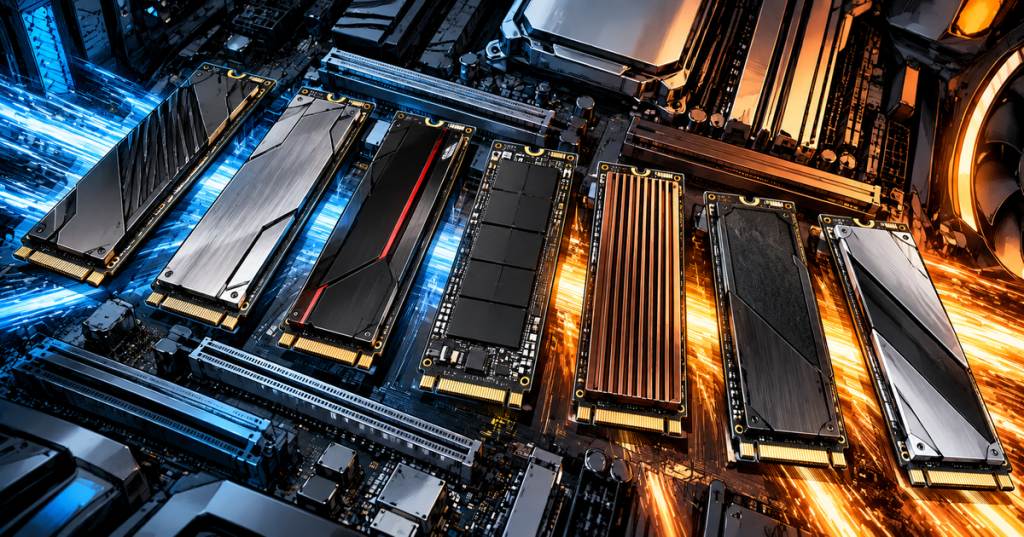
PCIe 5.0 has pushed consumer NVMe storage to the edge of a four-lane Gen5 interface. This countdown ranks seven of the fastest consumer SSDs available right now by each drive family’s published peak sequential read speed, with peak sequential write speed used as the tie-breaker. Real-world performance can differ by capacity, workload, cooling and platform.
For background on the hardware underneath these numbers, see BitcoinVersus.Tech’s guides to what is inside an SSD, NAND vs. NOR flash, and how DMA moves data across PCIe.
7. Sabrent Rocket 5 — 14,000 MB/s read
Sabrent’s Rocket 5 reaches about 14,000 MB/s read and 12,000 MB/s write on the 2TB model. It remains one of the fastest Phison E26-based consumer drives and is tuned for DirectStorage-heavy workloads.
6. Crucial T705 — 14,500 MB/s read
The Crucial T705 pushes the 2TB model to 14,500 MB/s read and 12,700 MB/s write. It helped establish the 14GB/s class before newer controllers improved efficiency.
5. MSI Spatium M580 FROZR — 14,600 MB/s read
MSI’s Spatium M580 FROZR reaches 14,600 MB/s read and 12,700 MB/s write on its 2TB version. Its defining feature is a large passive FROZR heatsink designed to keep the Phison E26 controller from throttling.
4. Samsung 9100 PRO — 14,800 MB/s read
The Samsung 9100 PRO reaches 14,800 MB/s read and 13,400 MB/s write on higher-capacity models. Samsung pairs PCIe 5.0 with an in-house controller and TLC V-NAND, with capacities extending to 8TB.
3. Crucial T710 — 14,900 MB/s read
Crucial’s T710 peaks at 14,900 MB/s read on the 1TB model and up to 13,800 MB/s write on higher-capacity versions. Micron’s newer G9 TLC NAND and lower power draw make it a more efficient successor to the T705.
2. WD_BLACK SN8100 — 14,900 MB/s read
The WD_BLACK SN8100 matches 14,900 MB/s read but raises peak write speed to 14,000 MB/s on 2TB and 4TB versions. Independent testing has also highlighted its strong sustained-write behavior and power efficiency.
1. Corsair MP700 PRO XT — 14,900 MB/s read, 14,500 MB/s write
The Corsair MP700 PRO XT 2TB takes the top spot because it combines the same 14,900 MB/s peak read speed with the highest published write figure in this group: 14,500 MB/s. It uses TLC NAND, NVMe 2.0 and a power-efficient Gen5 architecture, though Corsair still recommends proper cooling.
Bottom line: these rankings measure maximum sequential throughput, not which SSD is best for every workload. Random I/O, sustained writes, thermals, endurance, capacity and price can matter more in daily use. For large file transfers, workstation scratch disks and data-heavy creative or AI workloads, however, the fastest Gen5 drives are now operating close to the practical ceiling of PCIe 5.0 x4.
BitcoinVersus.Tech Editor’s Note:
We volunteer daily to ensure the credibility of the information on this platform is Verifiably True. If you would like to support to help further secure the integrity of our research initiatives, please donate using the QR code provided

For best QR-code scanning results, please scan this donation code from a desktop or larger screen. Mobile screens may prevent camera recognition.


Leave a Reply