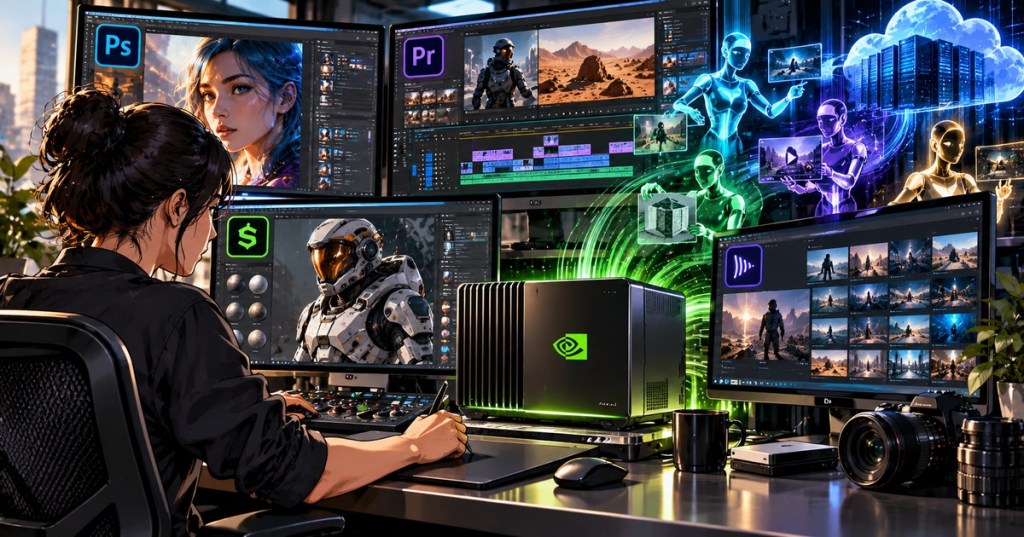
Adobe is pushing more of its creative stack toward NVIDIA’s new RTX Spark platform, with Photoshop, Premiere, Substance 3D, Frame.io and Brand Concierge all getting deeper GPU and AI acceleration.
In an Oct. 15 announcement, Adobe said Photoshop, Premiere and Substance 3D are being optimized to take advantage of RTX Spark’s unified memory and local AI compute. Adobe says the result can be up to 2× faster across selected AI processing, editing, color and effects workloads.
That claim should be read as a vendor performance figure, not as a blanket statement that every Adobe task is twice as fast. Independent reporting from RedShark News likewise describes the 2× figure as Adobe’s claimed uplift for optimized workloads rather than a universal benchmark across all projects and systems.
Photoshop is moving more work onto the GPU
Adobe says it rearchitected Photoshop around GPU-accelerated compositing so more of the editing pipeline can stay on accelerated hardware. The company specifically points to tasks such as Remove Tool operations, Gaussian Blur and Light Leaks as examples of work designed to feel more responsive on RTX Spark.
That direction lines up with NVIDIA’s broader pitch for RTX Spark: keep larger AI models, graphics workloads and agentic tools local instead of bouncing every step to the cloud. BitcoinVersus.Tech previously covered RTX Spark’s Grace-Blackwell architecture and local-AI focus, along with how CUDA moves parallel workloads onto NVIDIA GPUs.
Premiere and Substance 3D get the same treatment
In Premiere, Adobe says playback, rendering, effects, color and AI-assisted features are being tuned for RTX Spark. It specifically names Enhance Speech and Object Mask as examples of workloads that benefit from the optimization. Substance 3D Painter is also being accelerated for heavier texturing operations.
The bigger shift is that Adobe is treating local AI hardware as part of the creative pipeline rather than as a separate add-on. RTX Spark systems can be configured with up to 128 GB of unified memory, which gives applications a much larger shared pool for graphics and AI workloads than a conventional laptop GPU with its own smaller VRAM allocation. BitcoinVersus.Tech has also covered NVIDIA running a 74-billion-parameter Nemotron model on RTX Spark, which shows why Adobe is interested in the platform for more than graphics.
Frame.io moves faster in the cloud
The collaboration also extends beyond the PC. Adobe says its updated Frame.io pipeline uses NVIDIA NVDEC for hardware-accelerated video decoding and TensorRT with CUDA for preprocessing and embedding generation. Adobe reports approximately 5× faster embedding generation, a 4–5× improvement in P95 processing latency and an approximately 80% smaller search proxy in selected Frame.io transcode and search workloads.
Those are important numbers because they target the less-visible bottleneck in modern production: organizing and searching enormous media libraries. Faster embedding generation means newly uploaded footage can become searchable sooner, which matters more as video teams rely on AI-assisted discovery across thousands of clips.
Adobe is also tying agents to NVIDIA models
Adobe Brand Concierge is being optimized around NVIDIA Nemotron open models, while NVIDIA plans to use Brand Concierge for contextual customer interactions on NVIDIA.com. That makes this partnership broader than a simple GPU optimization deal: it links desktop creative software, cloud media processing and enterprise conversational agents to the same NVIDIA software and hardware ecosystem.
The practical question is now whether the performance gains are large enough in real projects to justify buying into a new PC platform. The architecture is promising, but the strongest evidence will come from repeatable application benchmarks across Photoshop, Premiere and Substance 3D after the optimized builds are widely available.
BitcoinVersus.Tech Editor’s Note:
We volunteer daily to ensure the credibility of the information on this platform is Verifiably True. If you would like to support to help further secure the integrity of our research initiatives, please donate using the QR code provided

For best QR-code scanning results, please scan this donation code from a desktop or larger screen. Mobile screens may prevent camera recognition.


Leave a Reply