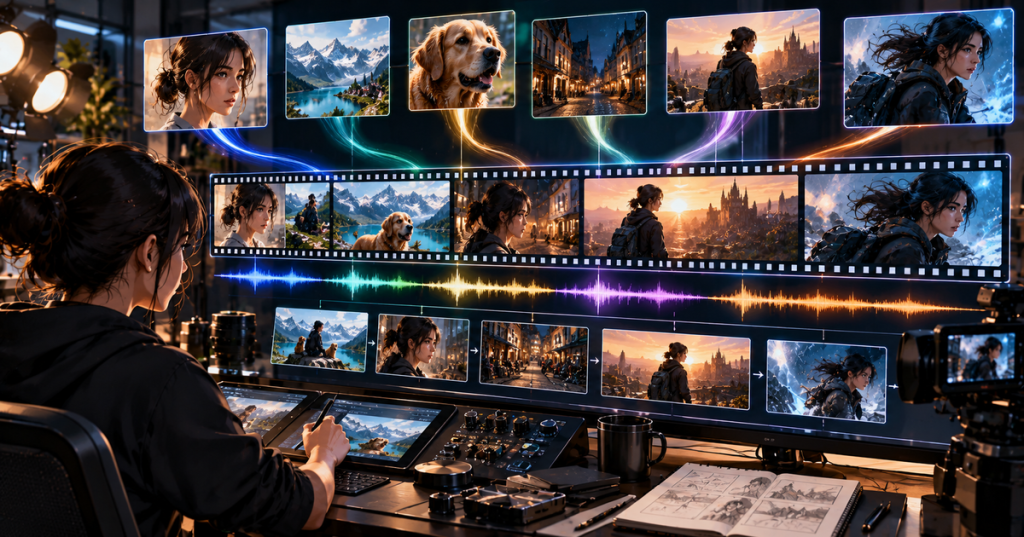
Kling AI has moved its newest video-generation model out of staged access and into broad availability. On October 15, Kling said Kling 4.0 is now fully available through its refreshed web creation interface, with MCP and CLI access also live. The release turns what had been a limited preview into a much wider production tool for creators working with text, images, video, audio and reference assets.
According to Kling’s official 4.0 release documentation, the model can generate clips from 3 to 30 seconds, accept as many as 10 keyframe images and combine as many as 15 reference inputs across images, videos, voice references and scene elements. It also adds stereo audio, broader language support, improved lip synchronization and a redesigned workflow built around longer, more directed sequences.
The biggest change is control
The jump from short prompt-to-video clips toward 30-second native generations matters because creators can hold a narrative together longer before stitching separate generations in an editor. Multi-keyframe control lets a user define important moments along that sequence, while Omni Reference gives the model more visual and audio context to preserve characters, objects, locations and performance across the shot.
That fits the direction already visible across creative AI. BitcoinVersus.Tech recently covered YouTube’s expansion of AI labeling, Meta opening Muse Spark, and ChatGPT Voice’s move to GPT-Live-1.1. The common trend is that generative systems are becoming less like one-shot novelty tools and more like controllable production environments.
Not every headline feature is live yet
There is an important distinction between the model being broadly available and every announced feature being available. Kling says 10-bit HDR output at 4K and 1080p is still coming, and API access for enterprise customers and developers is also listed as coming soon. That means “fully available” currently refers to the model through Kling’s own creation interface, MCP and CLI—not to the complete developer and HDR roadmap.
The competitive pressure is also growing. A Wall Street Journal technology roundup this week highlighted Kling 4.0 as a model that could gain share in the AI-video market. The larger question is no longer whether AI can generate an impressive isolated clip. It is whether these systems can maintain characters, motion, dialogue, camera direction and continuity well enough to fit real creative workflows.
Kling 4.0 is another step toward that goal. The strongest part of this release is not a single resolution number. It is the combination of longer clips, more references and more precise keyframe control—three tools that move AI video closer to something a director can shape rather than simply prompt.
BitcoinVersus.Tech Editor’s Note:
We volunteer daily to ensure the credibility of the information on this platform is Verifiably True. If you would like to support to help further secure the integrity of our research initiatives, please donate using the QR code provided

For best QR-code scanning results, please scan this donation code from a desktop or larger screen. Mobile screens may prevent camera recognition.


Leave a Reply