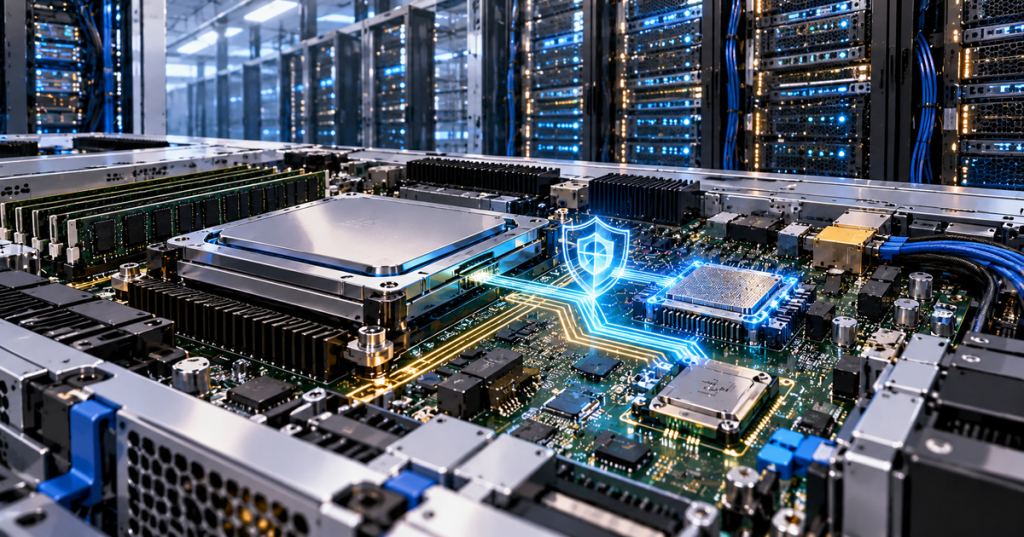
Lattice Semiconductor and Arm are putting a programmable security layer beside the CPU in a new AI-server collaboration aimed at making data-center management more adaptable and easier to secure.
Announced October 7, the joint design combines Arm AGI CPU server platforms with Lattice FPGAs and AMI firmware. In the architecture, the FPGA sits alongside the CPU and baseboard management controller rather than replacing either one. Its job is to provide hardware-level control, platform trust, connectivity, and management functions that can be updated as server requirements change. Lattice says the design also supports the Open Compute Project’s LTPI interface between a Host Processor Module and a Datacenter Secure Control Module.
The FPGA is not the AI accelerator here
The important distinction is role. The Lattice FPGA in this design is not being presented as the device that runs the large AI model. It acts as a programmable companion chip around the server’s management and trust infrastructure. That can matter because modern AI racks increasingly depend on a chain of boot firmware, management controllers, sensors, power states, networking, and remote-service functions that must remain trustworthy even when the main processor is unavailable.
BitcoinVersus.Tech has been following that control-plane shift closely. Lattice previously outlined an open control plane for AI racks, then moved post-quantum functions into a hardware root of trust. The Open Compute Project has now also launched a broader secure control-plane effort for AI data centers.
Why this matters for AI racks
As AI clusters grow, failure recovery and secure remote management become infrastructure problems, not just software problems. A programmable companion device can help operators adapt control logic, interface between platform components, and establish trust before the operating system or accelerator software starts. Igor’s Lab similarly describes the collaboration as using FPGAs for security and management around increasingly complex AI servers.
The companies demonstrated the joint platform during the 2026 OCP Global Summit in San Jose. The larger trend is clear: the AI-hardware race is expanding beyond GPUs and CPUs. The chips that boot, monitor, authenticate, connect, and recover those processors are becoming part of the competitive infrastructure stack too.
BitcoinVersus.Tech Editor’s Note:
We volunteer daily to ensure the credibility of the information on this platform is Verifiably True. If you would like to support to help further secure the integrity of our research initiatives, please donate using the QR code provided

For best QR-code scanning results, please scan this donation code from a desktop or larger screen. Mobile screens may prevent camera recognition.


Leave a Reply