OSHE.002 — Open-Source History of Engineering | Ancient Engineering Chronicle | Third Dynasty of Egypt, approximately the mid-27th century BCE
Elementary Overview
The oldest monumental Egyptian pyramids did not appear fully formed. After Djoser’s Step Pyramid, which was associated with Imhotep, and the unfinished Buried Pyramid built for his successor Sekhemkhet, Egyptian workers began another stepped monument at Zawyet el-Aryan, north of Saqqara. Its remains are known as the Layer Pyramid. The monument is generally attributed to a king named Khaba, although the identification cannot be established with certainty.
Unlike the finished tourist monuments at Giza, this pyramid survives as a low mass of rough masonry. Its underground galleries are difficult to study today, and the surviving drawings made by early excavators do not fully agree. Those problems make it especially valuable for a history of engineering: it shows how workers attempted a major stone structure and how modern investigators must test competing plans when an ancient building cannot be remeasured.
Learning Objectives
- Place the Layer Pyramid after Sekhemkhet’s building program as a plausible continuation, while recognizing the disputed Third-Dynasty succession.
- Identify the archaeological and inscriptional basis for associating the monument with Khaba.
- Describe the layered masonry, underground passages and challenges of building an early stepped pyramid.
- Explain why the two principal early excavations produced competing plans of the substructure.
- Distinguish a measured ruin, a historical hypothesis, a proposed completed pyramid, and an independently named engineer.
- Identify the next research question in a strict chronological history rather than skipping to the most famous later king.
The Chronological Problem After Sekhemkhet
The previous lesson, OSHE.001: Sekhemkhet and the Engineers of the Buried Pyramid, documented the king who followed Djoser and built another unfinished monument at Saqqara. The next step is more difficult. Unlike the succession of Djoser by Sekhemkhet, the relative positions of Khaba, Sanakht or Nebka, and possibly other short-reigning kings in the Third Dynasty are not fixed to everyone’s satisfaction.
An especially important scholarly summary, “Dynasties 2 and 3” in UCLA’s Encyclopedia of Egyptology, emphasizes two points. The attribution of the Layer Pyramid to Khaba is based on limited, circumstantial evidence. The sequence of Khaba and Sanakht remains uncertain. This prevents us from declaring, as a proven fact, that Khaba was the next person crowned immediately after Sekhemkhet.
Nevertheless, the Layer Pyramid has strong architectural similarities to Sekhemkhet’s complex and dates to the later Third Dynasty. In the most common working succession for early pyramid histories, Khaba is placed after Sekhemkhet and before Huni. The relationship between the two construction programs is therefore sufficiently plausible to justify OSHE.002. The lesson is placed here provisionally, with an explicit uncertainty marker, rather than inventing a complete royal chronology.
Some histories also mention an alternative identification linking Khaba with Huni; others treat the Horus name Sanakht as belonging to Nebka. These are proposals, not resolved biographies. A history of engineering must allow evidence to remain incomplete. If future archaeology revises a ruler’s precise place in the succession, the lesson’s numbered position can be annotated without discarding the physical engineering record.
Where the Layer Pyramid Stands
Zawyet el-Aryan lies between the Saqqara and Giza pyramid landscapes, to the west of the Nile Valley. The remains of the Layer Pyramid occupy a desert site north of the Saqqara monumental complexes. The location shows that royal construction did not remain confined to the immediate vicinity of Djoser’s monument. Different building commissions could choose new ground within the broader Memphite necropolis.
There are two separate monuments at Zawyet el-Aryan that are often confused. The Layer Pyramid belongs to the Third-Dynasty architectural tradition and is commonly attributed to Khaba. The much larger Unfinished Northern Pyramid, sometimes called the Pyramid of Baka, is generally discussed as a different, later project, often placed in the Fourth Dynasty. Its great open shaft should not be substituted for the underground plan of the Layer Pyramid. Photographs of one structure do not automatically illustrate the other.
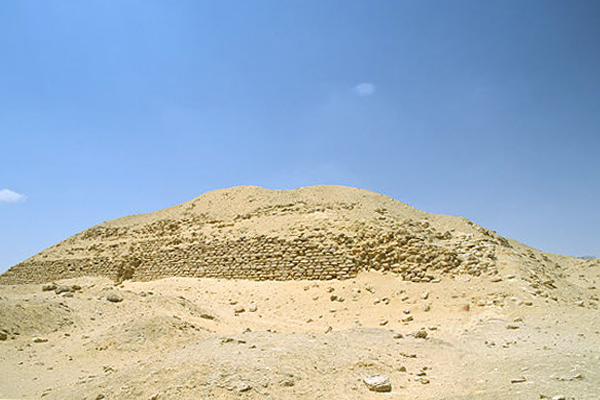
A photograph of the actual Layer Pyramid illustrates the difference between surviving evidence and an artist’s restoration:
What Was the Pyramid Supposed to Look Like?
The Layer Pyramid has a roughly square footprint, often reported as approximately 84 meters by 84 meters. Reconstructions commonly propose a monument of about five steps, potentially reaching roughly 40–45 meters if finished. These dimensions are not all measurements of the same surviving object: the base is derived from remains and survey records, while the proposed completed height and upper tiers are interpretations. The existing mound reaches only a fraction of the projected finished form.
The pyramid’s visible construction is associated with successive inclined courses, often described as accretion layers. Instead of treating the stepped monument as an arrangement of wholly independent square platforms, investigators reconstruct masonry sections leaning inward toward the center of the body. The method invites comparison with Djoser’s and Sekhemkhet’s early pyramids, while the Layer Pyramid’s layout displays its own construction choices.
This is where engineering analysis matters. Every layer adds mass above the courses beneath it. Workers needed to dress and place limestone so that blocks would carry loads through the body and avoid uncontrolled movement during construction. An inclined masonry system is not merely a decorative profile: it is a way to organize a large stone mass with internal bonds and stable geometry. The exact reasons why a historical architect chose the method cannot be recovered from physical geometry alone.
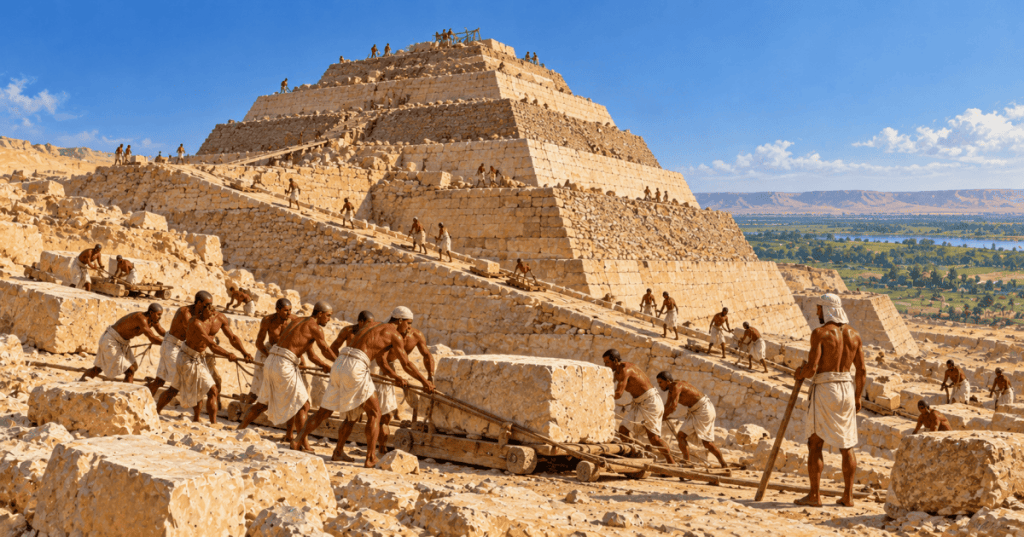
The image created for the cover of this lesson is an illustrative reconstruction of an early Egyptian stepped-pyramid worksite, not a faithful drawing of the surviving Layer Pyramid or its known construction machinery. Real Egyptian workers, their materials and the excavated masonry are the relevant historical subjects; no photograph survives from the Third Dynasty and no individual modern illustration establishes all of the ancient equipment.
Ancient Architects, “The Layer Pyramid at Zawyet el Aryan” (2025). A focused illustrated examination of the monument’s damaged exterior, proposed ownership, historic excavations and subterranean plans. The video provides a useful orientation but should be compared with Aidan Dodson’s peer-reviewed 2000 study rather than treated as the sole authority.
The Construction Process: Stone, Geometry and Labor
A stepped monument of this footprint required several interdependent operations. The site had to be selected and the corners and edges of the planned base established. Stone had to be quarried or obtained, shaped to suit the masonry, transported, stacked, and checked against the desired alignments. At the same time, underground access and burial spaces had to be excavated and kept accessible while work advanced above them.
Large-scale building also depended on the wider Egyptian economy. Quarrymen, toolmakers, stone dressers, hauling crews, surveyors and administrators may have supported work on the monument. Their presence is inferred from the tasks that construction would have demanded, not from a surviving register that names every team member. The Layer Pyramid has not yielded an independently established architect’s name or reliable staffing figure.
Ancient Egypt already had experience in massive stone funerary projects by this period. Comparison between the architectural remains of Djoser, Sekhemkhet and the Layer Pyramid indicates repeated solutions to similar questions: how to place large quantities of limestone, how to form a monumental outline, and how to integrate a substructure with a large mass above. The existence of shared methods does not prove that one previously named engineer personally designed all three monuments.
The term engineering is applied retrospectively to this practical work. These people had operational knowledge of materials, loads and layout; they did not possess the modern professional titles or written design standards used today. The surviving stones allow us to study what their technology accomplished without assigning them a mathematical model that no document records.
The Underground Galleries and Burial Installation
The pyramid’s subterranean passages are among its most informative and least straightforward features. Accounts describe a descending entrance leading toward a network of galleries and an underground burial installation. Branching passages and storage spaces have been included in modern reconstructions, but published descriptions differ in the layout, dimensions and number of rooms. Where a diagram gives a precise number of side chambers, the reader must ask which excavation it follows.
Working below ground presented a distinct construction problem. Builders had to maintain passage widths and slopes, ensure enough intact rock remained around adjoining corridors, clear excavated material, and provide access to larger chambers. A shaft or gallery shown on a modern reconstruction may also have served a construction or access purpose before final closure. Archaeologists must not assign a single function to each space merely because a later pyramid used an analogous feature in that way.
The arrangement of the substructure also offers a way to compare successive projects. Sekhemkhet’s Buried Pyramid included a complex of galleries and chambers; the Layer Pyramid is another example of the Third Dynasty’s interest in extensive underground planning. But similarity is not identity. The structures have separate excavation histories, and the plans should not be copied from one to the other.
Two Excavations, Two Different Engineering Plans
A crucial turning point in the modern study of the Layer Pyramid is the early twentieth-century survey record. Alessandro Barsanti investigated the monument in 1900. A later expedition led by George Andrew Reisner, working with Clarence Fisher, studied the site in 1910–1911. Both published drawings and descriptions, but they did not agree on all the important architectural details.
The Egyptologist Aidan Dodson examined the discrepancy in his peer-reviewed article “The Layer Pyramid at Zawiyet el-Aryan: Its Layout and Context”, published in the Journal of the American Research Center in Egypt in 2000. He observed that the early plans differed in fundamental dimensions and even the number of galleries, not merely small matters of illustration. Later authors tended to reproduce the Reisner–Fisher plan, which made one disputed version appear settled through repetition.
Dodson’s method is an essential historical-engineering lesson: the fact that several textbooks reproduce the same drawing does not show that several independent teams measured the same passages. Authors can copy a widely available source while forgetting that a conflicting original survey exists. Researchers must inspect the historical measurements, their method and any uncertainties before producing a new technical diagram.
When excavators could no longer re-enter the galleries to resolve these conflicts, the appropriate scientific response was not to invent the missing measurements. Dodson compared the available plans and textual measurements and examined the site context. His study demonstrates how architecture, survey science, documentary criticism and archaeology overlap. An uncertain plan is not worthless: it becomes a clearly qualified basis for further research rather than a false claim of precision.
To protect readers from this problem, OSHE.002 treats the underground network as known to exist, while individual side-gallery totals, exact room geometry, and some detailed reconstructions remain dependent on competing historical surveys. No single unqualified diagram is presented as the authoritative complete measured plan.
cf-apps7865, “Layer Pyramid — Zawyet El Aryan’s Other Unfinished Mystery” (2018). An illustrated discussion of competing reconstructions of the Layer Pyramid. Compare the video’s diagrams with Barsanti, Reisner and Fisher, and Dodson’s academic reassessment.
Why Many Scholars Associate the Pyramid With Khaba
Khaba is the Horus name of a Third-Dynasty king, preserved in ancient inscriptions and sealings. The name occurs on objects associated with sites in Egypt, including finds from the vicinity of Zawyet el-Aryan. That geographical association and the similarity of the monument’s architecture to other Third-Dynasty pyramids support the hypothesis that the Layer Pyramid belonged to his building program.
The crucial distinction is that there is no universally accepted inscription on the pyramid itself identifying Khaba as its indisputable royal owner. Khaba’s name at nearby archaeological contexts supports an attribution, but physical proximity is not the same thing as a foundation inscription saying he commissioned this precise project. An archaeological attribution can be persuasive without being certain.
The history of Khaba becomes further complicated by later royal name lists, differences between Horus names and other royal titulary, and proposals equating Khaba with other recorded rulers. World History Encyclopedia’s Third Dynasty review presents him as the likely third ruler after Djoser and Sekhemkhet, while acknowledging that some historians place Sanakht in another position. The surviving monument thus provides more physical evidence of a building program than the inscriptions provide about its patron’s precise reign.
The correct attribution is therefore Layer Pyramid: Third Dynasty; often assigned to Khaba; royal ownership and exact sequence disputed. Treating that uncertainty explicitly is not a weakness of the history. It is a clear representation of the available evidence.
What About Sanakht and Nebka?
Sanakht is an ancient Egyptian king known through a limited number of seal impressions and other finds. Nebka is a royal name transmitted in later king lists. Many researchers have proposed that Sanakht and Nebka were the same ruler, but the connection depends on fragmentary documentary evidence and is not universally accepted. Some chronological reconstructions place Sanakht before Djoser; others place him between Sekhemkhet and Huni.
Sanakht’s existence is therefore a legitimate subject in a methodical history of the dynasty even if the association between Khaba and the Layer Pyramid turns out to be correct. But it would be a mistake to insert a named engineer and a monumental structure for Sanakht where the archaeology has not furnished either. The evidence should instead be organized by distinct subjects: royal identification, secure monuments, chronology and disputed associations.
The archaeological and historical record becomes thinner around the short-reigning successors of Sekhemkhet. Scholars have debated how many kings should be counted between Djoser and Huni, whether some surviving names represent the same person, and whether monuments traditionally assigned to one king belong to another. This series will preserve that scholarly disagreement instead of creating a misleading uninterrupted chain of perfectly known monarchs.
Community discussion of Third-Dynasty succession, Khaba, Nebka and the early development of pyramids. A contemporary social discussion only; primary finds and Egyptological studies establish the evidentiary basis.
The History of Archaeological Access
The Layer Pyramid has been difficult to revisit. Its vicinity has long been subject to military restrictions, and detailed archaeological inspection of the underground architecture has been limited. Access constraints affect the quality of surviving measurements and the feasibility of settling contradictory early reports. Responsible writers should not claim to have freshly inspected tunnels or measured galleries that have not been made available for systematic re-examination.
This also explains why the condition of the Layer Pyramid cannot be described only from recent tourist photographs. The exposed masonry and rubble tell part of the story, but the early excavation drawings are necessary for reconstructing passages that are not visible today. Archives, photographs and plans are a kind of engineering data; preserving them is as important as preserving the monument itself.
The region’s Unfinished Northern Pyramid is a separate site often mentioned in discussions of the military zone. Claims that concern its great shaft, construction history, or later date must not be attributed automatically to Khaba’s Layer Pyramid. Conflating the two can produce false drawings and inaccurate reports about what archaeologists found.
Public research discussion on Sekhemkhet’s Buried Pyramid, with comparisons to the nearby Layer Pyramid, excavation ramps and restricted access. Included because comparing consecutive projects helps explain the archaeological gaps; not an independent source of measurements.
Was the Monument Abandoned or Later Damaged?
The Layer Pyramid is often described as unfinished. Its present low height relative to the reconstructed stepped form supports the possibility that work stopped before the planned superstructure was complete. Yet a ruined modern appearance can also result from erosion, stone removal and centuries of damage. The remaining evidence does not always allow researchers to separate these processes with precision. That is why a proposed original height should not be treated as a direct measurement of the work achieved.
No undisputed royal burial identified as Khaba has been discovered in the monument. It would be incorrect to state that he was certainly buried in its chambers or that the unfinished pyramid demonstrates a particular cause of death. A short reign is one plausible explanation for the stopping of work, but it is not a surviving construction diary. Royal succession, changing priorities and the condition of the architecture all require separate consideration.
An unfinished monument is still evidence of capable engineering. Surveying a square base, creating inclined masonry layers and cutting underground galleries required organization and technical judgment. In some cases, incomplete work even reveals production stages that final polished stone would have hidden. A history focused only on famous completed structures would neglect these stages of technological change.
The Engineers and Workers We Cannot Name
No authenticated record presently identifies the individual chief architect, master surveyor or construction foreman of the Layer Pyramid. King Khaba is a possible patron, not a proven modern-style engineer. The teams responsible for planning, quarried stone, transport, masonry, excavations and religious installations were social and technical specialists whose names have not been preserved in a source securely linked to the site.
That means the historically defensible subject of this lesson is a building society and a probable royal patron, not an invented famous engineer. Djoser’s Imhotep and Sekhemkhet’s possible Imhotep graffito belong to earlier research questions. Nothing established at the Layer Pyramid permits the automatic reuse of Imhotep as its designer. The apparent continuation of architectural practice is evidence of cultural and institutional continuity, not personal authorship.
The social achievement also included the work of people outside the building site. Supplying a large Egyptian construction project required access to food production, suitable stone, tools, transport and administrators who coordinated time and resources. Their presence is consistent with the organizational structure of royal building, but precise figures for total labor, productivity or cost at this site cannot be recovered.
Chronological and Technical Comparison
- Djoser and Imhotep, approximately twenty-seventh century BCE: the Step Pyramid at Saqqara, a completed monumental stone complex. The king and official are named; the architect’s traditional attribution should still be distinguished from surviving inscriptions.
- Sekhemkhet, shortly after Djoser: the Buried Pyramid at Saqqara, an unfinished superstructure with extensive excavated galleries; the name Imhotep appears in a damaged construction graffito.
- Khaba or a close Third-Dynasty contemporary: the Layer Pyramid at Zawyet el-Aryan, a roughly 84-meter square stepped project. The royal attribution is circumstantial, and surveyors disagree over the underground layout.
- Sanakht or Nebka: named or proposed Third-Dynasty rulers whose relative reign positions and identities remain debated. No pyramid is securely assigned to Sanakht in the same way that Djoser’s complex is assigned to Djoser.
- Huni and the end of the Third Dynasty: the sequence eventually reaches a longer-reigning king, but the assignment of individual buildings and small provincial pyramids requires separate investigation.
- Sneferu and the Fourth Dynasty: a later architectural chapter involving experiments at Meidum and Dahshur. These should not replace the documented, less-famous Third-Dynasty intermediate projects.
How Future Evidence Could Change This Lesson
A new safely conducted archaeological campaign might remeasure the hidden galleries with surveying and three-dimensional recording, compare old excavation drawings to contemporary geometry, investigate the nearby graves, or discover an inscribed object in securely dated context. Any one of these could improve our knowledge of the monument’s construction sequence and attribution. The possibility of future research should not be represented as a claim that such access or measurements have already occurred.
For historians, the most valuable near-term work may be archival. Barsanti’s measurements and the Reisner–Fisher publications can be compared carefully, as Dodson demonstrated. Reconstructing the circumstances of each survey, its coordinate assumptions and the distinction between measured lines and sketched lines can clarify the uncertainty even without opening a new excavation. This is a lesson in scientific documentation that applies equally to modern civil engineering.
Knowledge Check
- 1. What is the Layer Pyramid, and where is it located?
- 2. Why is Khaba treated as a probable rather than proven owner?
- 3. Which ruler and monument were documented in OSHE.001?
- 4. What does the Layer Pyramid’s approximately 84-meter base tell us, and what does it not tell us about its finished height?
- 5. Who conducted the two important early excavations of the underground passages?
- 6. What did Aidan Dodson identify as a major problem with the published architectural drawings?
- 7. Why should the Unfinished Northern Pyramid not be confused with the Layer Pyramid?
- 8. Why is Sanakht relevant to the historical sequence even though his exact chronological position is uncertain?
Answers
1. A ruined Third-Dynasty stepped-pyramid project at Zawyet el-Aryan. 2. Khaba’s name occurs in nearby contexts, while the monument lacks an undisputed attribution inscription. 3. Sekhemkhet and the Buried Pyramid at Saqqara. 4. The measured footprint establishes the project’s scale, not the exact appearance or height of an uncompleted upper pyramid. 5. Alessandro Barsanti and the Reisner–Fisher expedition. 6. Significant disagreement in dimensions, layout and numbers of subterranean galleries. 7. They are distinct sites with different dates, designs and excavations. 8. His name and proposed connection to Nebka complicate the succession after Sekhemkhet.
Elementary Conclusion
After Sekhemkhet, Egyptian builders continued experimenting with large stepped stone pyramids. The Layer Pyramid at Zawyet el-Aryan is one of the clearest physical examples from that period, even though it survives mostly as a damaged mound. Workers prepared a broad stone base, created inclined masonry layers and excavated underground passages.
The king Khaba may have commissioned the building, but the attribution is not certain. Historians also disagree about the exact order of Khaba and Sanakht and about the original plan of the buried rooms. Those uncertainties are part of the history, not something to hide. The next OSHE lesson will examine the best-supported remaining Third-Dynasty ruler or construction project before proceeding to the major innovations of the Fourth Dynasty.
References and Further Reading
- Aidan Dodson (2000), “The Layer Pyramid at Zawiyet el-Aryan: Its Layout and Context,” Journal of the American Research Center in Egypt, 37, 81–90, DOI: 10.2307/40000524 — academic reassessment of conflicting excavation plans.
- University of Bristol research record for Dodson’s article — author, year, journal, and publication context.
- UCLA Encyclopedia of Egyptology, “Dynasties 2 and 3” — limited archaeological evidence for attributing the pyramid to Khaba; uncertainty in royal succession.
- World History Encyclopedia, “Third Dynasty of Egypt” — general chronology and rival reconstructions.
- Pottery Fan, photograph of Khaba’s Layer Pyramid, Wikimedia Commons — authentic site photograph (CC BY-SA 3.0).
- Iry-Hor, Layer Pyramid cross-section, after Reisner and Fisher, Wikimedia Commons — diagram useful for comparing sources (CC BY-SA 3.0), not a universally settled modern survey.
- r/egyptology (2025), “The Buried Pyramid and why it deserves more research” — modern community context discussing the Layer Pyramid’s limited accessibility, not a primary source.
- Historic excavation reports: Alessandro Barsanti (1900); George Andrew Reisner and Clarence Fisher, “The Work of the Harvard University–Museum of Fine Arts Egyptian Expedition,” Bulletin of the Museum of Fine Arts 9 (1911), pp. 54–59, as evaluated by Dodson (2000).
BitcoinVersus.Tech Editor’s Note: We volunteer daily to ensure the credibility of the information on this platform is Verifiably True. If you would like to support to help further secure the integrity of our research initiatives, please donate using the QR code provided

For best QR-code scanning results, please scan this donation code from a desktop or larger screen. Mobile screens may prevent camera recognition.


Leave a Reply