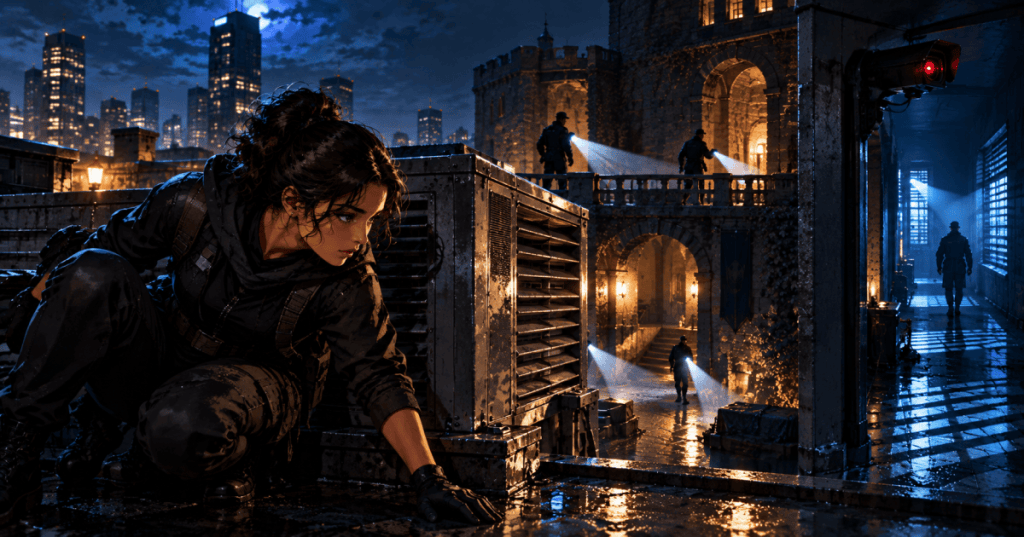
The best stealth games turn the simple act of not being seen into an entire design philosophy. Guards respond to light, noise, bodies, disguises, camera placement, or suspicious behavior. This BitcoinVersus.Tech Top 7 ranks individual games and the Hitman trilogy collection by stealth depth, innovation, level design, replayability, and long-term influence. It is an editorial judgment, not a sales ranking. For adjacent genre history, read our Top 7 First-Person Shooters and Top 7 Strategy Games.
7. Mark of the Ninja (2012)
Developer: Klei Entertainment. Why it matters: Clear visual feedback made 2D stealth every bit as sophisticated as 3D stealth. Sound pulses show which actions guards can hear, while line-of-sight and lighting are communicated visually. Players can complete encounters through observation and distractions rather than direct fighting. Few titles make stealth rules so understandable without making them easy.
6. Dishonored 2 (2016)
Developer: Arkane Studios. Why it matters: A supernatural immersive sim that rewards planning and inventive routes. Karnaca’s dense spaces make vertical travel, distractions, possession, teleportation, and nonlethal takedowns meaningful choices. The Clockwork Mansion and A Crack in the Slab are landmark mission-design showcases. Unlike a pure concealment simulator, the game also asks whether players want to avoid conflict when they possess overwhelming powers.
5. Hitman: World of Assassination (2016–2021 trilogy; consolidated 2023)
Developer: IO Interactive. Why it matters: This is social stealth at its most inventive. Agent 47 infiltrates public spaces by changing disguises, following routines, learning guard permissions, and turning everyday objects into opportunities. Paris, Sapienza and other sandboxes reward experimentation over memorizing a single correct route. The World of Assassination package brought the 2016, 2018 and 2021 games under one title in 2023; it is not a wholly new 2023 game.
4. Metal Gear Solid V: The Phantom Pain (2015)
Developer: Kojima Productions. Why it matters: Few stealth sandboxes allow this much improvisation. Enemy outposts can be approached from multiple directions, across day-night cycles and changing security patterns. Fulton extraction, gadgets, support options and adaptive guards create emergent plans. Its unfinished-feeling narrative limits the overall package, but its mechanical freedom remains a benchmark. The earlier Metal Gear Solid 3 is another contender for this position.
3. Thief II: The Metal Age (2000)
Developer: Looking Glass Studios. Why it matters: Thief II treats the world as an acoustic and lighting puzzle. Stone, tile, carpet and other surfaces affect footsteps; guards react to what they hear and see. Its missions make slipping past a guard, hiding a body, or extinguishing a light more important than swordplay. The result is a foundational demonstration that avoidance can carry an entire first-person game. PC Gamer’s stealth-game history describes the enduring appeal of the genre’s demanding classics.
2. Tom Clancy’s Splinter Cell: Chaos Theory (2005)
Developer: Ubisoft Montreal, with Ubisoft Milan. Why it matters: Sam Fisher’s third adventure remains a gold standard for tactical infiltration. Movement speed, shadows, ambient sound, gadgets and guard routes all matter. Its larger missions allow distinct approaches, and its cooperative mode expands the formula beyond solo play. An inspired choice for players who prioritize disciplined sneaking over spectacle; GameSpot’s stealth retrospective similarly highlights its lighting systems and open-ended levels.
Official Ubisoft Splinter Cell: Chaos Theory game page — includes the original game’s description and media. A game-specific video is still being sourced; this link is not a playable embed.
1. Metal Gear Solid (1998)
Developer: Konami Computer Entertainment Japan. Why it wins: The PlayStation original helped bring cinematic, three-dimensional stealth action to a mass audience. Solid Snake used cover, enemy sightlines, radar, distractions and timing to infiltrate Shadow Moses. Sophisticated boss encounters, memorable voice acting and unusual controller interactions also showed that stealth could anchor blockbuster storytelling. Metal Gear Solid did not invent stealth—earlier Metal Gear games, Tenchu, and Looking Glass titles are important to its lineage—but it made a genre-defining template widely recognizable.
Why These Seven Still Matter
Together the games represent seven different ways to make stealth rewarding: clear detection feedback, superhuman mobility, social disguises, systemic improvisation, sound-based concealment, tactical infiltration, and cinematic suspense. A player who values precise simulation might reasonably place Chaos Theory first; one who wants open-world freedom might choose The Phantom Pain. The ranking is about how powerfully each game advanced the genre over its era.
Honorable mentions: Tenchu: Stealth Assassins (1998), Metal Gear Solid 3: Snake Eater (2004), Alien: Isolation (2014), Shadow Tactics: Blades of the Shogun (2016), Deus Ex (2000) and Invisible, Inc. (2015). For more design history, see how classic RPGs and first-person shooters developed their own approaches to player choice.
BitcoinVersus.Tech Editor’s Note: We volunteer daily to ensure the credibility of the information on this platform is Verifiably True. If you would like to support to help further secure the integrity of our research initiatives, please donate using the QR code provided

For best QR-code scanning results, please scan this donation code from a desktop or larger screen. Mobile screens may prevent camera recognition.


Leave a Reply