
The North American Electric Reliability Corporation (NERC) filed proposed registration changes with the Federal Energy Regulatory Commission (FERC) on October 21, 2026, seeking to bring some of the largest AI data centers and Bitcoin mining facilities into its mandatory power-grid reliability framework.
Key Takeaways
- NERC proposes two entity types: Computational Load Owner (CLO) and Computational Load Operator (CLOP).
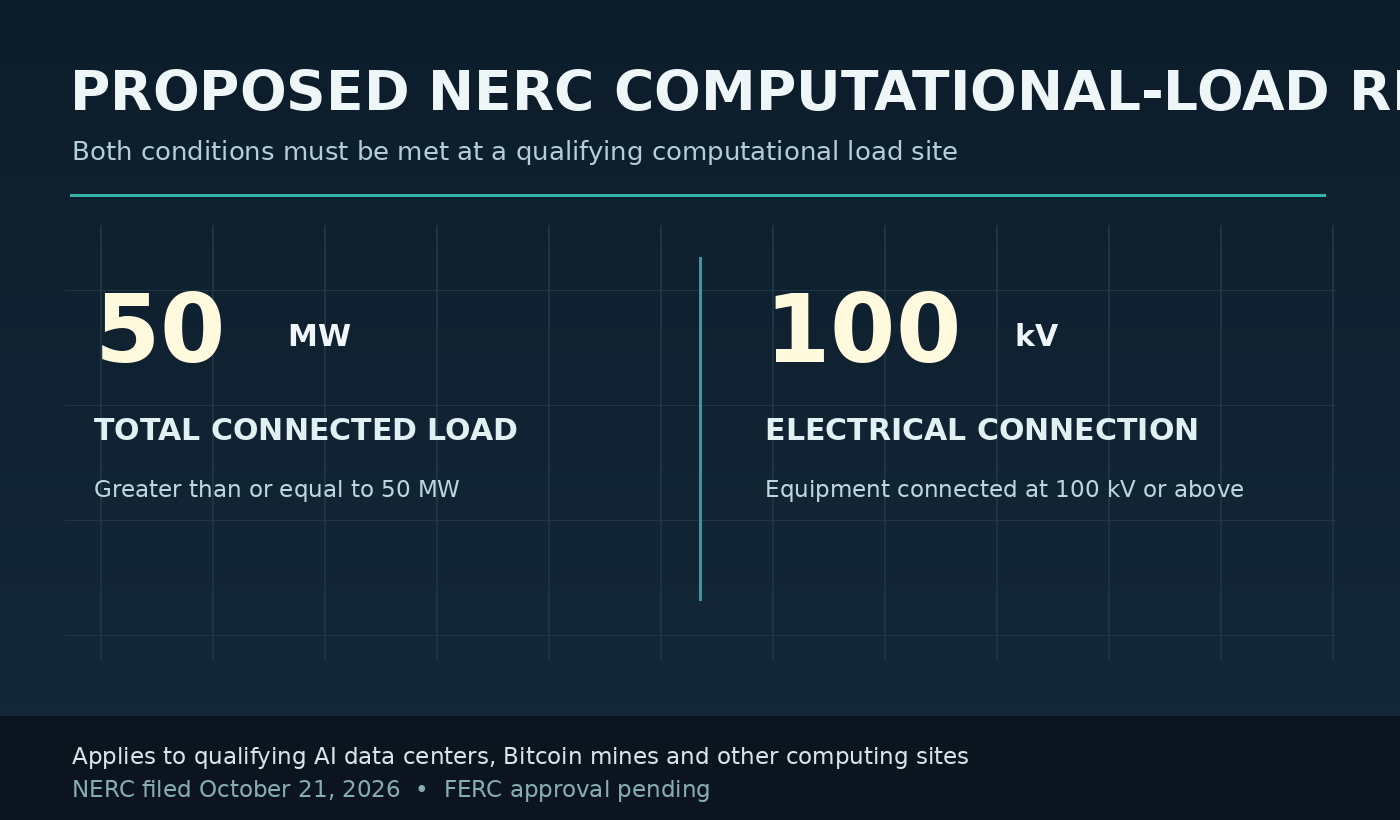
- Registration would target computational sites with at least 50 MW of total connected load supplied through electrical equipment connected at 100 kV or higher.
- The registration changes still require FERC approval; associated reliability standards follow a separate approval process.
NERC’s board approved the proposed Rules of Procedure revisions on October 8 before submitting them to FERC. An owner would be responsible for owning and maintaining a qualifying site, while an operator would be responsible for operating it. Those organizations may be different businesses, particularly at multi-tenant data centers.
Why the 50 MW and 100 kV thresholds matter
The two thresholds operate together, not as alternative triggers. The proposal measures total connected site load, rather than merely the computing equipment’s electricity draw, and accounts for electrical supply equipment connected at one or more points. Smaller facilities are not automatically placed in these new categories.
NERC’s concerns go beyond rising energy consumption. Large computing loads can respond rapidly to voltage disturbances or change demand in coordinated ways, complicating the modeling and operation of the bulk-power system. The SERC reliability organization describes related draft standards addressing interconnection studies, operating data, communications, protection and monitoring.
What it means for Bitcoin mining and AI infrastructure
For large miners and data-center developers, the proposal points toward more direct reliability compliance and closer coordination with transmission-system operators. It follows the separate ERCOT push for hardware-tested load models and PJM’s large-load registry decision; neither should be confused with this nationwide NERC proposal.
FERC’s July 16 directive established a December 31 deadline for initial computational-load rules and standards. NERC’s Project 2026-02 is developing the associated requirements. Until regulators approve and implement them, the 50 MW/100 kV framework remains a proposal, not a new enforceable obligation.
BitcoinVersus.Tech Editor’s Note: We publish research and reporting to make emerging technology and electricity policy easier to verify and understand. Support independent coverage with a 5,000-satoshi Bitcoin donation using the QR code below.

For best QR-code scanning results, scan this donation code from a desktop or larger screen; mobile screens may make camera recognition difficult.


Leave a Reply