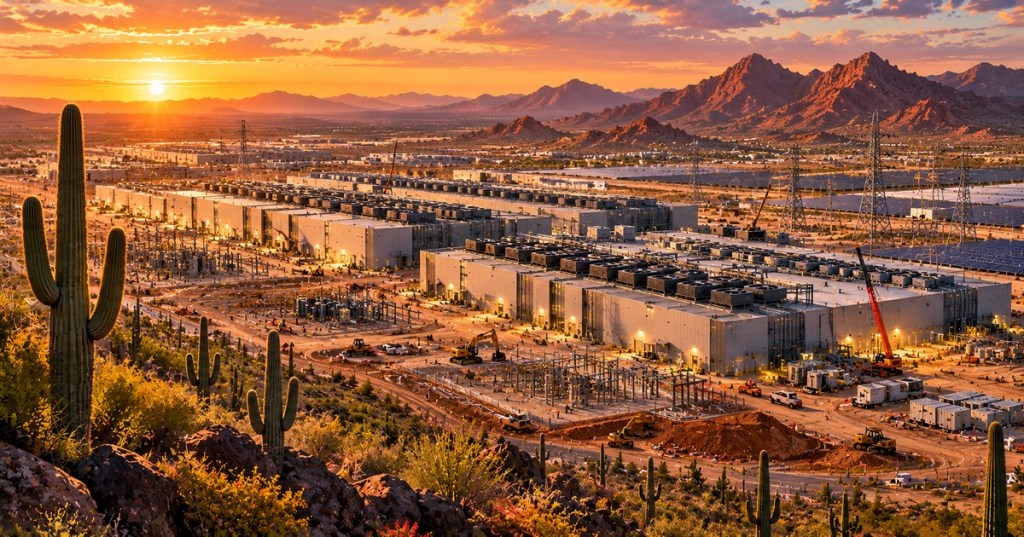
Arizona has some of America’s largest announced data-center land developments, but their power figures are primarily proposed future capacity, not live electrical load. The third installment in BitcoinVersus.Tech’s state-by-state Top 3 series examines Tract’s Buckeye technology park, Arizona Land Consulting’s Hassayampa Ranch, and Beale Infrastructure’s Luckett Road development in Marana. We rank distinct, identifiable data-center campus proposals by the maximum publicly announced electrical capacity as of October 27, 2026.
These figures have different degrees of confidence: Tract lists a marketed long-term site capacity subject to future utility infrastructure; Hassayampa represents a land-development opportunity with no confirmed 1.5 GW service contract; and the two-parcel Marana campus has town-approved rezoning, but no verified operating megawatts. Beale’s 1.5 GW maximum and Hassayampa’s 1.5 GW potential are tied, though the certainty of their underlying plans differs. None should be reported as commissioned IT megawatts. Projects denied or withdrawn are excluded.
3. Beale Luckett Road, Marana — up to 1,500 MW planned
Beale Infrastructure’s Luckett Road campus spans approximately 600 acres west of Interstate 10 in Marana. The coordinated development comprises two adjacent parcels of roughly 300 acres each. According to the Town of Marana’s official project FAQ, each parcel has an estimated 550–750 MW electrical demand, yielding a 1,100–1,500 MW combined planning range rather than 1.5 GW of installed servers. Tucson Electric Power and Trico Electric Cooperative would serve different parts of the project, and regulated utility agreements are still required.
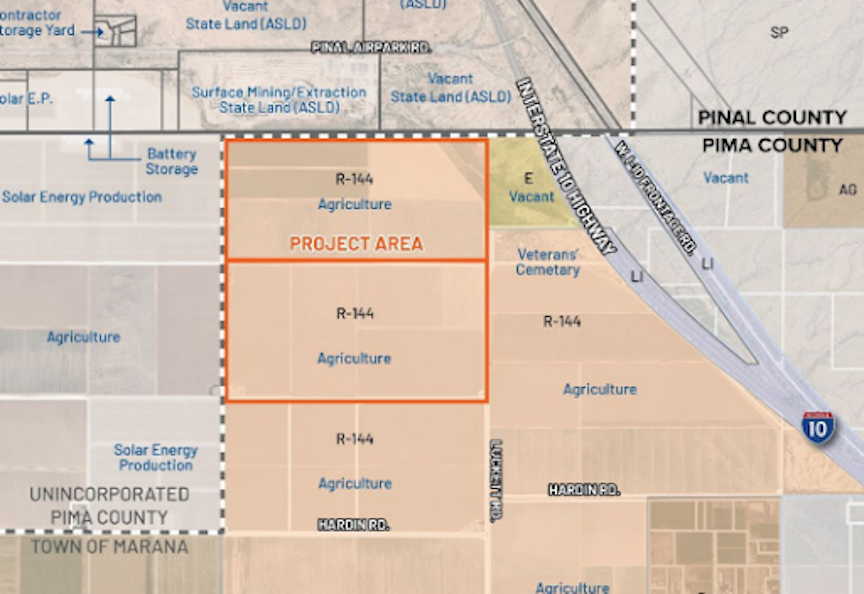
The Marana Town Council approved rezoning on January 6, 2026, not final construction or utility energization. The town describes air-cooled equipment and prohibits use of municipal potable water for cooling. Beale forecasts construction beginning around 2027, with initial occupancy potentially in late 2028 or early 2029. Updated local noise and decommissioning requirements add another layer of oversight. These remain developer expectations, not evidence of construction completion. The campus’s full-buildout upper figure ties Hassayampa Ranch’s advertised maximum, but Marana’s parcel-level figures are better documented by its municipality.
2. Hassayampa Ranch, West Valley — up to 1,500 MW proposed
Arizona Land Consulting, led by Anita Verma-Lallian, and investors including Chamath Palihapitiya acquired roughly 2,100 acres for $51 million in 2025 near Tonopah and Buckeye. The developer has discussed a potential 1.5 GW power opportunity and as much as $25 billion in eventual investment if future data-center tenants build out the property. The $25 billion is a potential long-range development value, not verified spending. The developer’s own publication of the Bloomberg report says a utility agreement remains a next step.
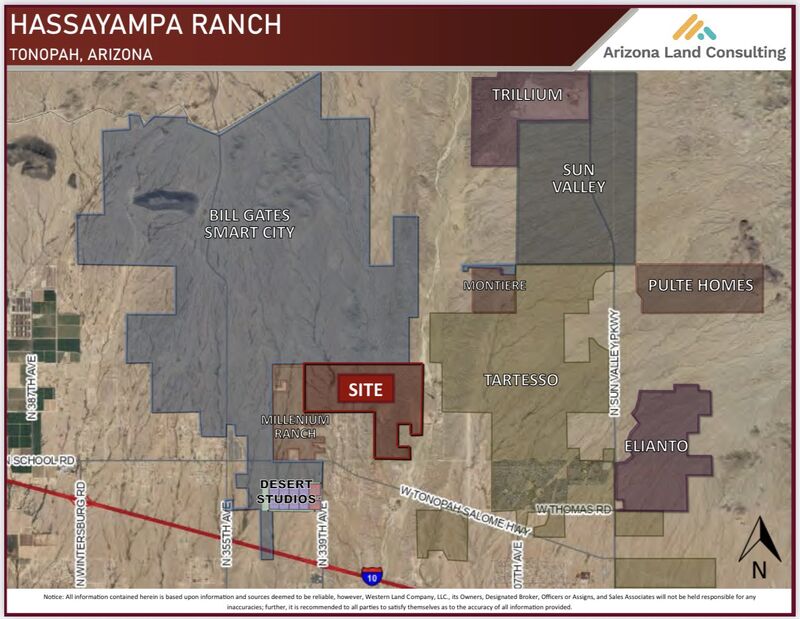
Maricopa County approved an industrial rezoning on April 8, 2026 after negotiations over setbacks and buffers. County hearing documents confirm the zoning request; local reporting describes the revised community terms. The approved zoning does not mean an end user has leased the entire campus or that 1.5 GW is available today. A recent October 13 follow-up from the reporter who visited the site still described the land as undeveloped. A separate 1 GW number appears in some zoning trackers; this ranking uses the upper developer-reported 1.5 GW potential and labels its uncertainty.
1. Tract Buckeye Technology Park — up to 1,800 MW planned
Tract’s official Buckeye project page lists 2,019 acres and 1,800 MW of potential capacity for a master-planned technology park west of Phoenix. The developer’s August 2024 acquisition release originally described 2,069 acres, up to 20 million square feet and as many as 40 future data-center buildings, supported by long-term utility planning. The acreage figures reflect differing dated descriptions of the property; neither is a completed-building count.
The local video above shows the project as reported at its announcement; it is not evidence that the full 1.8 GW campus has since been built. Tract markets individual parcels to data-center operators and continues power-infrastructure planning. The ultimate electrical requirement could change as tenants, substations and phases are finalized. Read the original station report.
Why the largest numbers are not the same as operating power
The upper announced figures total 4.8 GW across these three developments (1.8 GW Buckeye plus 1.5 GW each at Hassayampa Ranch and Marana). That sum is not a measurement of Arizona’s current data-center electricity demand, and it is not a forecast of 4.8 GW energized by a particular year. Power requests, parcel marketing capacity, actual utility contracts and critical IT load are separate measures. High-voltage transmission, transformers, backup generation, water availability, cooling technology, fiber routes and local approvals remain major dependencies.
Several other substantial Arizona proposals are worth tracking. Project Blue in Pima County has published potential full-build demand of 400–600 MW; Project Baccara received approval for a proposed 700.2 MW gas power plant intended to serve a data center, but its generation nameplate is not necessarily the site’s IT load. The Entrata Data Center proposal near White Hills has an early-stage maximum of approximately 1.25 GW and remains subject to land-use and infrastructure requirements. Huntley’s proposed 1 GW Page campus is still in feasibility review, with neither a site build approval nor municipal power or water commitment. Both therefore fall below the current 1.5 GW second-place tie. The La Osa proposal was denied by Pinal County supervisors in August and is excluded rather than counted as active capacity. For context, see our national megaproject comparison and Dakotas report.
Editor’s Note: This state series ranks disclosed project potential rather than claiming operational IT load. The in-story site maps are externally sourced and credited, not original graphics or proof of completed buildings; the video is an original local-news report. Support independent infrastructure journalism with 5,000 satoshis by scanning the QR code below.

Scan this QR code with a Bitcoin wallet while viewing the story on a separate screen.


Leave a Reply