
Unconventional AI announced October 26, 2026, that it has agreed to acquire Israeli AI inference-chip company NeuReality. The deal adds engineers specializing in silicon, system architecture and data-center software as the buyer pursues a dramatic improvement in computing efficiency.
Both companies’ boards have approved the proposed acquisition. The transaction is expected to close in the fourth quarter of 2026, subject to customary conditions; its price was not disclosed. NeuReality’s own announcement confirms that founder and CEO Moshe Tanach and the founding team will join Unconventional, which plans to retain an engineering presence in Israel.
The acquisition offers something beyond additional transistor designs. NeuReality has spent years developing infrastructure intended to reduce host-CPU orchestration and data-movement overhead during AI inference—the stage when trained models answer user requests. That work complements specialized accelerators instead of simply replacing every GPU.
The 1,000× target needs independent evidence
Unconventional describes its planned four-dimensional computing substrate as targeting 1,000 times the compute efficiency of conventional architectures. This is a research target, not a verified benchmark. The announcement provides no public results demonstrating a thousandfold performance-per-watt improvement.
In a Reuters interview, Unconventional cofounder Naveen Rao described an accelerated research effort involving a completed first test chip and another chip nearing completion. Test silicon is an important milestone, but it does not establish commercial readiness, manufacturing yield or power measurements at scale.
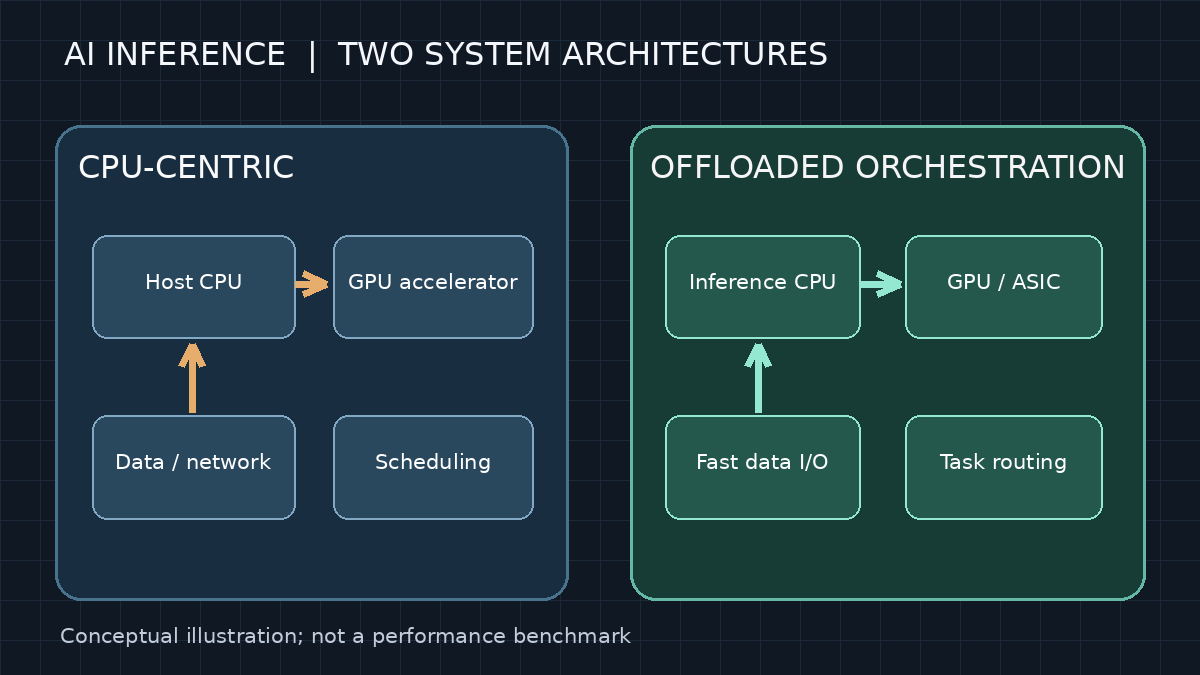
The systems challenge is familiar to data-center operators: even a powerful processor can sit idle if software, networking or memory cannot feed it quickly enough. The diagram below illustrates the distinction between CPU-centered orchestration and more specialized inference infrastructure; it is not a product schematic or measured comparison.
In the interview below, NeuReality CEO Moshe Tanach explains why idle GPUs, network traffic and data orchestration are central engineering problems. The video predates this acquisition and provides technical background, not an announcement of the deal.
The efficiency race also connects to previous BitcoinVersus.Tech coverage of Qualcomm’s tokens-per-watt strategy, Microsoft’s Maia 300 accelerator, and Efficient Computer’s dataflow chips. For now, the next evidence to watch is independently comparable joules-per-token testing—not the size of an efficiency ambition.
BitcoinVersus.Tech Editor’s Note: Our coverage distinguishes announced research goals from independently tested hardware. Support independent reporting and engineering education with a 5,000-satoshi Bitcoin donation using the original QR code below.

For best scanning results, display the donation QR on another device or a larger screen.


Leave a Reply