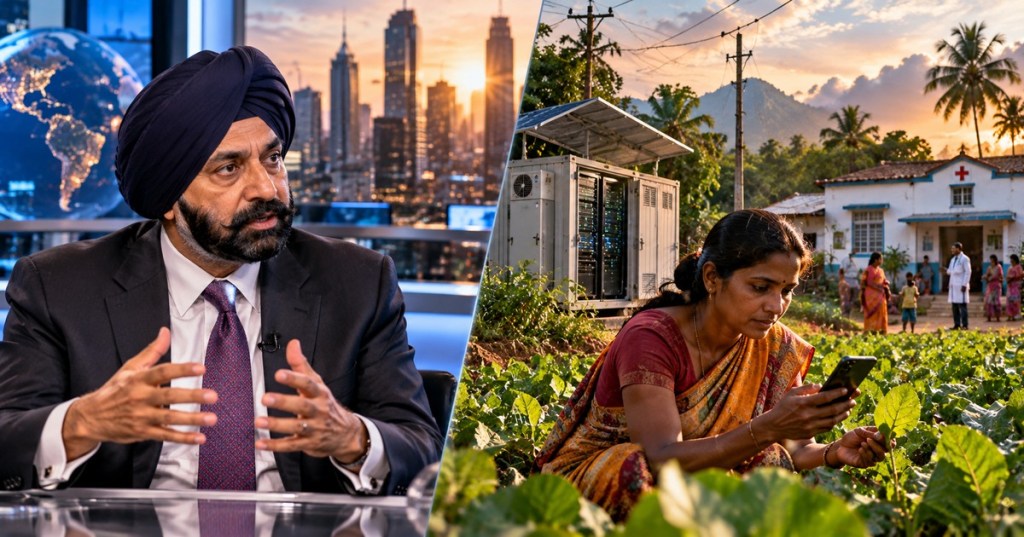
World Bank President Ajay Banga says developing countries can gain from artificial intelligence without reproducing Silicon Valley’s giant computing campuses. Speaking on CNBC’s Squawk Box on October 27, 2026, Banga distinguished practical “Small AI” from capital-intensive frontier models and said access to infrastructure investment remains stronger than some investors assume.
Key Takeaways
- Banga emphasized affordable, task-specific AI for farming, health and education.
- He said capital availability is not the principal obstacle for many emerging-market infrastructure projects.
- The World Bank reported mobilizing $112 billion in private capital in fiscal 2026, a figure distinct from AI-specific spending.
In CNBC’s interview coverage, Banga acknowledged concerns about circular AI financing and rising borrowing costs but argued that developing economies have a different investment profile: roads, electricity, digital connectivity and smaller computing facilities, rather than exclusively hyperscale GPU clusters.
What Small AI Means in Practice
A localized crop-diagnosis tool running on a basic smartphone can potentially help a farmer identify a diseased leaf, while a clinic might use a lightweight system to guide referrals. These applications require accurate local data, reliable connectivity and appropriate human oversight, but not necessarily a multibillion-dollar training installation.
The World Bank’s October annual-meetings session explained the approach in greater depth, with Banga and other leaders describing practical AI that works in local languages and on limited connectivity.
Capital and the Infrastructure Divide
The World Bank Group reports record private-capital mobilization of $112 billion and $25 billion in guarantees in FY2026. That total spans development priorities; it is not a claim that $112 billion was invested in AI. The distinction matters when comparing global development financing with the much larger announced budgets of American hyperscalers.
A smaller AI deployment may still need a functioning electric grid, a modest local data center, secure data access and staff trained to maintain the system. These practical requirements are why finance and infrastructure planning matter even when models are inexpensive to run.
Why This Matters
The World Bank’s argument offers a different way to measure AI progress: improved agricultural income, faster medical access, stronger local enterprises and better jobs rather than solely GPU counts or megawatts. Outcomes must be evaluated, not presumed from a technology demonstration.
BitcoinVersus.Tech has also explored AI power-demand uncertainty, AI infrastructure financing and Meta’s major equity financing proposal. Banga’s interview highlights how the needs of developing economies can differ from those projects.
Editor’s Note: BitcoinVersus.Tech supports independently verified technology reporting. If you value this work, consider donating 5,000 sats using the QR code below.

Scan the QR code with your phone from a larger screen to support the publication.


Leave a Reply