A proposed data center on Montana’s northern plains is inching toward construction, but the state’s biggest electricity-demand announcements remain a long way from fully operational computing campuses. Yellowstone County approved an agreement on October 27, 2026 requiring the developer of the huge Broadview project to pay for road damage. In Butte, an established cryptocurrency-mining facility is seeking more electricity. Farther east, another mining operator has only a conditional path toward a much larger expansion.
The three largest distinct Montana computing sites with publicly attributable developer, utility or regulatory power figures that remain in development or operation are Quantica’s Big Sky Campus at 1,100 MW planned, Atlas Power’s Butte data center with an up-to-150 MW utility expansion proposal, and Hyperscale Data’s BNI Montana facility with up to 125 MW of additional power under a conditional utility determination. Their reported figures are not directly equivalent. Atlas has a separately confirmed 75 MW operating site, while Hyperscale says around 10 MW is already active at the location considered for expansion. The ranking describes published development scale, not current metered server demand.
The distinction is particularly important in Montana, where plans for some 250–600 MW developments were withdrawn and where utility letters of intent often precede formal service agreements. A signed road-maintenance contract does not authorize a data center’s power consumption; a conditional utility letter does not deliver megawatts; and power-generation proposals cannot simply be labeled AI computing load. Those limits determine the rankings below.
3. Hyperscale Data, BNI Montana — 125 MW Additional Power Under Conditional Utility Letter
Hyperscale Data says it has a path to potentially add 125 MW at one of two leased Montana mining sites. In its June 24, 2026 company announcement, subsidiary BNI Montana reported receiving a formal conditional “will serve” letter from Lower Yellowstone Rural Electric Cooperative after a load study. The affected facility operates at approximately 10 MW supporting Bitcoin mining, the company said. Its second Montana site, about 15 miles away, can also operate at roughly 10 MW but has not undergone the same power study.
This is 125 MW of possible new supply in addition to the current roughly 10 MW, not 125 MW already energized. If every required investment and approval were secured, the single studied site could theoretically approach about 135 MW of total electrical availability. That is a conditional development scenario, not a signed 135 MW service agreement. Critically, Hyperscale’s June announcement did not publicly identify which of its two Montana leases received the study, so we do not assign the 125 MW letter to a precise parcel or add the same opportunity to both sites.

The co-op’s determination still requires engineering, transmission and distribution upgrades, interconnection studies, utility agreements, regulatory approvals and financing. One needed transmission line was described with an expected completion around 2031, while timing for other improvements remained uncertain. A willingness to serve a future load is different from a binding power contract, and the operator has not announced a completed AI data hall at the expanded capacity.
BNI Montana’s existing operation is a Bitcoin mining data center. Hyperscale’s July 2, 2025 operational notice said it had reenergized about 10 MW and was restarting its Antminer fleet. The company also discussed high-performance computing, cloud and artificial-intelligence customers as potential future uses; those prospective workloads should not be reported as commissioned GPU deployments. Its actual SEC disclosures distinguish Montana mining operations from its separate Michigan AI campus.
A further 125 MW per site ambition was floated during a company conference call, but only one of the two locations received the specific conditional letter. A proposed 250 MW combined expansion is therefore not two confirmed utility commitments. The project’s importance in this ranking comes from the officially issued 125 MW determination, with all conditions and the unidentified location made explicit.
2. Atlas Power, Butte — 150 MW Expansion Proposal; 75 MW Existing Operating Site
Atlas Power Group runs one of Montana’s better-established large data centers outside Butte, Silver Bow County. The Montana Department of Environmental Quality’s 2026 data-center information sheet lists the Butte facility at 75 MW of existing operating electricity load. The site primarily supports cryptocurrency mining rather than an announced large AI training installation.
For its next stage, utility NorthWestern Energy announced on December 19, 2024 a plan to provide 75 MW of new supply beginning in 2026, with growth of up to another 75 MW in the following three to five years. The corresponding up-to-150 MW figure is an announced new-service expansion envelope, based on a nonbinding letter of intent. It should not be described as 150 MW of added supply that has already been delivered, or automatically added to the original 75 MW to state a completed 225 MW campus.
The October 2026 release of previously confidential utility letters reinforced how provisional the negotiations remain: NorthWestern stated that no new formal electric service agreements for the proposed large-load developments were active and cautioned that the older letters might not reflect current development conditions. The existing 75 MW Atlas operation is a separate fact from this prospective new arrangement.
The regional power debate is already affecting local politics and public utility review. An account by Montana Free Press described Atlas’s predominantly air-based cooling system and the community’s concern about energy prices and water consumption. Atlas’s operation is real; its expansion still faces a separate utility-cost, interconnection and regulatory pathway.
The distinctions also matter for the state’s data-center politics. Sabey Data Centers had pursued a separate 250 MW development on roughly 600 acres in the Montana Connections park, but withdrew the May 2026 land purchase after REC Silicon exercised land rights. That canceled site is not Atlas’s existing Butte operation and cannot be counted as another active completed campus.
1. Quantica Big Sky Campus, Broadview — 1,100 MW Proposed; Site Work Advancing
Quantica Infrastructure, through its Big Sky Digital Infrastructure subsidiary, is planning a 1,100 MW data center and integrated power campus across approximately 5,100 acres near Broadview in Yellowstone County. The developer confirmed that scale in its August 31 announcement. The site is roughly 30 miles north of Billings. At full buildout, the company envisions multiple computing buildings, local energy generation and transmission infrastructure. No completed 1,100 MW computing campus or publicly identified anchor cloud tenant was documented in the materials reviewed as of October 29.
The project moved forward in a limited but concrete way this week. On October 27, the Yellowstone County Board of County Commissioners approved a road-use and maintenance agreement by a 3–0 vote. It requires the developer to use designated sections of Heiken and Buffalo Trail roads, improve one mile of gravel access, conduct inspections and post a $250,000 surety bond. County officials specifically said the road deal did not approve land use, water withdrawal or electric service. The initial phase involves road access and groundwork for a proposed well, not energizing an AI data hall.
Water permitting remains under state review. The Montana Department of Environmental Quality is accepting public comments on a proposed deep-aquifer well through November 6. The company forecasts maximum water demand around 150,000 gallons per day during peak construction, decreasing to about 20,000 gallons daily in normal full-campus operations if its proposed closed-loop cooling works as designed. Those are engineering projections submitted for review, not actual measured use at a completed 1,100 MW facility.
One highly important power distinction has attracted attention. In May, Quantica filed interconnection applications for as much as 7,235 MW of possible generation capacity over multiple phases. That giant number is not a 7.235 GW data center or an electrical connection already built. It is the maximum of a portfolio of potential generating resources designed to serve future customers and power systems, requiring separate transmission studies and permits. The project’s officially reported 1,100 MW campus scale is the relevant power figure for the numbered ranking.
In a local recorded community forum, Montana Environmental Information Center brought together Broadview residents, public-health advocates and energy specialists to discuss the 5,100-acre proposal. The discussion provides firsthand community perspectives on the development’s potential impacts. Speakers’ opinions and predictions are their own, not settled findings about Quantica’s plans.
Montana Environmental Information Center, Broadview community panel held June 18, 2026. Recorded local discussion of Quantica’s actual Big Sky proposal, including energy, health and water concerns; the company’s separate announcements and DEQ filings provide the project-specific capacity information.
Quantica says it will pay for infrastructure required by its customers and take steps to protect ratepayers. The company’s project FAQ describes energy procurement, transmission planning and a goal of closed-loop cooling. Critics have questioned whether the local utility, aquifers and public accountability mechanisms are ready for a development of this size. Whether the project meets its financial, environmental and construction commitments remains to be demonstrated through permitting, engineering agreements and future milestones.
An earlier January 26 community panel in Broadview documents how the proposal was presented and contested before Quantica’s May interconnection filings and this autumn’s road agreement. That recording provides a useful comparison with the later June discussion. It is a stakeholder event, not a vote by county commissioners or a developer capacity filing.
Montana Environmental Information Center’s January 26, 2026 Broadview panel, recorded with local residents and conservation and water specialists. The project’s later 1,100 MW scale and approvals are supported by separate developer and state sources.
Why Other Large Montana Plans Are Not Included
Several once-prominent proposals are no longer progressing as originally advertised. Sabey’s Butte Montana Connections campus, discussed at up to 250 MW, lost its intended site in May 2026. The proposed 600 MW Project Cardinal near Great Falls is classified as canceled in multiple project histories, and no confirmed active official build plan was established for it. Krambu’s 29 MW Bonner proposal was also withdrawn in July. These are important pieces of Montana’s development history, but they would distort a ranking of currently advancing projects.
A separate issue concerns Big Horn/Beowulf near Hardin. Montana’s state data-center FAQ lists a 100 MW load at the coal-plant-connected site, but more recent independent trackers describe the historic cryptocurrency-mining hub as paused or closed. The available evidence does not resolve its October 2026 operating status consistently enough to rank it as an active 100 MW project. The discrepancy should be addressed by a fresh plant or utility statement before restoring it to a current operating-power list.
The state also hosts smaller state-government and telecommunications data centers that provide working computing services but do not have publicly comparable hundreds-of-megawatts expansion announcements. Their exclusion says nothing about their importance for everyday networks, cloud applications or public services.
Montana’s Power Numbers Are Not All Operating Power
These three projects differ at the most basic engineering level. Quantica’s 1,100 MW describes an enormous proposed campus. Atlas’s up-to-150 MW refers to proposed incremental utility service under a nonbinding letter, beside a separately documented 75 MW operating facility. Hyperscale Data’s 125 MW is a conditional possibility for one existing 10 MW Montana mining location. None should be sold to readers as measured operational AI computing power.
If a facility drew 1,100 MW steadily for 24 hours, it would consume 26,400 megawatt-hours (26.4 GWh). That is a hypothetical calculation, not a statement that Broadview currently consumes 26.4 GWh a day. Likewise, the 7,235 MW of proposed generating capacity at Quantica should not be added to the planned data center load. Generation output, contracted import capacity, nameplate storage discharge and critical IT load have different meanings.
Montana’s next significant milestones are the November 6 public-comment deadline on Quantica’s well, a future binding NorthWestern electricity-service agreement, actual construction of data halls, and the engineering and financing behind Hyperscale’s conditional expansion. Readers comparing stages can consult BitcoinVersus.Tech’s Missouri ranking and the revised Mississippi ranking, which apply the same distinction between company announcements, utility commitments and real operating load.
BitcoinVersus.Tech
Follow BitcoinVersus.Tech on X for technology reporting and research.
BitcoinVersus.Tech Editor’s Note: We volunteer daily to ensure the credibility of the information on this platform is Verifiably True.
If you would like to support our work and help further secure the integrity of our research initiatives, please scan the QR code below to donate (For the best results, scan the QR code on a Laptop or larger screen).
Suggested donation: 5,000 sats. Bitcoin address: 3C9o19EH5HSiwEPyCTmEKzxhNCbo2X6TTb. Confirm the destination address before sending.

BitcoinVersus.tech is not a financial advisor. This media platform reports on financial subjects purely for informational purposes.
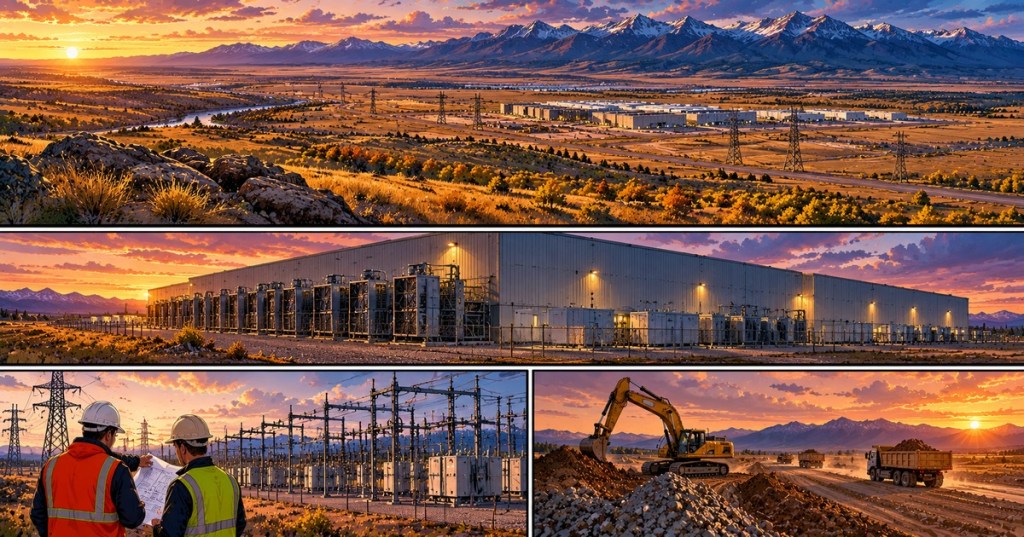
Featured cover: Original wordless comic created for this report, showing an imagined Montana data center construction and power-infrastructure landscape. It does not depict a specific built project.


Leave a Reply