
Oklahoma’s latest wave of data center development is taking shape around three very different projects: a newly rezoned, multi-campus proposal in Enid; an operating computing hub expanding in Muskogee; and a contested large development outside Piedmont. Together, their developers describe plans approaching several gigawatts of electrical capacity. But only part of the power and computing infrastructure exists today, and local communities are still deciding whether—and on what terms—some of the proposed buildings can proceed.
The three largest identifiable, actively advancing Oklahoma developments with documented project-specific power figures are Project Thunderbird in Enid, up to 2,750 MW of proposed IT power; Core Scientific’s Muskogee campus, up to 1,500 MW of planned gross power; and Cloverleaf Infrastructure’s Project Open Sky near Piedmont, approximately 1,400 MW of long-range electrical demand. The figures are not directly equivalent. Critical IT load, facility gross power, and aspirational utility service are different measures; none should be summed and presented as servers currently operating.
3. Cloverleaf Project Open Sky, Piedmont — About 1,400 MW Proposed
Cloverleaf Infrastructure is pursuing a large campus on the north side of Piedmont in Canadian County. The company’s filing for its initial approximately 633-acre development describes six data center buildings, each approximately 352,800 square feet, along with a substation, warehouses, internal roads, landscaping and drainage facilities. An expanded footprint, including land options in nearby Kingfisher County, supports a long-range aim of around 1.4 GW of electricity demand. The first six-building development is expected to need about 600 MW; 1.4 GW is not a commissioned first phase.
The project has seen extensive public review. On October 22, 2026, Piedmont’s City Council voted 4–1 to endorse an amended master design plan that keeps Frisco Road open, while separate annexation, rezoning and site approvals still remained. According to a chronology of council proceedings, the developer had previously revised its proposals several times amid local concerns. An approved concept plan is therefore not final authorization to build or energize a 1.4 GW facility.
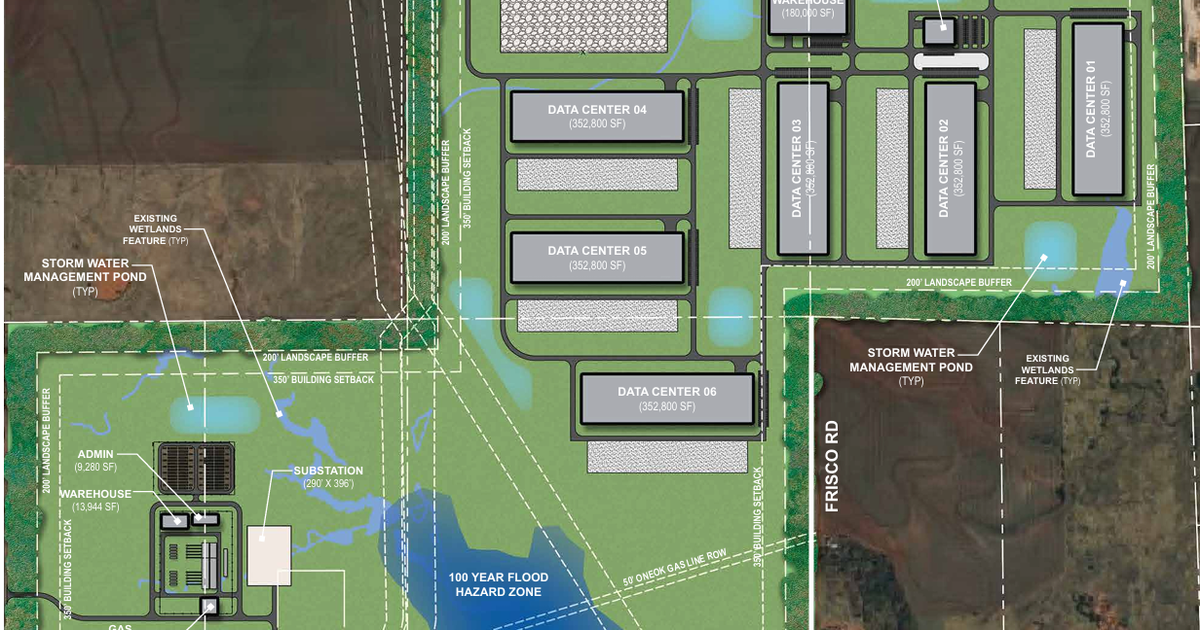
The engineering approach has also changed. Cloverleaf removed a proposed 300 MW on-site natural-gas peaker plant from its current plan and promised closed-loop cooling, noise monitoring, and a daily water-use cap of 75,000 gallons in its revised proposal. New Project Media reported that the company is working through utility studies and regional transmission requirements, while developer commitments to pay for infrastructure remain subject to enforceable agreements.
These revisions show an effort to address concerns rather than proof that every question is settled. Neighbors have raised objections to the potential scale, sound, road changes, water use and effects on electricity bills. Cloverleaf estimates substantial construction activity and local tax receipts, but the financial benefits and obligations must be documented through actual contracts, utility tariffs and completed facilities. Cimarron Electric Cooperative stated in May that discussions were preliminary and no final electricity-service agreement had been reached.
2. Core Scientific Muskogee — 1,500 MW Planned Gross Power; Existing Capacity Secured
Core Scientific has a materially different position in Muskogee: it owns or controls operational infrastructure and is constructing more high-density colocation space for AI customers. On August 14, the company announced the completion of its approximately $444 million acquisition of Polaris DS, securing access to around 440 MW of existing gross, grid-connected power capacity under agreements with Oklahoma Gas & Electric. That electricity supply was already being used at the Polaris site, principally for Bitcoin mining.
With Polaris and adjacent development land, Core Scientific plans to expand the Muskogee complex toward 1,500 MW of gross power, or approximately 1,000 MW of future leasable data center power. Those company targets include new electrical infrastructure and potential behind-the-meter generation that remain to be built or contracted. The existing 440 MW is part of the expansion strategy, not an extra amount to add to the 1,500 MW headline. Similarly, gross facility power is larger than the share ultimately available to customer computing equipment.
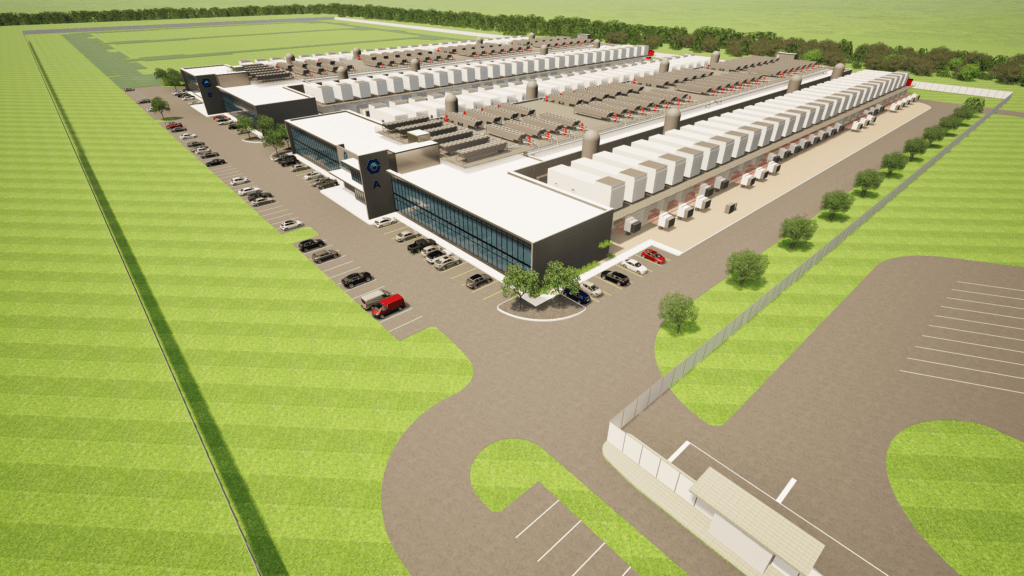
Core Scientific’s July investor materials indicated that its existing 70 MW critical IT deployment for CoreWeave had started billing by midyear. The company also described a separate approximately 82 MW expansion associated with AMD, for which delivery is expected to begin in the second half of 2027. Construction activity and power rights give this project a firmer basis than sites that have only entered a planning process, though neither the current tenant halls nor the Polaris acquisition proves 1.5 GW of servers already installed.
The site reflects a broader transformation of Bitcoin-mining infrastructure into AI hosting. Land, switchgear, transmission access and operating experience are valuable foundations for both workloads, but modern liquid-cooled GPU systems require substantially different building designs, cooling distribution and uptime provisions. The next milestones are customer acceptance tests, successful commissioning of additional halls and documented delivery of utility power. BitcoinVersus.Tech has separately covered the Polaris purchase and the largest planned AI computing campuses across the country.
1. Project Thunderbird, Enid — Up to 2,750 MW of Planned IT Capacity
Project Thunderbird is the largest announced Oklahoma development by its developer’s stated 2.75 GW of eventual critical IT capacity. Plainsmen Holdings, a group led by Enid business owners, proposes a four-campus data center corridor and related utility infrastructure covering approximately 1,735 acres at full buildout. Its model also envisions up to 3.3 GW of dedicated power generation. The 3.3 GW is a separate supply-side design envelope, not another 3.3 GW of server demand to add to the 2.75 GW.
A significant land-use decision arrived this week. On October 27, 2026, Enid’s mayor and City Commission voted 6–1 to approve the developer’s three rezoning requests affecting its North and West campus areas. Plainsmen’s October 28 update confirms that the planned South campus still needs annexation and rezoning, while the East campus involves a separate land option with the city. The City of Enid has emphasized that a rezoning change does not authorize a data center, a power plant or construction: intensive-use applications, site-specific engineering, another public hearing and further approvals remain.
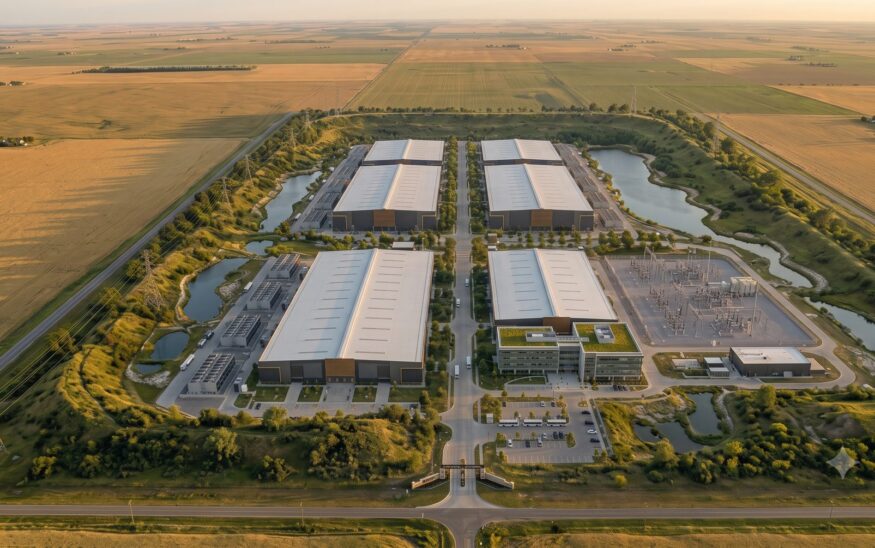
The developer says its design would use a largely dedicated electricity system, a raw-water connection to Kaw Lake and industrial cooling that does not rely on conventional open evaporative towers. Its published full-build estimate calls for approximately 562 million gallons of water annually consumed despite internal recirculation. That is an engineering forecast rather than a measured operating result. It also proposes contributions to schools, local infrastructure and watershed restoration, while projecting as many as 600 permanent jobs. Those benefits must be translated into enforceable agreements before they can be considered realized.
The public debate has been substantial, with supporters pointing to industrial diversification and potential support for energy resilience near Vance Air Force Base, and opponents questioning water supply, emissions, noise, power costs and the eventual identity of a hyperscale operator. The development team says no final operating partner has been selected. The October rezoning vote advances the project, but the remaining approvals and economic arrangements will determine whether the immense proposal becomes a deliverable campus.
Why IREN’s Project Emerald Is Not Included
IREN’s Project Emerald in Pittsburg County has been listed by project trackers with up to 1,600 MW of prospective scale near Kiowa. That would numerically exceed both Core Scientific and Open Sky. Yet the October 2026 statewide project register lists Emerald as on hold, with no comparably clear record of a current construction program, energized data halls or active final land-use approval. Until a fresh developer filing establishes progress, presenting it above continuing development efforts would misrepresent where the project stands.
Google’s operating Pryor data center and additional projects around Stillwater, Owasso and Muskogee County are major parts of Oklahoma’s computing economy, but publicly comparable single-campus capacity disclosures are not available for every expansion. Likewise, the roughly 200 MW CloudBurst Oklahoma City development has a more limited published scale than the three projects in this comparison. A ranking by announced full-build capacity should not be read as a ranking of computers actually performing work today.
Power Costs, Jobs and the Next Milestones
The developers’ underlying business cases are compelling: reuse of industrial electrical infrastructure, access to land near transmission, multiyear construction contracts and new demand for electricians, cooling specialists, network technicians and data center operators. Oklahoma’s existing energy industry could also supply engineering expertise and grid investment. Communities have equally legitimate reasons to seek detailed evidence about where energy comes from, who pays for substations and whether local water and road systems can sustain expansion.
Oklahoma regulators and utilities are increasingly focused on large-load tariffs and financial commitments intended to prevent speculative requests from shifting excessive grid costs onto households. But even a favorable tariff cannot guarantee that projected megawatts will be connected by a given year. For the three projects here, the decisive tests will be an intensive-use permit and named customer for Thunderbird, commissioned Core Scientific capacity beyond its existing customer halls, and final Piedmont zoning and utility agreements for Open Sky. Those are the milestones that will turn planned computing infrastructure into measurable economic activity.
Readers can compare Oklahoma’s proposals with BitcoinVersus.Tech’s Ohio ranking, North Dakota ranking, New York ranking and the capacity-planning engineering lesson. The same distinction applies in every state: gross power availability, critical IT load and operating power are related but separate measures.
BitcoinVersus.Tech
BitcoinVersus.Tech Editor’s Note: We volunteer daily to ensure the credibility of the information on this platform is Verifiably True. If you would like to support our work and help further secure the integrity of our research initiatives, please scan the QR code below to donate 5,000 sats. For best results, scan the QR code from a laptop or larger screen.
Bitcoin address: 3C9o19EH5HSiwEPyCTmEKzxhNCbo2X6TTb. Confirm the destination address before sending.

BitcoinVersus.tech is not a financial advisor. This media platform reports on financial subjects purely for informational purposes.


Leave a Reply