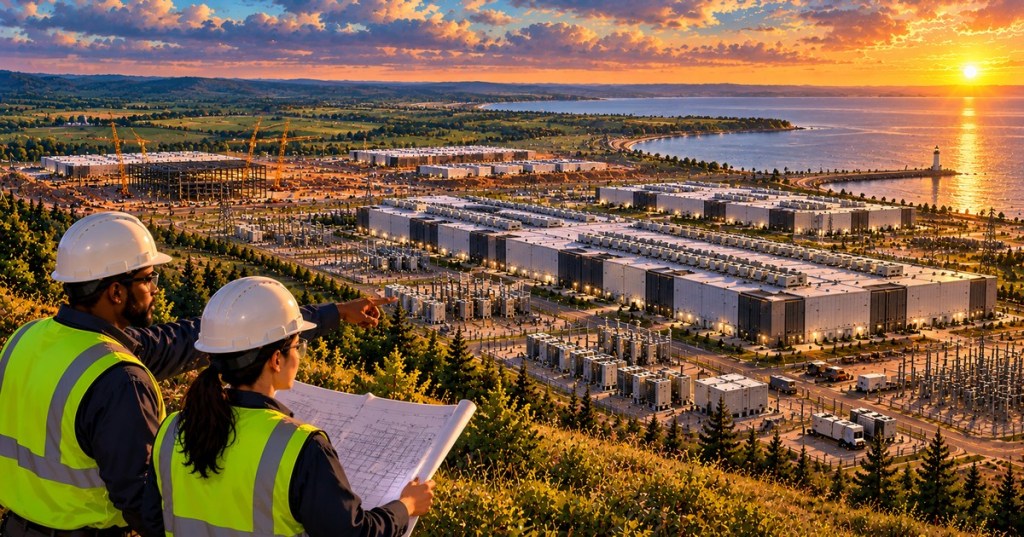
Wisconsin’s largest documented AI data center developments now span three very different stages: Vantage Data Centers is building its 902-megawatt Lighthouse campus in Port Washington, Microsoft has brought its first Fairwater facility online in Mount Pleasant, and Meta is constructing a 220 MW data center in Beaver Dam. All three are drawing scrutiny over new utility infrastructure, local tax benefits and water and land use as the state’s AI buildout accelerates.
The comparison below ranks three substantial, independently identifiable projects by published or tracked site-level power figures. The numbers are not identical metrics: Lighthouse’s 902 MW is an operator-published planned critical IT load, Fairwater’s roughly 450 MW comes from an independent campus model rather than a Microsoft-disclosed meter, and Beaver Dam’s 220 MW is projected peak utility demand documented in regulatory reporting. This is a ranking of documented development scale, not an audited statewide leaderboard of currently running server power. Figures and project statuses are assessed as of October 30, 2026.
3. Meta Beaver Dam — 220 MW Projected Peak Demand; Under Construction
Meta announced its first Wisconsin data center in Beaver Dam, Dodge County, on November 12, 2025. The planned AI-optimized campus will contain more than 700,000 square feet of facilities and represents at least $1 billion in investment. Alliant Energy’s initial project announcement anticipated roughly 1,000 construction jobs at peak and more than 100 long-term operational roles, with the data center expected to come online in 2027.
The 220 MW figure comes from utility filings and Wisconsin Watch’s examination of the Public Service Commission’s May approval of Alliant’s service agreement. The regulator modified the agreement and scrutinized how costs would be allocated to other customers. That projected peak does not establish that 220 MW of servers are energized in October 2026. Some market inventories use a larger gross development envelope; without matching phase definitions, those figures should not be added to this entry’s utility-demand number.
Milwaukee Journal Sentinel’s April 7, 2026 aerial video documents construction at Meta’s Beaver Dam data center.
Meta says it will underwrite nearly $200 million in energy infrastructure and match the campus’s electricity use with clean and renewable energy. The company also committed $15 million over a decade to Alliant’s Hometown Care Energy Fund and described a wetland and prairie restoration partnership with Ducks Unlimited. Those investments do not eliminate concerns about groundwater, the timing of power upgrades or how the utility agreement will protect household customers. A more revealing future benchmark will be the first energized IT load and the site’s actual cooling-water balance.
2. Microsoft Fairwater, Mount Pleasant — About 450 MW Tracked; First Facility Operating
Microsoft announced on June 23 that its first Fairwater facility in Mount Pleasant was fully operational after equipment began coming online in April. The large AI computing campus occupies land once associated with Foxconn’s much smaller-than-promised Wisconsin manufacturing expansion. Microsoft said the first facility was supporting nearly 550 full-time jobs at the June milestone and that its second adjacent facility was under construction for anticipated completion in 2028.
Microsoft’s public release does not provide a comparable present critical-IT megawatt measurement for its Mount Pleasant building. A separate infrastructure-tracking model associates roughly 450 MW of campus-scale power with Fairwater and around 370 MW of estimated energized power; both are independent modeled figures, not Microsoft-certified measured consumption. An older regulatory discussion also involved larger multi-building load forecasts that should not be treated as one completed facility. The operator’s more directly verifiable numbers concern the first building’s opening, site jobs and spending.
Aeroworks Productions’ April 8, 2026 drone video shows the Fairwater construction site in Mount Pleasant.
The development has already changed the local economy. Microsoft estimates $4.7 billion in Wisconsin hyperscale construction spending between 2024 and 2028. In September, Mount Pleasant officials announced that Microsoft would forgo a possible $5 million annual development incentive, allowing nearly all of that amount to be returned to the village for tax relief. That public-finance decision is separate from the eligibility of other data-center projects for state sales tax treatment.
Questions remain about day-to-day operations. Microsoft published updates on a tonal humming noise associated with cooling fans and said its engineering team had installed or planned further mitigation. Meanwhile, updated October 2026 plans for adjacent construction show that the wider site layout is changing. The operating first Fairwater facility should not be confused with every proposed future building, just as reported computing throughput cannot be converted directly into megawatts without workload and electrical measurements.
1. Vantage Lighthouse, Port Washington — 902 MW Critical IT Planned; Construction Underway
The largest disclosed site-level critical IT plan in this selection is Vantage Data Centers’ Lighthouse campus near Lake Michigan in Port Washington. The company describes four data center buildings spanning 2.5 million square feet across 672 acres, with a planned 902 MW of critical IT load and targeted full completion in 2028. It is being developed to serve Oracle and OpenAI’s Stargate infrastructure. A different roughly 1.3 GW figure appears in electrical interconnection planning; that is not an additional operating data center or 1.3 GW of running chips.
Vantage’s 2025 announcement projected more than $15 billion of investment. By 2026, construction was underway and local coverage reported progress on multiple large buildings. But project financing, construction milestones, site access and the final availability of electricity are separate matters. The Wisconsin Department of Natural Resources says the campus requires wetland, stormwater and air-emissions reviews, with a separate state review of the proposed transmission interconnection. The DNR’s published analysis and permit history provide a better account of approvals than a single headline power figure.
Vantage Data Centers’ November 17, 2025 video introduces the Lighthouse proposal and its planned Port Washington campus. It is the developer’s presentation, not independent construction verification.
Lighthouse has become a flashpoint in local debates over energy rates, water supply, the city’s use of tax-increment financing and environmental effects. The city maintains a public information page linking project materials, while the DNR details infrastructure and permitting review. Vantage says its cooling design uses a closed-loop water system and has presented plans for infrastructure upgrades and habitat restoration. Those commitments still require scrutiny of actual withdrawals, construction effects and operating performance.
The most important near-term milestone is how much of Lighthouse’s 902 MW future IT design can be energized and leased by each delivery date. Comparing it with an already operating Fairwater building or an under-construction Meta campus requires tracking commissioned halls, actual grid deliveries and critical IT MW, not merely an ultimate development vision.
Which Other Wisconsin Projects Were Left Out?
Several large proposals have been canceled, withdrawn or stalled. The QTS Dane County proposal around DeForest and Vienna was withdrawn in early 2026 after public opposition, according to a Wisconsin development tracker; it is not an approved operating 800–900 MW campus. An approximately 800 MW Viridian proposal for the former GM/JATCO site in Janesville also encountered withdrawal or pause reports, with public interest shifting to a November referendum. The former Wisconsin Rapids paper-mill site has seen a roughly 150 MW data-center proposal, but its approval status has changed and does not displace the established three in this report.
Microsoft is also developing additional Mount Pleasant sites, while the first Fairwater building and its adjacent construction must be distinguished from later master plans. The state also has a substantial older market of Milwaukee, Madison and enterprise colocation facilities, many without publicly comparable recent site-level power figures. This Top 3 is not a statement that those operating facilities consume no power.
Electricity Costs and Water Use Will Shape Wisconsin’s Next Phase
The central public-policy question is who pays when a developer needs new transmission lines, substations or generation. The Citizens Utility Board of Wisconsin describes its role in the Meta/Alliant case and argues that standardized large-load tariffs can reduce risks of costs shifting to customers. Developers and utilities counter that new large customers can expand the tax base and fund infrastructure when contracts are carefully designed. The Wisconsin Public Service Commission’s final tariffs and project-specific contracts will matter more than either side’s publicity alone.
As data-center investment accelerates, clear reporting should distinguish announced IT capacity, maximum utility demand, permitted generation, energized server halls and actual measured consumption. Comparing unlike figures creates a false sense of precision. For a wider view, BitcoinVersus.Tech recently examined West Virginia’s power-heavy proposals, Washington’s Quincy campuses, and Texas’s Top 7. Our data center capacity-planning lesson explains why planned headroom and live IT load must be kept apart.
BitcoinVersus.Tech
BitcoinVersus.Tech Editor’s Note: We volunteer daily to ensure the credibility of the information on this platform is Verifiably True. If you would like to support our work and help further secure the integrity of our research initiatives, please scan the QR code below to donate 5,000 sats. For best results, scan the QR code from a laptop or larger screen.
Bitcoin address: 3C9o19EH5HSiwEPyCTmEKzxhNCbo2X6TTb. Confirm the destination address before sending.

BitcoinVersus.tech is not a financial advisor. This media platform reports on financial subjects purely for informational purposes.


Leave a Reply