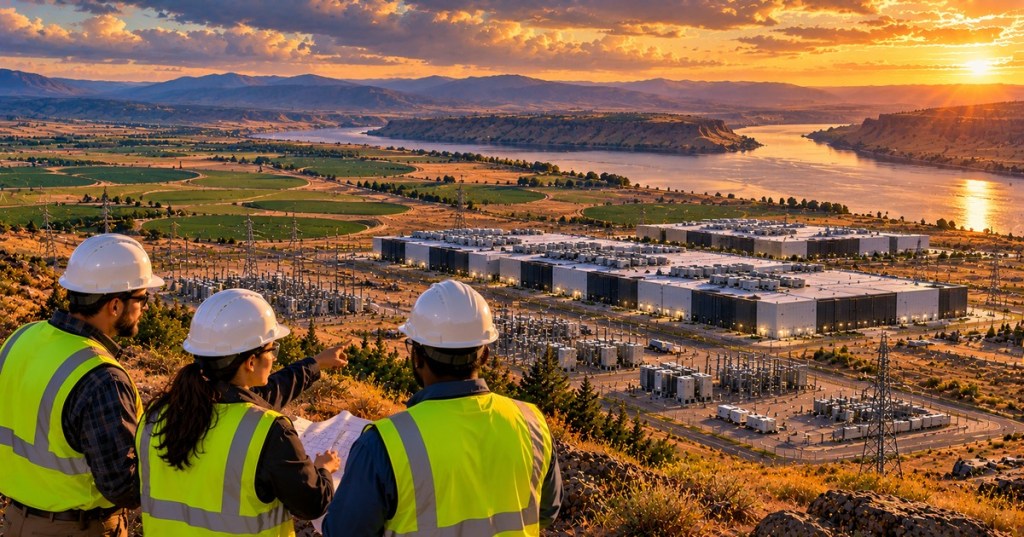
Washington’s largest established data center developments are concentrated in the Columbia Basin, where Microsoft operates multiple Quincy campuses and is expanding into Chelan County. Three of the state’s most substantial documented facilities are Microsoft Quincy MWH, modeled at about 295 megawatts of IT power by an independent infrastructure researcher; Microsoft Malaga, with a 288 MW maximum authorized utility demand; and Microsoft Quincy Columbia, listed by a separate industry record at about 240 MW. The three figures describe different things and cannot be read as electricity currently consumed by running servers.
This installment preserves the series’ Top 3 Largest Data Center Projects in Washington (2026) name but ranks three major, independently identified campus developments by their reported upper capacity figures, with a qualification beside every number. It is not a verified statewide ranking of metered IT load. Microsoft does not publicly disclose an equivalent recent site-specific megawatt figure for every Quincy campus. Planned substation capacity, third-party modeled IT capacity and actual electricity supplied to the facility must be treated separately.
3. Microsoft Quincy Columbia — About 240 MW in a Third-Party Site Record; Operating
Microsoft’s Quincy Columbia data center is a distinct facility in Grant County’s extensive cloud-computing hub. Data Center Record lists approximately 240 MW for its Quincy Columbia campus (MWH01), describing the facility as operating. That number is an attributed directory entry, not an independently recovered Microsoft technical specification. The record’s primary link identifies the Washington location but does not itself provide a readily retrievable 240 MW meter reading. Readers should treat the figure as provisional rather than an audited critical-power rating.
The existing cloud infrastructure is meaningful regardless of the exact rating. Microsoft has operated data centers in Quincy for approximately two decades, drawn by available land, hydropower infrastructure and connectivity. It uses the Central Washington facilities for online applications and cloud services. The company’s state-facing materials discuss local employment and water stewardship but do not resolve the uncertainty in campus-by-campus live IT power.
Cascade PBS’s August 20, 2026 report interviews Quincy’s current and former mayors about the data center buildout. The video is Quincy community context, not a tour specifically identified as Microsoft Columbia.
Quincy illustrates the economic and environmental tradeoffs of mature cloud infrastructure. Local officials credit data centers with increased tax receipts that helped fund roads and public services, while residents have questioned water use, energy demand and the conversion of farmland. KUOW reported in January that Microsoft used Quincy as an example for a new program promising data centers would cover the costs of their own electrical infrastructure. Those commitments should be evaluated against utility tariffs and actual expenditure, not marketing alone.
2. Microsoft Malaga, Chelan County — 288 MW Authorized Demand; Construction and Partial Service Reported
In Malaga, just south of Wenatchee, Microsoft has been constructing a multi-building campus near the former Alcoa industrial property. The most authoritative number is in Chelan County Public Utility District’s June 2025 agreement summary: a maximum authorized demand of 288 MW under a 15-year large-load service arrangement covering August 2025 to July 2040. That is a contractual ceiling subject to supply and reliability conditions, not an assertion that 288 MW of hardware is running continuously.
The PUD’s June 17 announcement specified a much smaller initial short-term supply—up to 18 MW through December 2025—and said long-term supply would require separate arrangements. The utility said Microsoft was responsible for major interconnection costs, including the Jumpoff Ridge substation. Its contract also enables service reduction when needed to protect system reliability, with provisions designed to prevent other ratepayers from paying for the data center’s electricity purchases.
Cascade PBS’s August 21, 2026 report shows construction at Microsoft’s Malaga campus and interviews Chelan PUD officials about its electricity requirements.
Notably, Cascade PBS reported Microsoft’s operational projection as up to 150 MW at full buildout, substantially below the 288 MW utility-contract maximum. The difference is an important reminder that contract flexibility and expected operating demand are not synonymous. Microsoft’s community project page originally planned one building in the first phase with additional buildings driven by demand. By August 2026, local footage showed additional site work; October reporting indicated some data halls had begun operating while further phases remained in construction and testing. Neither evidence establishes full authorized utilization.
The environmental questions include cooling-water infrastructure, construction activity and future power sourcing. Chelan PUD stressed that it would retain control of its hydropower resources rather than automatically allocate inexpensive local hydroelectric generation to the new campus. The next meaningful disclosure is the verified operating IT megawatts and the origin of contracted long-term electricity supply.
1. Microsoft Quincy MWH — About 295 MW Modeled IT Capacity; Operating and Expanding
Microsoft’s larger Quincy MWH campus ranks first among the three on the basis of an approximately 295 MW independent IT-power estimate published in a sample table by Cleanview. Its Washington market inventory also names Microsoft Quincy MWH as the state’s largest operating campus by its model of power associated with online buildings. This is researcher-modeled capacity, not a disclosed Microsoft utility meter or a guaranteed 2026 instantaneous IT draw. Differences in modeling methods and campus boundaries can alter the comparison.
The campus is demonstrably established and still seeing infrastructure work. The Washington Department of Ecology’s permit registry lists the MWH08 data center at 1500 Port Industrial Way as an active facility with a construction-stormwater permit continuing into 2030. A construction permit does not itself reveal operating load, but it provides a concrete trace of the project’s continuing development. Microsoft has separately described investment in water systems and programs intended to expand training for data-center workers in Central Washington.
CNET’s January 2021 video shows Microsoft’s Quincy data center operations during a tour presented by Microsoft executive Brad Smith. It documents the company’s local facilities, though it does not certify the present MWH campus power rating or identify every building shown.
The Columbia Basin’s cloud concentration has created opportunities for electricians, networking professionals, mechanical technicians and contractors, as well as a larger tax base. But Columbia Riverkeeper’s February analysis found that available documentation does not disclose enough comparable operator megawatt figures to construct a precise county-wide leaderboard. That is why the modeled 295 MW should not be represented as an audited meter reading, and why this article avoids asserting a definitive statewide live-IT ranking.
Why Amazon Wallula Gap and Proposed Gigawatt Projects Are Not Ranked
The largest visible new proposal outside the Microsoft cluster is Amazon Web Services’ Attalia campus at the Wallula Gap Business Park in Walla Walla County. Amazon’s 2026 land-use application describes three data center buildings of about 220,000 square feet each on approximately 134 acres, along with a water facility, security infrastructure and a future substation site. County notices reported in September established an application and environmental review process, not final operating approval.
Some commercial infrastructure indexes assign hundreds of megawatts to the prospective campus, but the publicly reviewed record does not establish an operator-confirmed site MW figure. Washington State Standard reported on October 6 that residents and environmental advocates disputed the level of review, while county officials said impacts might be mitigated within existing industrial zoning. AWS Wallula is significant, but an undisclosed electrical rating cannot be ranked numerically against known contracts or operating sites without labeling the estimate as speculative.
Other large numbers are even less mature. Spokane County’s Rock Point inquiry has been associated with around 1 GW, while power requests in Klickitat County include large proposals with uncertain data-center users, permits and final sites. The October 21 public project survey marks such entries as inquiries or rumors rather than construction-ready projects. They should not displace operating facilities merely because a transmission request mentions one gigawatt.
Washington’s Power Rules Are Changing in 2026
Washington also changed its data-center incentive structure. The Department of Revenue’s June 3 notice says replacement server equipment and qualifying rural data-center refurbishments lost particular sales and use tax exemptions effective July 1, 2026. This does not end every tax exemption for newly built facilities; the eligibility rules are more specific. The change affects the economics of refreshing server fleets at long-established campuses as well as debates over subsidies for new construction.
The larger lesson is the same whether a company is expanding an existing Quincy site or applying for a greenfield campus: distinguish requested grid connection, permitted electrical facilities, maximum contractual service, installed server power and actual electricity consumption. They have different effects on utility planning and different degrees of certainty. As a comparison, BitcoinVersus.Tech recently examined Virginia’s five major campuses, Texas’s seven megaprojects, and Utah’s behind-the-meter proposals. Our capacity-planning lesson covers the distinction between provisioned power and realized equipment demand.
BitcoinVersus.Tech
BitcoinVersus.Tech Editor’s Note: We volunteer daily to ensure the credibility of the information on this platform is Verifiably True. If you would like to support our work and help further secure the integrity of our research initiatives, please scan the QR code below to donate 5,000 sats. For best results, scan the QR code from a laptop or larger screen.
Bitcoin address: 3C9o19EH5HSiwEPyCTmEKzxhNCbo2X6TTb. Confirm the destination address before sending.

BitcoinVersus.tech is not a financial advisor. This media platform reports on financial subjects purely for informational purposes.


Leave a Reply