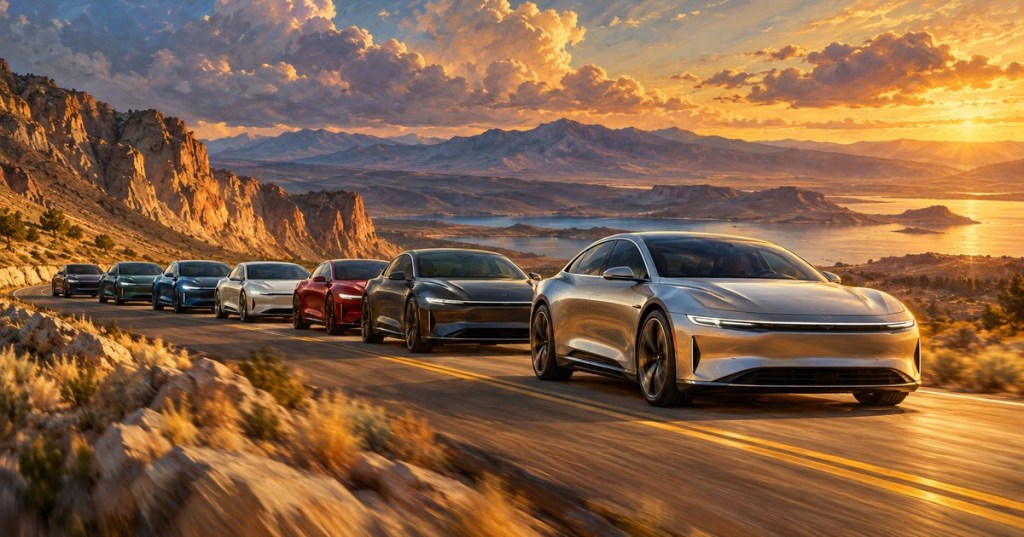
The U.S. Environmental Protection Agency’s 2026 driving-range ratings reveal a wide gap among the electric sedans and liftbacks sold in the United States. The leader, the Lucid Air Grand Touring, is rated for 512 miles on a full charge. Six other models form the rest of this countdown, including a Tesla flagship whose production has already ended.
This ranking compares the highest U.S. EPA combined-range rating for a 2026 model-year version of each distinct car, using the most efficient eligible trim and wheel configuration. It excludes SUVs, pickup trucks, overseas-only vehicles, non-EPA WLTP or CLTC figures, and duplicate trims of the same nameplate. Ratings are laboratory-based estimates; actual highway speeds, weather, tire choices, temperature and driving habits change results.
7. BMW i4 eDrive40 — 333 Miles
BMW’s 2026 i4 eDrive40 reaches 333 EPA miles with 18-inch wheels. The liftback gains silicon-carbide power electronics in the inverter, reducing losses between its battery and electric motor. Its 19-inch wheel version is rated lower, at 307 miles, demonstrating why tire and wheel selection matters even before a trip begins.
Motormouth reviews the updated 2026 BMW i4 and discusses its efficiency gains.
The rear-drive i4 is a useful reminder that a lighter-duty motor layout and carefully engineered power electronics can improve range without a substantially larger battery. BMW says the upgraded inverter also supports power delivery and thermal durability.
6. Tesla Model 3 Premium Rear-Wheel Drive — 363 Miles
The 2026 Tesla Model 3 Premium RWD is rated for 363 EPA miles. Its aerodynamic shape and relatively modest electricity consumption give it a strong range result without the footprint of a full-size luxury flagship. Choosing the Premium rear-drive version matters: all-wheel-drive and higher-performance configurations carry different ratings.
Ryan Shaw compares the different 2026 Model 3 trims, including the Premium model.
For drivers who charge primarily at home, the car’s efficiency can matter as much as how far it travels between stops. Consumption is measured in kWh per 100 miles, so a lower figure indicates less electricity needed for the same distance; the range number alone does not disclose battery efficiency.
5. Mercedes-Benz CLA 250+ with EQ Technology — 374 Miles
The new 2026 electric Mercedes-Benz CLA 250+ earns 374 EPA miles in its most efficient configuration. Mercedes combines an 85-kWh usable battery, a two-speed rear drive unit and an 800-volt electrical system. The automaker specifies DC charging capability of up to 320 kW and a 10-to-80-percent fast-charging time of about 22 minutes under favorable conditions.
Wahacz TV takes the electric CLA 250+ on a 2026 model-year road test.
The CLA makes the strongest case here for engineering rather than battery size alone: efficient motors, drivetrain gearing and charging architecture can cut road-trip downtime as well as the energy consumed over a given distance. The more powerful CLA 350 4MATIC has a shorter EPA rating.
4. Mercedes-Benz EQS 450+ Sedan — 390 Miles
The larger 2026 Mercedes-Benz EQS 450+ tops out at 390 EPA miles. Unlike the compact CLA, the EQS prioritizes limousine-like space, a quiet cabin and luxury features. Its 118-kWh battery stores considerably more energy, but its size and weight help explain why its rated advantage over the CLA is only 16 miles.
Autogefühl drives the updated EQS 450+ and examines its battery and real-world range.
The EQS shows that a substantial battery is not necessarily the most economical way to achieve range. Its long-distance comfort is central to its appeal, while efficiency and charging time remain distinct buying considerations.
3. Audi A6 Sportback e-tron RWD with Ultra Package — 392 Miles
Audi’s 2026 A6 Sportback e-tron is rated for up to 392 EPA miles with the rear-drive Ultra package. The sleeker Sportback body and efficiency-oriented wheels distinguish this configuration from the shorter-range quattro variants. Built on an 800-volt platform, the A6 also supports DC fast charging of up to 270 kW, with an advertised 10-to-80-percent window of roughly 21 minutes in suitable conditions.
TheStraightPipes examines the 2026 Audi A6 Sportback e-tron. The filmed quattro configuration has a different range rating from the RWD Ultra model ranked here.
This entry uses the 2026 model-year 392-mile specification, rather than the later 2027 A6 e-tron Ultra figures that appear in some newer vehicle listings. Both model year and trim must match before two published range numbers are compared.
2. Tesla Model S All-Wheel Drive — 410 Miles
Tesla’s standard 2026 Model S AWD carries a 410-mile EPA rating, retaining second place among these car nameplates. However, it is a historical model-year entry, not a currently manufactured car: Tesla ended Model S and Model X production in May 2026. The company says remaining pre-owned or inventory vehicles may still be available.
Detroit Tesla reviews the 2026 Model S Plaid refresh. The 410-mile rating belongs to the standard AWD Model S, not the Plaid shown in this video.
The 410-mile figure also underscores the importance of comparing like with like: the quicker Plaid variant sacrifices range. Shoppers seeking a new-build alternative should account for the Model S’s discontinued status and the availability of specific inventory vehicles.
1. Lucid Air Grand Touring — 512 Miles
The 2026 Lucid Air Grand Touring is the clear leader at 512 EPA miles with its most efficient 19-inch wheel configuration—102 miles beyond the Model S. Lucid’s aerodynamic luxury sedan combines an approximately 117-kWh battery with a highly efficient powertrain. The automaker lists 819 horsepower and a three-second 0-to-60-mph time for the Grand Touring.
Bros FOURR Speed tours and drives the 2026 Lucid Air Grand Touring.
Lucid’s achievement comes from the full system rather than battery capacity alone: body aerodynamics, motor and inverter efficiency, battery management and thermal control all influence the distance achievable on one charge. Its lead is substantial, but buyers should still weigh charging access, purchase cost and real highway efficiency.
EPA Range Is a Benchmark, Not a Road-Trip Guarantee
These figures reflect the rated combined test cycle for the specified trims. High-speed driving, low temperatures, strong headwinds, hills and oversized wheels can reduce practical range. Meanwhile, fast-charge curves—how long a vehicle sustains a particular charging rate—help determine the time required to cover a longer trip. The Car and Driver highway-range tests illustrate how real-road results can differ from sticker ratings.
The range race also reveals two distinct strategies. The Lucid Air and EQS use large batteries in premium sedans; the smaller CLA and Model 3 lean heavily on low energy consumption. Neither approach eliminates charging infrastructure as a constraint. For buyers, the most relevant number is the vehicle’s EPA rating in the exact trim and wheel configuration they intend to drive.
BitcoinVersus.Tech
BitcoinVersus.Tech Editor’s Note: We volunteer daily to ensure the credibility of the information on this platform is Verifiably True. If you would like to support our work and help further secure the integrity of our research initiatives, please scan the QR code below to donate 5,000 sats. For best results, scan the QR code from a laptop or larger screen.
Bitcoin address: 3C9o19EH5HSiwEPyCTmEKzxhNCbo2X6TTb. Confirm the destination address before sending.

BitcoinVersus.tech is not a financial advisor. This media platform reports on financial subjects purely for informational purposes.


Leave a Reply