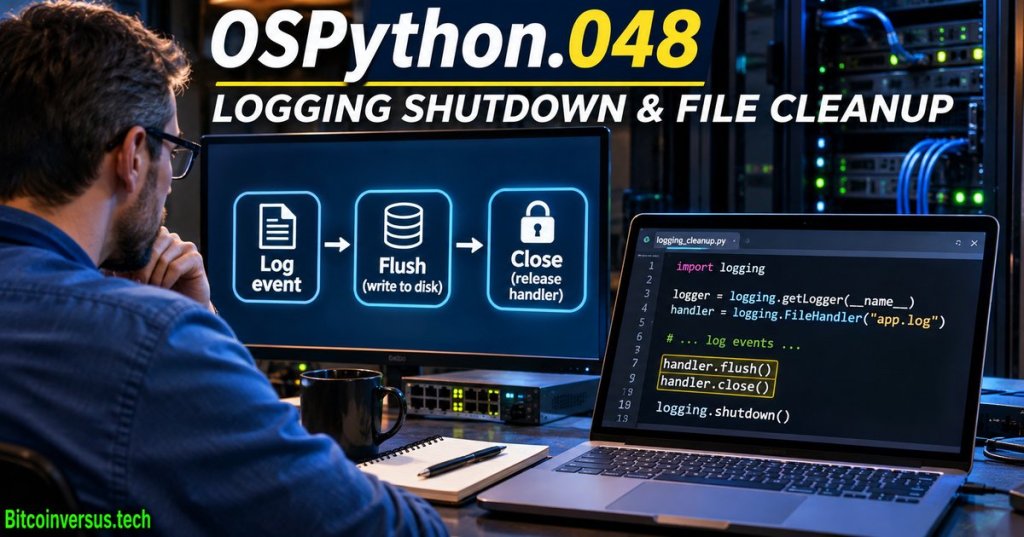
OSPython.048 follows the previous logger-propagation lesson with a practical operations question: who closes a file handler when an application ends or replaces its logging configuration? Python’s logging module normally handles interpreter exit automatically, but software that creates and removes handlers during a running process must manage those resources deliberately. OSPython.047 established where records travel; the new lesson addresses the destination’s lifecycle.
Corey Schafer, “Python Tutorial: Logging Basics — Logging to Files, Setting Levels, and Formatting,” March 15, 2017. The tutorial introduces file logging; final cleanup appears below. Credit: Corey Schafer / YouTube.
Python already registers orderly shutdown
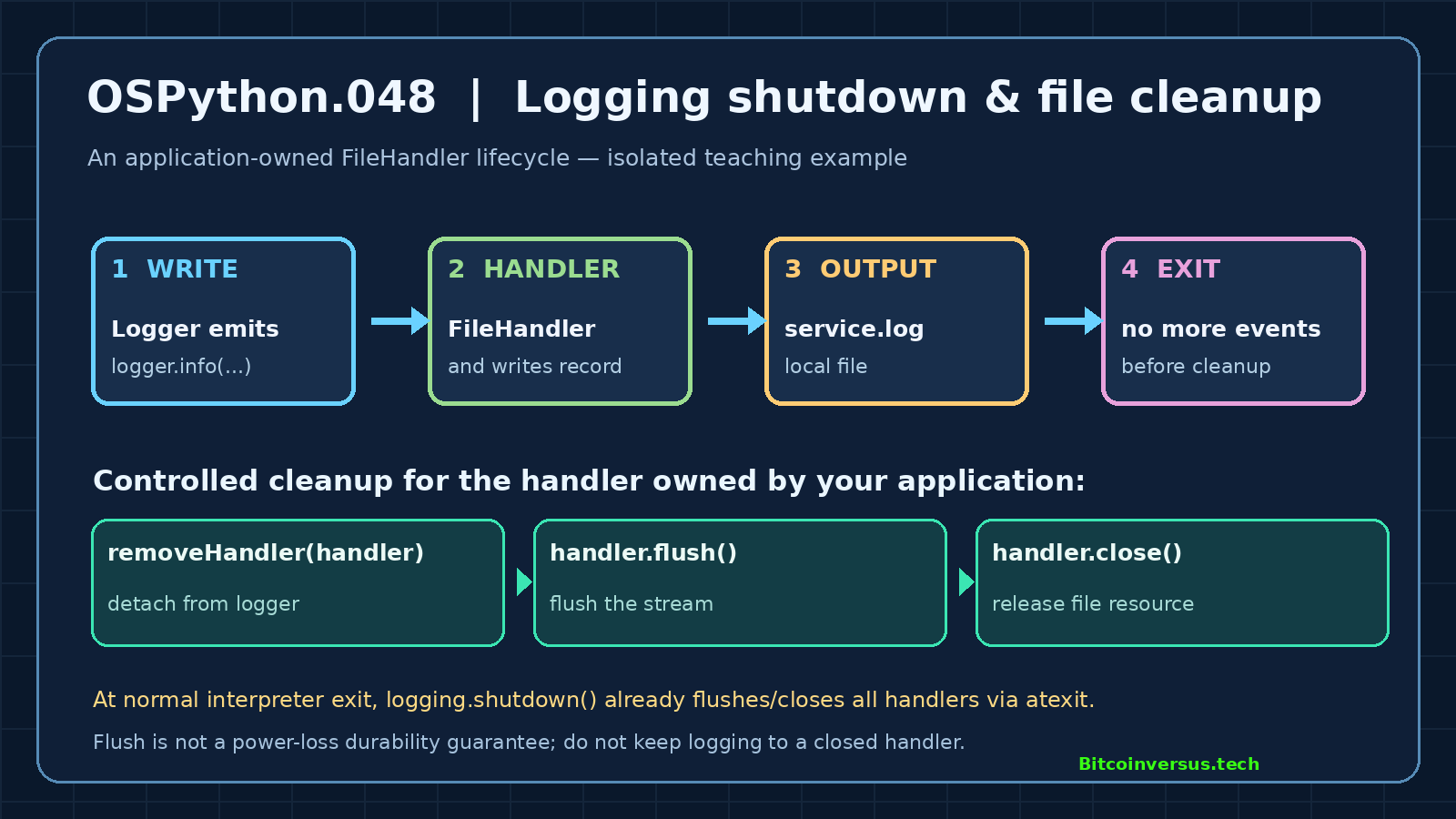
The official Python logging reference states that logging.shutdown() flushes and closes the logging system’s handlers. Importing logging registers the function with atexit, so ordinary interpreter shutdown generally needs no manual call. Logging after shutdown is unsupported. A service stopping a subsystem while the interpreter keeps running presents a different responsibility: release only handlers owned by that subsystem.
A FileHandler ordinarily opens a file in append mode and sends formatted messages to it. Its emit() behavior is inherited from StreamHandler. The handler reference describes an important edge case: a handler opened with mode "w" and closed during shutdown will not emit a subsequent record. Avoid depending on late logging from exit callbacks or destructors.
A small, reproducible cleanup lab
The following standard-library example owns a dedicated logger and file handler, avoids changing the root logger and uses a temporary directory. It intentionally removes the handler before flushing and closing it. Stop new writes before cleanup; coordinate concurrent producers.
import logging
from pathlib import Path
from tempfile import TemporaryDirectory

with TemporaryDirectory() as directory:
    path = Path(directory) / "service.log"
    logger = logging.getLogger("course.048.cleanup")
    logger.setLevel(logging.INFO)
    logger.propagate = False
    handler = logging.FileHandler(path, encoding="utf-8")
    handler.setFormatter(logging.Formatter("%(levelname)s %(message)s"))
    logger.addHandler(handler)
    try:
        logger.info("service started")
        logger.warning("graceful stop")
    finally:
        logger.removeHandler(handler)
        handler.flush()
        handler.close()
    print(path.read_text(encoding="utf-8"))
A local Python 3.13.5 run produced two expected lines, INFO service started and WARNING graceful stop, and verified the handler’s file stream was closed. The temporary file is deleted afterward. A separate logging.shutdown() call is unnecessary for the isolated test. OSPython.046 covers replacing the plain-text formatter with JSON output.
Flush is not the same as guaranteed durability
Flushing transfers application-side buffered data toward the operating system; it does not itself guarantee a disk write survives sudden power loss. Durability requires storage-specific controls beyond handler.flush(). The Python Logging Cookbook also cautions against separately opening the same log file through multiple handlers because concurrent writes and rotation can fail.
AI Programming Zone, “Python Logging Tutorial: How to Save Logs to a File (Step-by-Step),” April 2, 2026. The independent tutorial demonstrates file destinations, logging levels and formatting; it does not establish production durability guarantees. Credit: AI Programming Zone / YouTube.
Operational checks before deployment
For log rotation, confirm that the existing writer releases file resources before replacement; OSPython.030 covers rotation mechanics. If using queued delivery, stop or drain the queue listener before closing downstream handlers, as explained in OSPython.037. Apply a retention and redaction policy before storing diagnostic records: OSPython.041 reviews the exposure of credentials in logs. Confirm shutdown, restart, file permissions and post-rotation behavior in an authorized staging environment.
Conclusion: Routine interpreter exit already triggers Python’s logging shutdown, while an application-owned handler removed during runtime needs controlled detachment and closure. File cleanup is a resource-management step, not proof of durability or complete delivery in every failure mode.
Editor’s Note: Technical claims were cross-checked against the official Python 3 logging reference, handler documentation and Logging Cookbook. The isolated example was executed with Python 3.13.5; no production log destination was modified. The original photorealistic 1200 × 630 featured cover bears the neon-green Bitcoinversus.tech watermark, while the in-story workflow drawing is conceptual. YouTube listings establish video identity, but actual player playback and mobile layout require separate browser verification.

BitcoinVersus.Tech is volunteer-run and publishes independent technical education. An optional 5,000-satoshi donation supports research. Scan the original QR from a second screen with a compatible Bitcoin wallet; on the same phone, use a wallet that supports importing a saved QR image. Independently verify recipient 3C9o19EH5HSiwEPyCTmEKzxhNCbo2X6TTb and amount before sending. Bitcoin transfers are generally irreversible.
We volunteer daily to ensure the information on BitcoinVersus.Tech is Verifiably True. The lesson is educational and informational, not authorization to alter production systems, certified engineering advice, financial advice or investment advice.


Leave a Reply