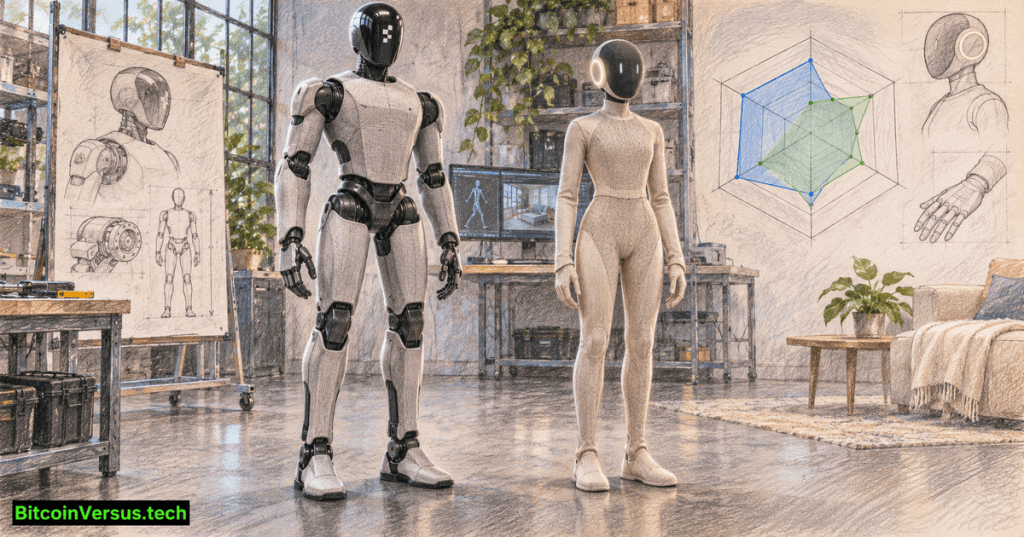
Figure 03 and 1X NEO are competing to make humanoid robots useful in ordinary environments, but their published hardware specifications reveal different priorities. Figure emphasizes reach, endurance, tactile manipulation and wireless fleet charging. 1X favors a much lighter body, tendon-driven movement and a consumer ordering model. A four-axis radar chart makes the differences visible without inventing missing specifications.
Two designs for homes and workplaces
Figure introduced its third-generation robot on October 9, 2025, with new palm cameras, fingertip tactile sensors, washable soft coverings and inductive charging. 1X announced consumer preorders for NEO on October 28, 2025, emphasizing household chores, a soft body and its proprietary tendon-driven actuation. Both launches describe engineering platforms, not results from a shared independent household trial.
Figure’s original launch and later Helix demonstrations: View the October 2025 launch post; the embedded 2026 update shows its newer control system.
Chart #38: Radar comparison of published specifications
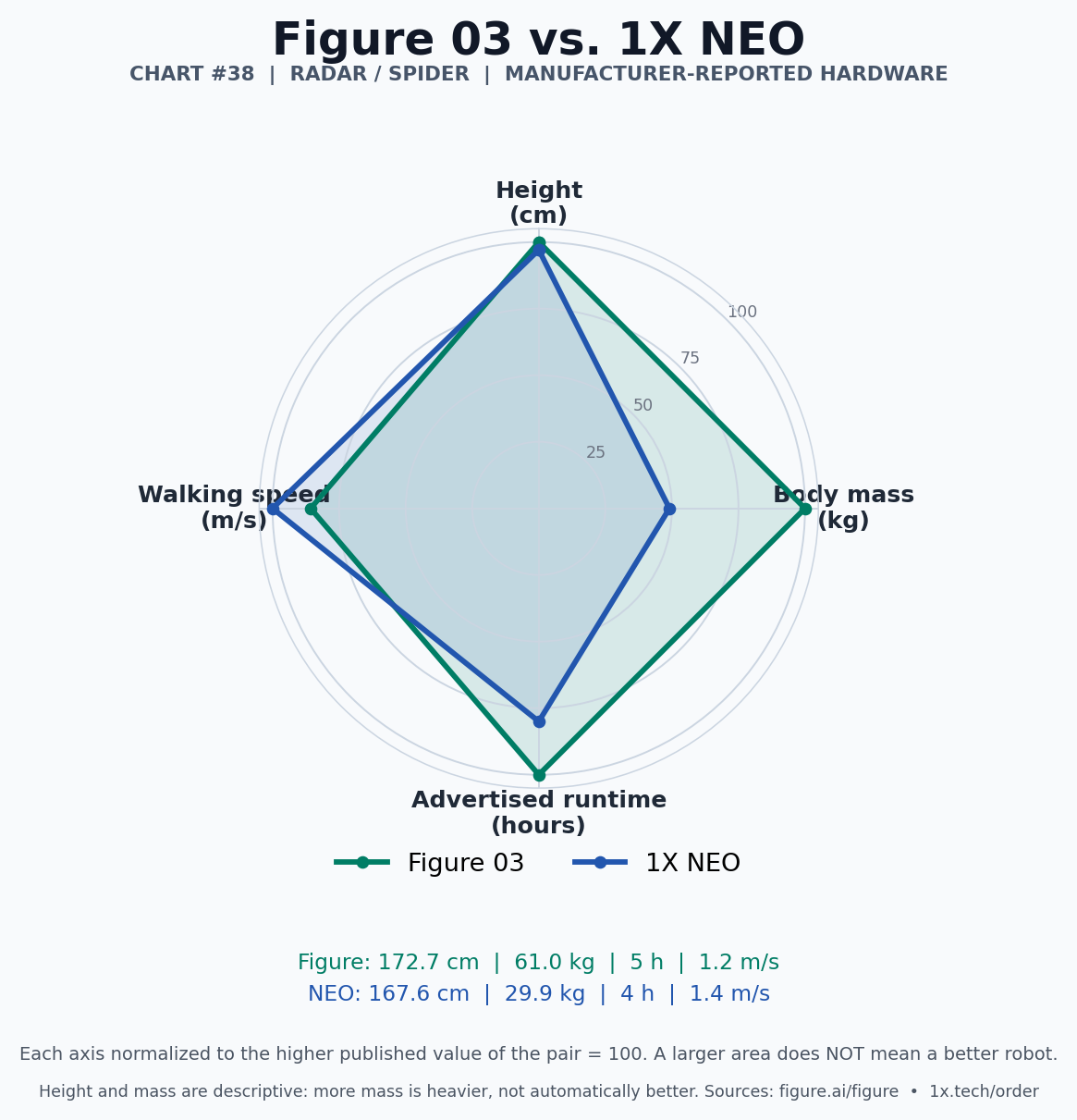
The official Figure 03 product sheet lists a 173-centimeter height, 61-kilogram mass, five-hour runtime, 1.2-meter-per-second speed and 20-kilogram payload. The 1X NEO order page lists a 168-centimeter height, approximately 30-kilogram mass, four-hour runtime and 1.4-meter-per-second walking speed. NEO weighs roughly half as much and lists a walking speed about 17% higher. Figure lists 25% more runtime than NEO, measured against NEO’s four-hour rating.
Mass makes the radar comparison especially easy to misread. A larger mass spoke means a heavier machine, not a stronger or safer one. Likewise, extra height can help with upper cabinets while reducing clearance under furniture. The plotted area is deliberately not an overall performance score.
The payload comparison needs a warning label
Figure lists a general 20-kilogram payload without an equivalent arm-specific test condition. 1X separately specifies an 18-pound arm payload, 55-pound carrying capacity and 154-pound lifting rating. Combining those categories into a single radar axis would manufacture a false winner. Neither company provides a standardized, independently measured household loading and battery endurance benchmark for the two products.
Where the specification sheets diverge
Figure’s engineering announcement highlights tactile fingertips sensitive to forces equivalent to roughly three grams, palm-mounted cameras, 10 Gbps millimeter-wave data offload and 2 kW inductive charging through the feet. NEO instead provides detailed listings for an 842 Wh battery, a Jetson Thor-based computing platform, covered joints, IP44 body protection and IP68 hand protection. IP68 for the hands does not mean the entire robot is waterproof.
1X also lists 22 degrees of freedom per hand on its order page. A separate July report on the company’s more advanced hands documents evolving dexterity hardware, so individual hand generations should not be silently mixed. Figure does not publish a directly comparable hand joint count on its primary product page.
1X’s official hand update on X: View the manufacturer’s demonstration.
Which hardware profile is better?
For an endurance-oriented fleet, Figure 03 has the stronger published runtime and a defined wireless charging architecture. For a lighter home assistant, NEO has the stronger mass and listed walking-speed profile, along with a public purchasing offer of $20,000 or $499 per month. NEO’s scheduled Expert Mode allows remote human assistance for tasks beyond its current autonomous abilities, an important operational and privacy consideration.
Hardware alone cannot settle household reliability, safe contact forces, task completion rate, maintenance cost or supervised versus unsupervised performance. Readers exploring the broader field can compare seven major humanoid platforms, follow Genesis AI’s Eno robotics program, or review Rockwell’s industrial automation expansion. The defensible verdict remains a split decision, pending common tests under identical conditions.


Leave a Reply