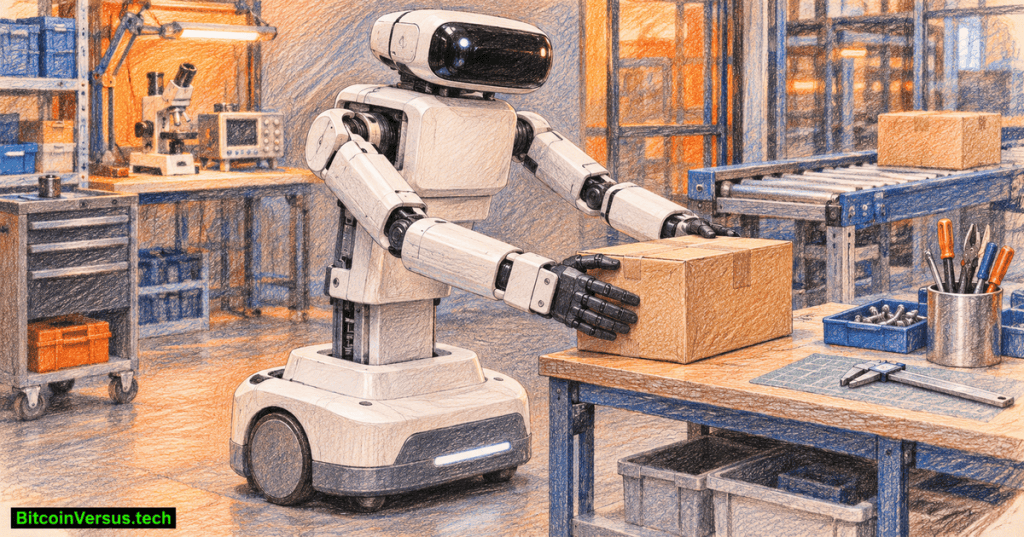
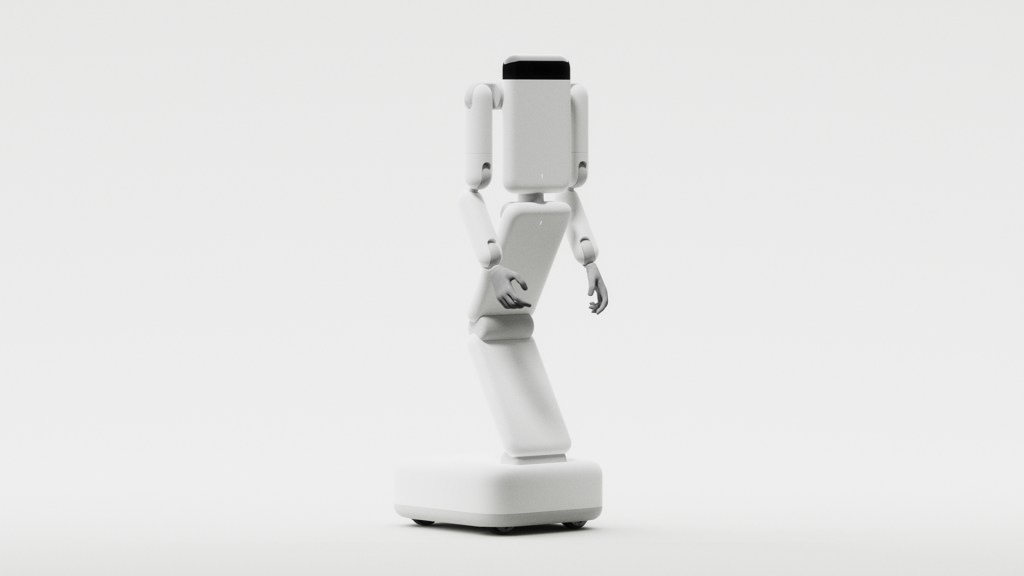
Genesis AI has raised $500 million in Series A financing to move its general-purpose Eno robot toward larger-scale production and commercial deployment. The Paris- and San Carlos-based company announced the round on November 17, 2026, at a $3.5 billion post-money valuation. Eno differs from familiar two-legged humanoids: it moves on wheels and uses an adjustable body, two articulated arms and dexterous hands to work with equipment built for people.
Premji Invest, Khosla Ventures and Eclipse co-led the round. Genesis identified Nvidia, AMD Ventures, Samsung Next and Ericsson among its participating investors. The valuation represents an investment transaction, not robot sales or annual revenue. A prior BitcoinVersus.Tech report examined Nvidia’s backing of Genesis AI; the new round puts a price and a larger financing package behind the company’s manufacturing ambitions.
Why build a humanoid robot without legs?
A factory or laboratory robot needs stable transport, useful reach and hands capable of working with real objects. Wheels avoid many of the balance and actuator demands of bipedal locomotion on level floors. Eno’s tower changes height and folds down for storage; its arms handle manipulation. The trade-off is reduced mobility around stairs and obstructed terrain, so early industrial deployments are a more realistic test than unrestricted household use.
Eno’s architecture also reflects a broader distinction across the sector: locomotion and manipulation are separate engineering bottlenecks. BitcoinVersus.Tech recently covered Boston Dynamics experimenting with wheeled Atlas mobility and NXP’s modular robotics development platform.
How Eno learns human hand movements
Genesis says its GENE robotics model is trained partly on activity recorded through sensor-equipped gloves and wearable cameras. Human hand motions and force measurements become examples for robotic hands engineered to closely match human proportions. In a November 17 report, TechCrunch described more than 100 workers contributing glove-based task data. Genesis also uses its Genesis World simulator for virtual training and evaluation before real-machine trials.
The objective is not simply recognizing a box or tool. A useful manipulator must estimate contact forces, control grip, deal with friction and complete sequential actions such as packaging, labeling or wire handling. A robot could identify a label perfectly yet still fail while peeling it from its backing.
The demonstrations expose the hard part
During an independent visit, TechCrunch watched off-the-shelf robotic arms pack and label boxes using Genesis software. The sequence ran, but a repeat included a dropped box and trouble removing an adhesive label. Crucially, Eno itself was not available for that demonstration. The evidence supports a promising manipulation system; it does not establish that the finished Eno robot already performs the same tasks continuously without human help.
Genesis told TechCrunch it had built about 30–40 Eno units and was piloting the machine with a small number of unnamed customers. Its current dexterous hands reportedly last only a few weeks under regular work before replacement. Hardware longevity, repair frequency and safety procedures could therefore affect cost far more than an impressive short video. The company says a U.S. contract manufacturer is expected to start mass-production work in 2027.
What the new money must prove
Genesis plans to expand training data, improve manipulation, recruit engineers and ramp Eno production. Manufacturing, logistics and laboratories are first on its roadmap, with hospitality, healthcare and homes later. Those are company plans, not verified large fleet deployments. Measurable results will depend on task-completion rates, uptime, intervention frequency, service costs and performance outside rehearsed environments.
The commercialization challenge extends beyond Genesis. BitcoinVersus.Tech’s survey of robots already performing industrial jobs separates active deployment from prototypes, while coverage of Boston Dynamics’ simpler-to-service Stretch design shows why maintenance matters. Eno’s next milestone is not another funding round: it is independent evidence that complex manipulation remains dependable over weeks and months.
Sources: Genesis AI financing announcement, November 17; TechCrunch site visit, November 17; Genesis Eno launch, June 16.


Leave a Reply