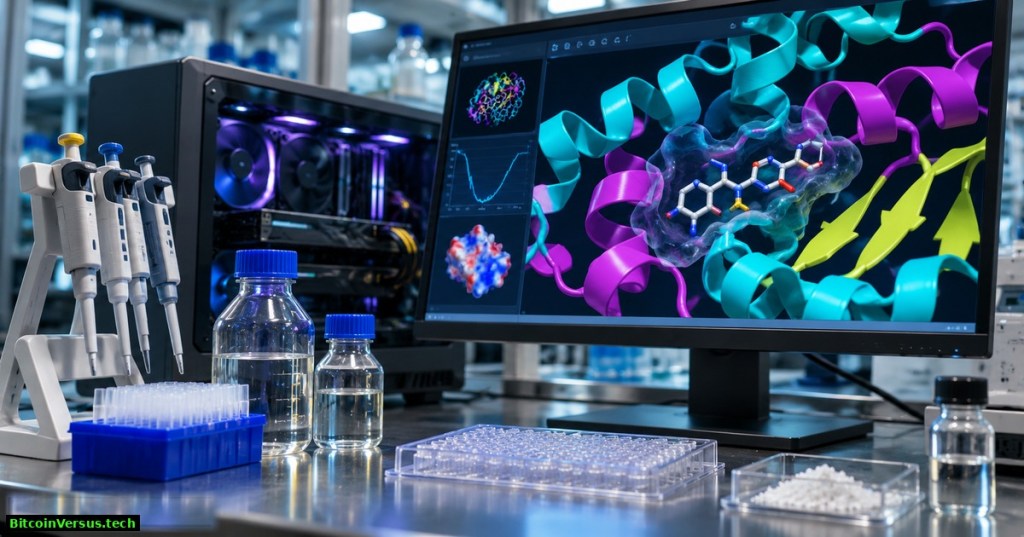
Biomolecular AI company Boltz raised $110 million in Series A funding to expand software that helps scientists predict molecular interactions and design possible drug candidates. The company announced the financing on November 18, 2026, with Bessemer Venture Partners leading the round and Andreessen Horowitz among the participating investors. Its strategy combines widely used open-source research models with commercial tools for pharmaceutical laboratories.
Boltz also reported partnerships with six of the world’s 20 largest pharmaceutical companies and a 50-fold increase in paid molecular-token usage since June. Both figures come from the company’s own announcement; neither measures approved medicines, independently verified revenue growth or clinical success. The funding will support additional computing capacity, training data and hiring.
Boltz CEO and co-founder Gabriele Corso presents molecular modeling and design in a QCMS seminar, recorded May 28 and published July 20, 2026. Earlier technical background, not footage of the November fundraising.
What does Boltz actually build?
The company grew from research associated with MIT’s Computer Science and Artificial Intelligence Laboratory. Boltz-1 predicts the three-dimensional arrangements of biomolecular complexes. Boltz-2 adds binding-affinity prediction, estimating how strongly a candidate compound may interact with a protein. BoltzGen addresses the separate task of proposing protein binders. Engineers can use those estimates to decide which molecules deserve further laboratory tests.
An independent development collaboration helps explain the technical foundation. In June 2025, MIT and Recursion introduced Boltz-2, reporting performance approaching some physics-based affinity methods in selected benchmarks at computational speeds up to 1,000 times faster. A benchmark speed comparison is not a measurement of the time needed to deliver a safe, effective medicine.
Boltz launched its commercial laboratory platform in January 2026 and introduced proprietary BoltzMol-1 and BoltzProt-1 models in June. According to lead investor Bessemer, the open models have surpassed five million downloads. Download counts demonstrate distribution, not validated experimental outcomes or distinct active users.
The business behind molecular tokens
Boltz charges for hosted inference and model access using molecular tokens. Its November announcement reported that the four-week rolling average of molecular tokens processed for paying customers reached roughly 50 times the June 16 baseline by November 8. The absolute token total was not disclosed, making it impossible to independently calculate subscription revenue, profitability or the actual number of paid experiments from the multiplier alone.
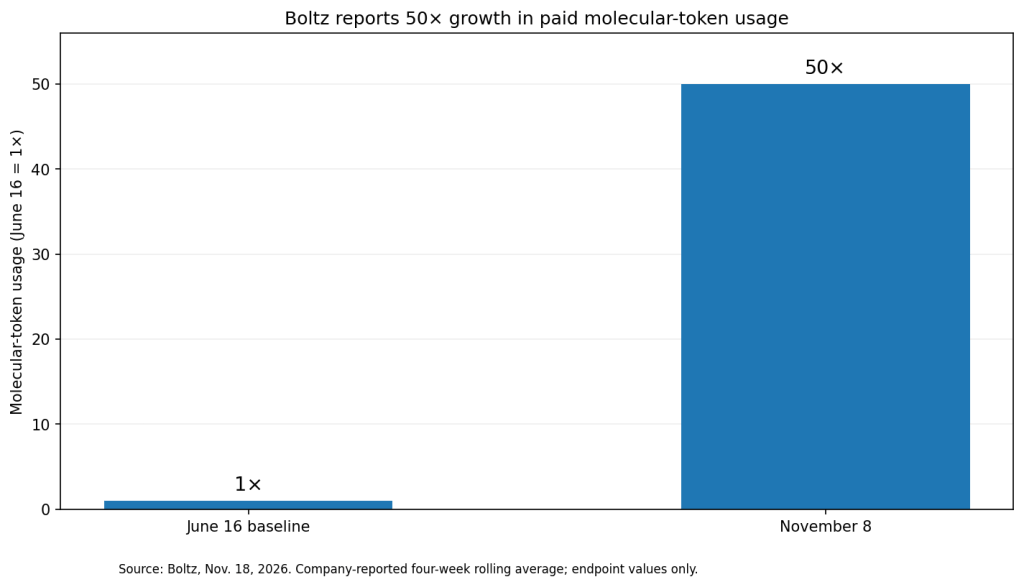
Our original vertical chart compares only the two reported endpoints. A line or slope chart could imply intermediate measurements that were not separately disclosed. The resulting growth signal is substantial, but it remains a company-reported operating metric rather than an audited financial series.
June 11, 2026 Discovery Engines interview with Boltz co-founder Gabriele Corso on open molecular models, Pfizer collaboration and the commercial business model. Archival interview, not a recording of the funding announcement.
From computer predictions to real laboratory results
Generating a promising candidate on a GPU is only an early step. A molecule must be synthesized, tested against its target, checked for selectivity and toxicity, and evaluated for behavior inside living systems. Clinical development takes further controlled studies. Commercial claims about faster discovery therefore require comparisons using equivalent targets, experimental protocols and success criteria.
The broader industry is building both computational and physical infrastructure. BitcoinVersus.Tech recently reported on El Capitan’s protein-structure predictions, PNNL’s planned autonomous biology laboratory, Opentrons’ laboratory-robotics expansion and AI-assisted research on experimental therapeutics. Computational screening and wet-lab verification serve complementary roles, not interchangeable ones.
Boltz says its platform is already used in collaborations involving Pfizer, GSK, Takeda and Bristol Myers Squibb. Agreements and model adoption are commercial milestones, but a validated drug developed by the platform has not been established in the fundraising disclosure. The important next evidence will be independently reproducible laboratory results, published candidate outcomes and eventually clinical progress.
Primary sources and further reading
- Boltz, November 18, 2026: $110 million Series A announcement and paid-token chart
- Bessemer Venture Partners, November 18, 2026: investment rationale, model adoption and platform details
- Recursion and MIT, June 6, 2025: open-source Boltz-2 research and benchmark context
- Public Boltz biomolecular interaction model repository
Editor’s Note: We volunteer daily to ensure the credibility of the information on our platform is Verifiably True. If you would like to support our work and the integrity of our research initiatives, scan the QR code below to donate 5,000 sats.

For mobile scanning, open the article on another display and scan the QR code with a Bitcoin wallet. Verify the recipient address 3C9o19EH5HSiwEPyCTmEKzxhNCbo2X6TTb before sending.
Disclaimer: BitcoinVersus.Tech publishes technology, science and business journalism for information only. Funding, model benchmarks and early drug discovery results do not establish clinical safety, efficacy or regulatory approval, and no financial or medical advice is provided.


Leave a Reply