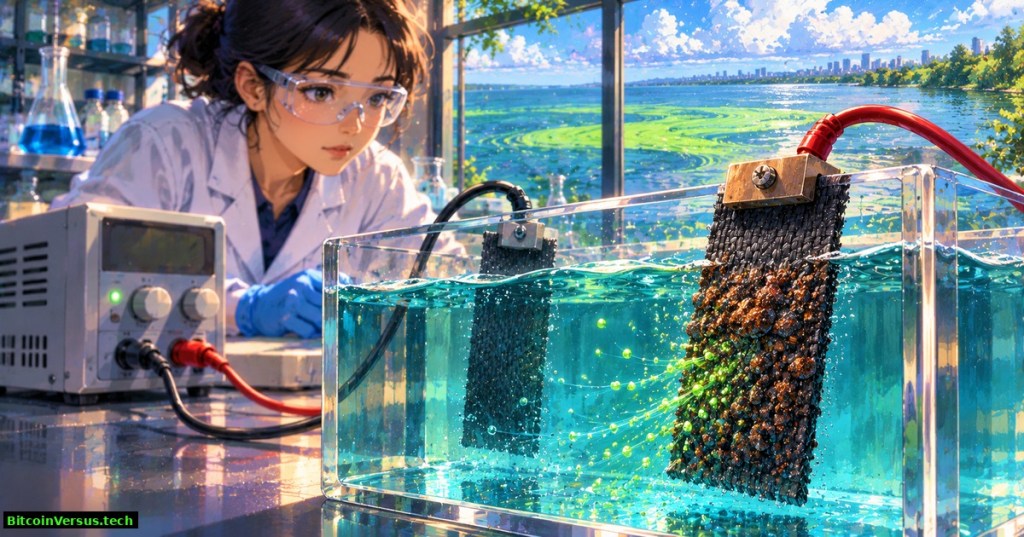
Researchers at Northwestern University and Argonne National Laboratory have developed an electrically controlled fabric that captured approximately 2.6 times as much phosphate as an unpowered comparison in laboratory tests. Their reusable material combines ordinary carbon cloth with magnetite nanoparticles, and a change in voltage helps release the collected nutrient for potential recovery.
Published November 18, 2026 in ACS ES&T Engineering, the research explores a dual problem. Excess phosphorus from fertilizer runoff can promote harmful algal blooms and deplete oxygen in waterways. Phosphate is also a finite, economically valuable fertilizer input. Recovering it rather than discarding it could eventually address pollution and resource supply together. Northwestern’s announcement describes a laboratory advance, not an installed municipal treatment system.
Northwestern University’s April 2022 video featuring professor Vinayak Dravid on earlier pollutant-capturing sponge research. The archival video explains the research group’s environmental work; it does not demonstrate the new 2026 carbon-cloth electrode.
A carbon cloth coated with iron oxide
Graduate researcher Kelly Matuszewski and collaborators cleaned conductive carbon fabric, then repeatedly dipped it into a suspension of magnetite nanoparticles. Magnetite, a form of iron oxide, provides sites that can attract phosphate. The cloth’s conductive fibers turn the resulting material into an electrode capable of participating in an electrically driven separation process.
In the team’s hybrid capacitive deionization experiment, applying 1.2 volts across the electrochemical cell increased phosphate capture by approximately 2.6-fold relative to the no-voltage control. Changing the electrical polarity encouraged phosphate release back into solution, creating a potential recovery stage. Unlike some conventional approaches, the release step did not require adding a chemical regenerant.
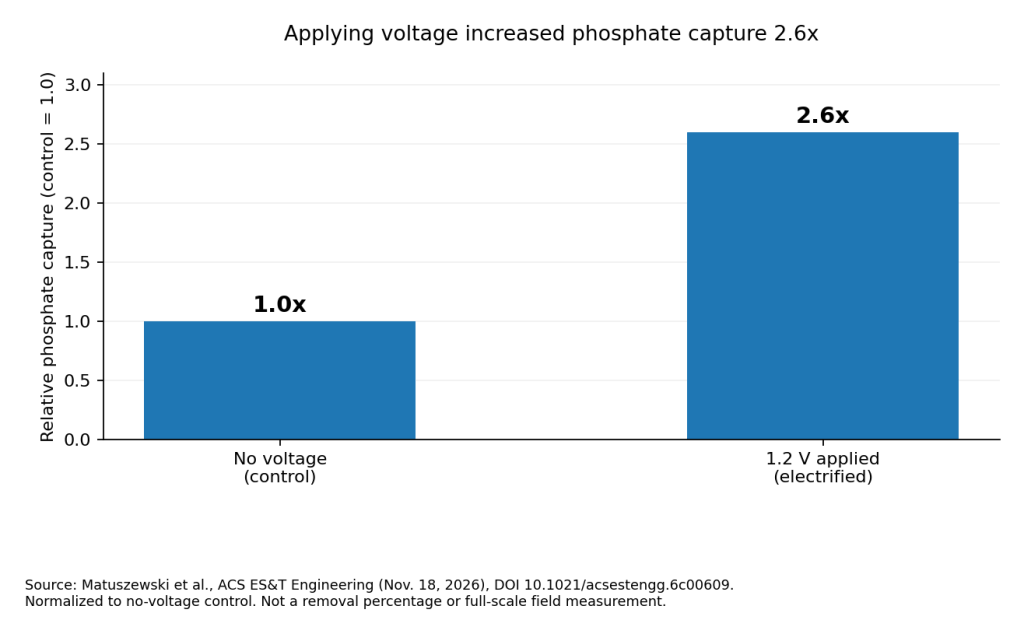
The 2.6-fold improvement is a measured relative comparison within the researchers’ experimental conditions. It does not mean the cloth removed 260% of phosphate, made water safe to drink, or operated 2.6 times faster. The published university summary does not establish a universal capture percentage, a plant-scale electricity requirement, or an operating cost per kilogram recovered.
Why wastewater plants might care
Traditional phosphate treatment can involve dosing water with iron or aluminum salts, followed by solid separation and sludge handling. Chemical consumption, pH changes, and waste disposal complicate treatment economics. An electrical capture-and-release cycle could offer more control over when nutrients are collected and concentrated, although actual efficiency will depend on water chemistry, electrode longevity, throughput, and the cost of electricity.
Related technologies are already exploring different ways to handle water scarcity and waste streams. BitcoinVersus.Tech previously reported advanced filtration for military water systems and desalination using AI data center waste heat. Our water-system engineering lesson examines the operational importance of flow, water quality, and treatment, while an earlier Army clean-water experiment illustrates another energy-for-water trade-off.
New York State Department of Environmental Conservation’s August 2024 program on harmful algal blooms and nutrient pollution. Environmental background; no endorsement or independent test of the new electrode.
The hard part comes after the laboratory
Real wastewater contains competing ions, organic material, suspended solids, and microorganisms. Their interactions may alter phosphate uptake, contaminate electrodes, or reduce efficiency after repeated cycles. Researchers still need to test actual wastewater matrices and determine how the cloth behaves under continuous flow, with realistic fouling and maintenance requirements.
The work also has commercial context. Northwestern disclosed that Matuszewski and Dravid are inventors on a provisional patent application related to the research. Dravid is a founder, equity holder, and board director of Coral Innovations, a company developing water-treatment technologies. Those connections do not invalidate the laboratory results, but independent engineering replication and transparent costs will matter before broad commercial claims can be evaluated.
For now, the most defensible conclusion is narrow and useful: a voltage-controlled, magnetite-coated fabric demonstrated stronger phosphate capture than an unpowered control and reversible release in laboratory experiments. Whether the approach can recover fertilizer economically while protecting waterways remains an open engineering question.
Primary sources and technical background
- Northwestern University, November 18, 2026: original research announcement
- Matuszewski et al., ACS ES&T Engineering: Voltage-Switchable Phosphate Recovery Using Magnetite-Coated Electrodes in Hybrid Capacitive Deionization
- Argonne National Laboratory publication record
- National Science Foundation, 2025: earlier reusable adsorbent research
- U.S. Environmental Protection Agency, nutrient pollution background
Editor’s Note: We volunteer daily to ensure the credibility of the information on our platform is Verifiably True. If you would like to support our work and the integrity of our research initiatives, scan the QR code below to donate 5,000 sats.

For mobile scanning, open the article on another display and scan the QR code with a Bitcoin wallet. Verify receiving address 3C9o19EH5HSiwEPyCTmEKzxhNCbo2X6TTb before sending.
BitcoinVersus.Tech publishes technology, science and financial journalism for informational purposes and does not provide professional environmental, financial, or engineering consulting advice.


Leave a Reply