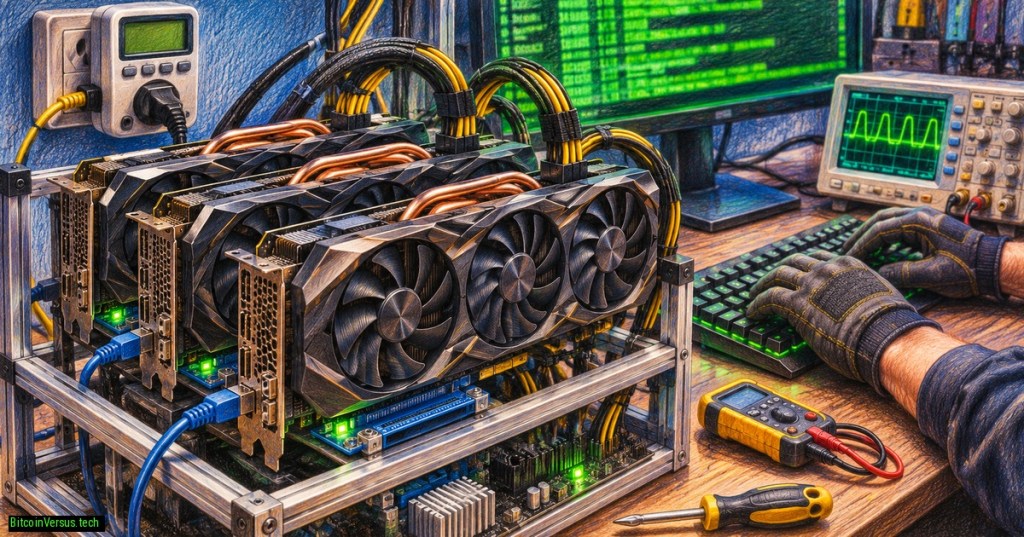
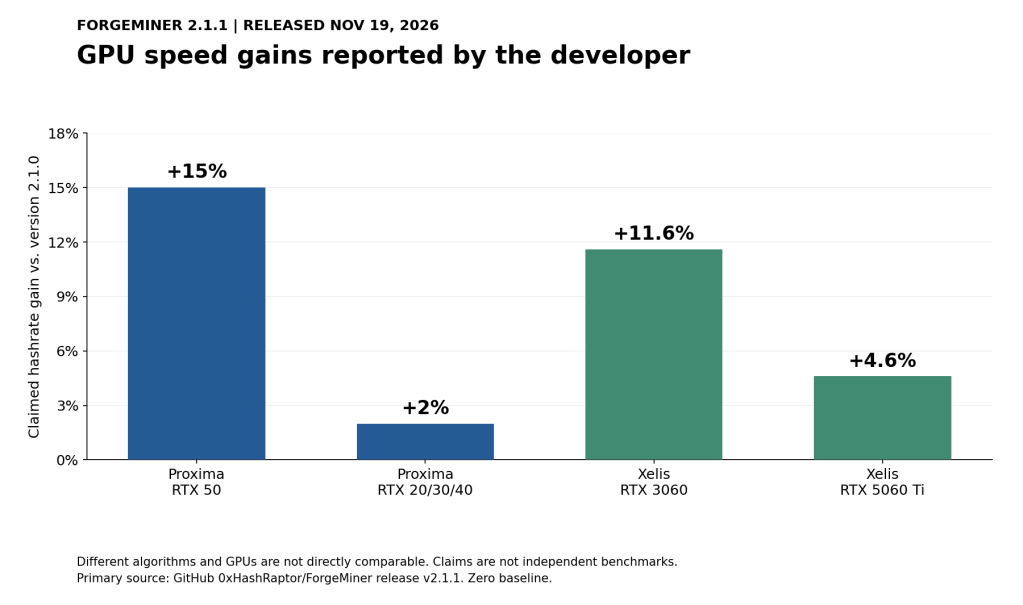
GPU mining software ForgeMiner has shipped two rapid updates aimed at keeping graphics cards productive during shifting pool workloads. Version 2.1.1, published November 19, 2026, reports 15% faster Proxima mining on NVIDIA RTX 50-series GPUs compared with version 2.1.0 running at the same clocks. The developer also reports Xelis improvements on selected GPUs, while an earlier update expanded support for Proxima and shortened reconnect delays. The numbers are developer claims, not BitcoinVersus.tech lab measurements.
Red Panda Mining’s December 2025 footage documents real Xelis GPU and CPU mining during an earlier network fork. Archival hardware context only; it does not test ForgeMiner 2.1.1.
Which GPUs get faster?
The release notes specify an approximately 2% Proxima improvement on RTX 20, 30 and 40 cards, and up to 1% on AMD GPUs for the job format used by most pools. Separate work scheduling is credited with another 1.5% to 2.8% on live pools. For pools using a longer job format, the developer reports 14% to 31% gains across cards. Those outcomes describe different test conditions; their percentages cannot simply be added to predict a single miner’s speed.
Xelis receives a separate tuning change. Reported hashrate rises 11.6% on the RTX 3060 and 4.6% on the RTX 5060 Ti, with the RTX 30 and 50 generations affected. RTX 20 and 40 Xelis performance is listed as unchanged. Faster share submission may also help pools that reject jobs after a narrow validity window, but no independently confirmed reduction in stale shares was provided.
A stable graph does not necessarily mean more mining
A Proxima pool can pause briefly between tasks. Earlier ForgeMiner monitoring apparently counted the idle interval when calculating displayed hashrate, making charts dip even when the GPU was hashing at its normal rate during active work. Version 2.1.1 reports the card’s active hashing speed while keeping the power measurement tied to actual draw. Operators should therefore compare accepted shares and watt-hours, not just a smoother HiveOS dashboard.
A Windows GPU whose clock falls between jobs may instead stay busy under the new scheduling logic. The developer observed about 6% more speed with 8% more board power on an RTX 4060 in that condition. Taken literally, 1.06 ÷ 1.08 is approximately 0.9815, implying 1.9% fewer hashes per watt. More hashrate does not guarantee higher efficiency or profit; electricity tariffs and the coin’s market value still matter.
A June 2026 independent Pearl mining setup tutorial from ПРО100 Майнинг illustrates GPU rigs and pool configuration using different mining software. Its income examples are historical and are not proof of ForgeMiner profitability.
Proxima support, voltage control and software risks
The preceding November 18 release introduced Proxima’s BLAKE2b-256 work, with NVIDIA GTX 10-series and later GPUs plus AMD RX 5000-series and later GPUs supported. It also reduced the first pool reconnection wait from three to five seconds to one second after an established connection drops. On Windows, RTX 20 through 50 cards received expanded voltage controls, although the developer explicitly tested only selected models.
Operators should use the official, versioned release and verify its SHA-256 checksum rather than trusting repackaged miner downloads. The RTX 50 series requires NVIDIA driver 580 or newer. Recovering a GPU after a failed tuning command, preserving a known-good image and checking accepted shares are more important than chasing an advertised peak. Our ForgeMiner recovery coverage explains earlier voltage and crash safeguards; SRBMiner’s latest tuning changes offer an alternative GPU-software baseline.
Bitcoin mining remains a different workload: modern Bitcoin uses dedicated SHA-256 ASICs, not these Proxima or Xelis GPU kernels. Our CMP 170HX hardware report and Team Black Miner review place GPU mining firmware in broader context. The engineering lesson is that kernel scheduling, pool handling and reporting methods can alter performance measurements without changing the silicon.
Primary sources and methodology
Sources: ForgeMiner 2.1.1, November 19, 2026; 2.1.0, November 18; 2.0.0, November 13; and the official project repository. Chart candidates considered were line, scatter and vertical bar; discrete release-to-release developer percentages favor zero-baseline vertical bars. All improvements represent disclosed conditions, not independent device measurements.
Editor’s Note: We volunteer daily to ensure the credibility of the information on this platform is Verifiably True. If you would like to support our work and help further secure the integrity of our research initiatives, please scan the QR code below to donate 5,000 sats.

Disclaimer: BitcoinVersus.tech provides independent technology journalism, not investment recommendations or electrical-safety certification. GPU overclocking, undervolting, custom mining software and unknown binaries can cause instability, equipment damage or data-security risks. Historical video examples do not establish current profitability. The featured cover is a conceptual colored-pencil illustration, not a photograph of the developer’s actual equipment.


Leave a Reply