STATS | Semiconductors. French semiconductor-materials maker Soitec reported €107 million in Edge & Cloud AI revenue for its second fiscal quarter ended September 30, 2026, more than double the €52 million reported a year earlier. The company announced the results on November 18, attributing much of the increase to Photonics-SOI substrates used in optical connections for AI data centers.
Soitec’s primary earnings release reports 105% growth on a reported basis and 109% at constant currency and scope. The distinction matters because currency translation affects comparisons between fiscal periods. Total quarterly company revenue rose to €204 million from €139 million, a reported 46% gain.
How much did AI-related materials grow?
Using the rounded figures displayed in the company’s end-market table, the change equals (€107 million − €52 million) ÷ €52 million × 100 = 105.77%. The calculated figure differs slightly from the reported 105% because the published euro amounts are rounded. The absolute increase using those displayed values is €55 million.
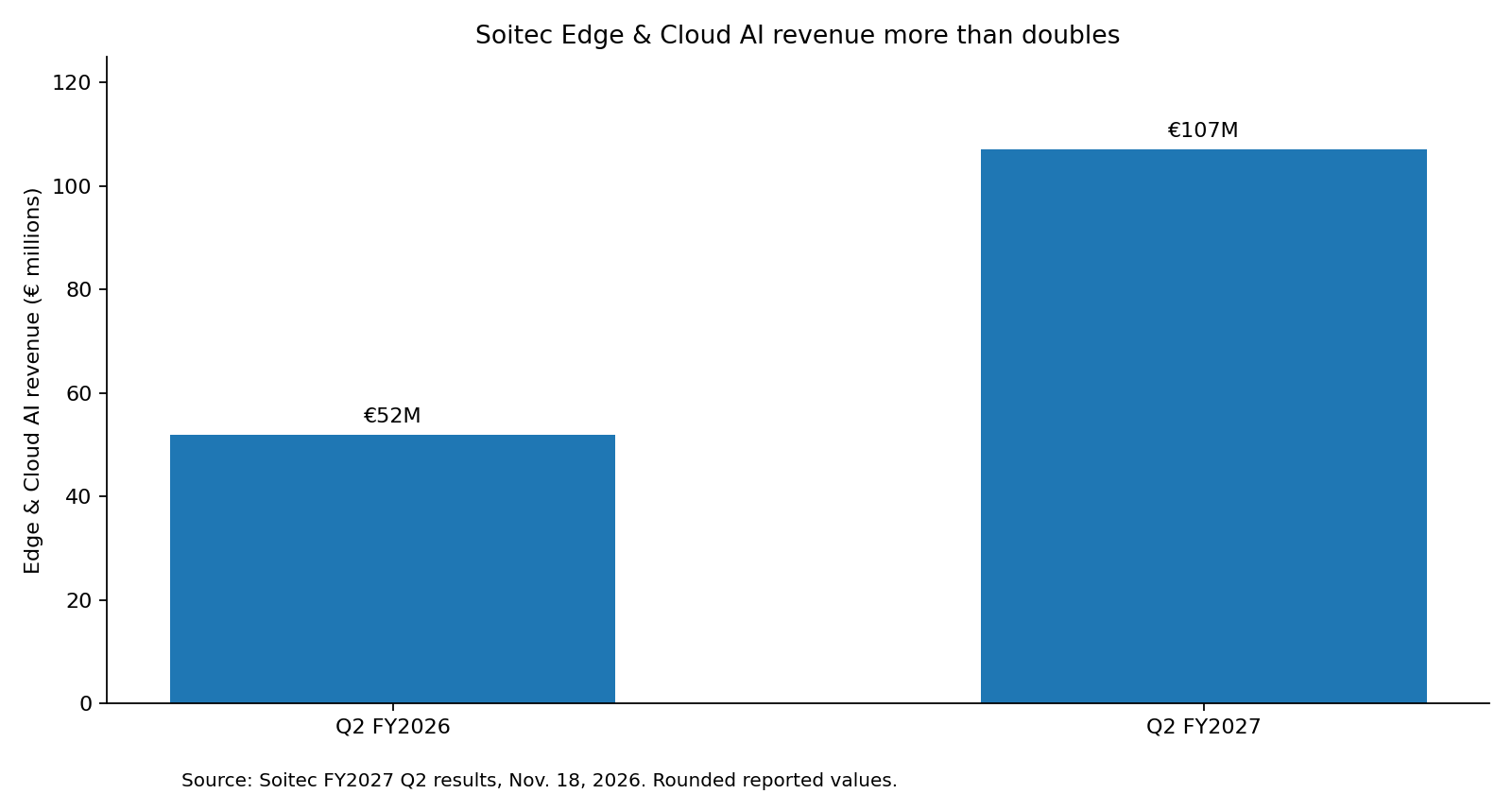
The chart compares the corresponding second fiscal quarters, with euro millions on the vertical axis. It avoids combining incompatible currencies or treating annual percentage growth as a physical performance measurement. Among alternatives, a line chart would imply continuity across missing periods, while a pie chart would obscure the year-over-year comparison.
Why silicon photonics matters
Photonics-SOI is an engineered silicon-on-insulator wafer substrate designed for optical components. Optical interconnects carry information as light rather than relying exclusively on copper electrical traces. In high-density GPU clusters, optical links can support bandwidth and reach requirements while reducing some interconnect power constraints. Soitec supplies substrate materials, not complete transceivers or finished GPU systems.
The company disclosed approximately $75 million in quarterly Photonics-SOI revenue and approximately $125 million for the fiscal first half, compared with around $50 million a year earlier. The dollar-denominated Photonics-SOI product figure is distinct from the euro-denominated Edge & Cloud AI end-market figure. Adding the two would double count overlapping sales and mix currencies.
Soitec is expanding capacity in France and Singapore. It also reported approximately $1.2 billion in customer commitments through capacity-reservation agreements backed by deposits. Those commitments represent future contractual demand, not revenue recognized in the quarter or delivered wafer volumes. Its forecast of Photonics-SOI revenue above $300 million for fiscal 2027 remains guidance.
Where the results fit in AI infrastructure
AI clusters increasingly require coordinated advances in processors, memory, optics, cooling and electrical distribution. Related BitcoinVersus.Tech reporting has examined 1.6 Tb/s optical modules, Arista networking revenue, Cisco’s AI infrastructure outlook, and NVIDIA’s Data Center sales. Those figures describe different businesses and cannot be aggregated as one market total.
Soitec’s first-half gross profit rose to €106 million from €58 million. Management attributed the improvement partly to higher volumes and favorable mix, but also to lower depreciation after extending equipment useful lives from eight to ten years. The accounting change limits any simple interpretation of the margin improvement as purely operational efficiency.
Limitations: Revenue does not reveal wafer count, transceiver throughput, manufacturing yield or deployed AI data-center capacity. Forecasts and reservation agreements are not completed sales. The featured illustration is conceptual. Social posts provide historical technology context rather than proof of the November financial figures.
Primary source: Soitec fiscal Q2 2027 results, November 18, 2026. Editor’s note: the chart uses rounded reported values; calculations are independently reproducible. Financial information is not investment advice. Support independent technical journalism through the site’s donation page.


Leave a Reply