
A cryptocurrency mining software update is giving multi-GPU rigs a new way to handle AI jobs without suspending every card. Keryx miner 0.6.1, released November 8, 2026, can pause the GPU serving an inference request while the other graphics cards keep mining. A November 11 follow-up, version 0.6.2, also added encrypted connections to compatible mining pools.
Keryx operates a different network from Bitcoin. Its Proof-of-Model system requires GPUs to hold AI model weights in video memory and uses those weights in mining work. The model can also answer network inference requests. Neither release turns NVIDIA GPUs into competitive Bitcoin SHA-256 ASICs, nor does running an AI model automatically mean the work earns enough revenue to cover electricity.
A June 2026 mining overview explains Keryx’s Proof-of-Model design, GPU memory requirements and the network’s approach to AI inference.
One AI request no longer stops the whole rig
Earlier software could interrupt mining across a multi-card setup when AI inference arrived. Version 0.6.1 changes scheduling so only the serving GPU pauses its model-walk computation. If another card remains capable of holding the required model, a CUDA fault on one GPU can also be isolated without bringing down the entire mining process.
Such isolation matters to operators who measure utilization card by card. A rig with several graphics cards has more useful remaining capacity when one card receives an AI task. Actual improvement depends on how often inference arrives, model size, workload duration and hardware configuration. The release does not establish a measured increase in whole-rig profit.
Keryx Labs described its mining approach in a November 18 statement, emphasizing that GPUs perform model-weight work and can provide AI inference through the same hardware.
RTX 3090 test shows a faster mining kernel
The developer’s RTX 3090 benchmark records a change from 2.13 to 2.72 million Proof-of-Model attempts per second after a lock-step CUDA optimization. The calculated gain is 27.7%. Keryx separately describes overall performance as approximately 40% better than version 0.6.0 under its developer testing; neither claim has been independently reproduced here.
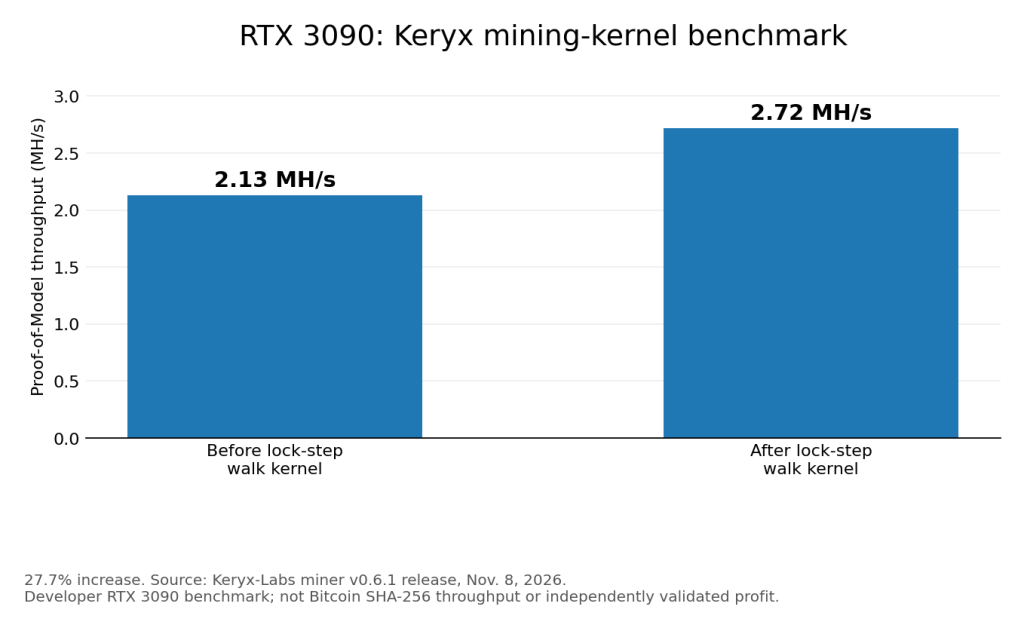
The implementation groups work across GPU execution lanes and reads model weights more contiguously, reducing overhead. Performance could vary on other NVIDIA generations, with different models or when inference interrupts mining. BitcoinVersus.Tech has separately examined ForgeMiner’s RTX 50 claims and a modified 80 GB mining GPU, neither of which uses comparable benchmark units.
The follow-up adds safer pool connections
Keryx miner 0.6.2 supports TLS-encrypted Stratum connections, including certificate validation through public certificate authorities and optional private certificate files. Plain TCP pool connections remain possible but produce an unencrypted-connection warning. The update also lets a memory-limited GPU fall back to a smaller previously downloaded model tier, preserving operation where compatible.
A July 2026 HiveOS walkthrough shows an RTX 3090 mining setup, including worker configuration, wallet setup, pool connections and software updates.
Those details distinguish Keryx from traditional GPU mining and from Bitcoin ASIC facilities. Our earlier reporting covers dual-algorithm GPU software and the different hardware requirements of mining and cloud computing. Operators considering Keryx still need to assess GPU memory, pool compatibility, energy use, exchange liquidity and the reliability of paid inference demand.
The technical advance is more targeted than an AI-mining revolution: one GPU can serve an AI request while the remaining cards continue their mining work, and pool communication now has an encrypted option. Independent multi-rig testing will determine how much productive capacity is preserved under sustained demand.
Sources
- Keryx-Labs original miner 0.6.1 release, November 8, 2026
- Keryx-Labs miner 0.6.2, November 11, 2026
- Official Keryx miner documentation and GPU model tiers
- Keryx protocol technical overview
- ASIC.tools, November 2026, independent release analysis
Editor’s Note: We volunteer daily to ensure the credibility of the information on our platform is Verifiably True. If you would like to support our work and the integrity of our research initiatives, scan the QR code below to donate 5,000 sats.

For mobile scanning, open the article on another display and scan the QR code using a Bitcoin wallet. Verify the receiving address 3C9o19EH5HSiwEPyCTmEKzxhNCbo2X6TTb before sending.
BitcoinVersus.Tech provides Bitcoin mining, hardware and technology journalism for informational purposes, not financial, investment or professional engineering advice.


Leave a Reply