
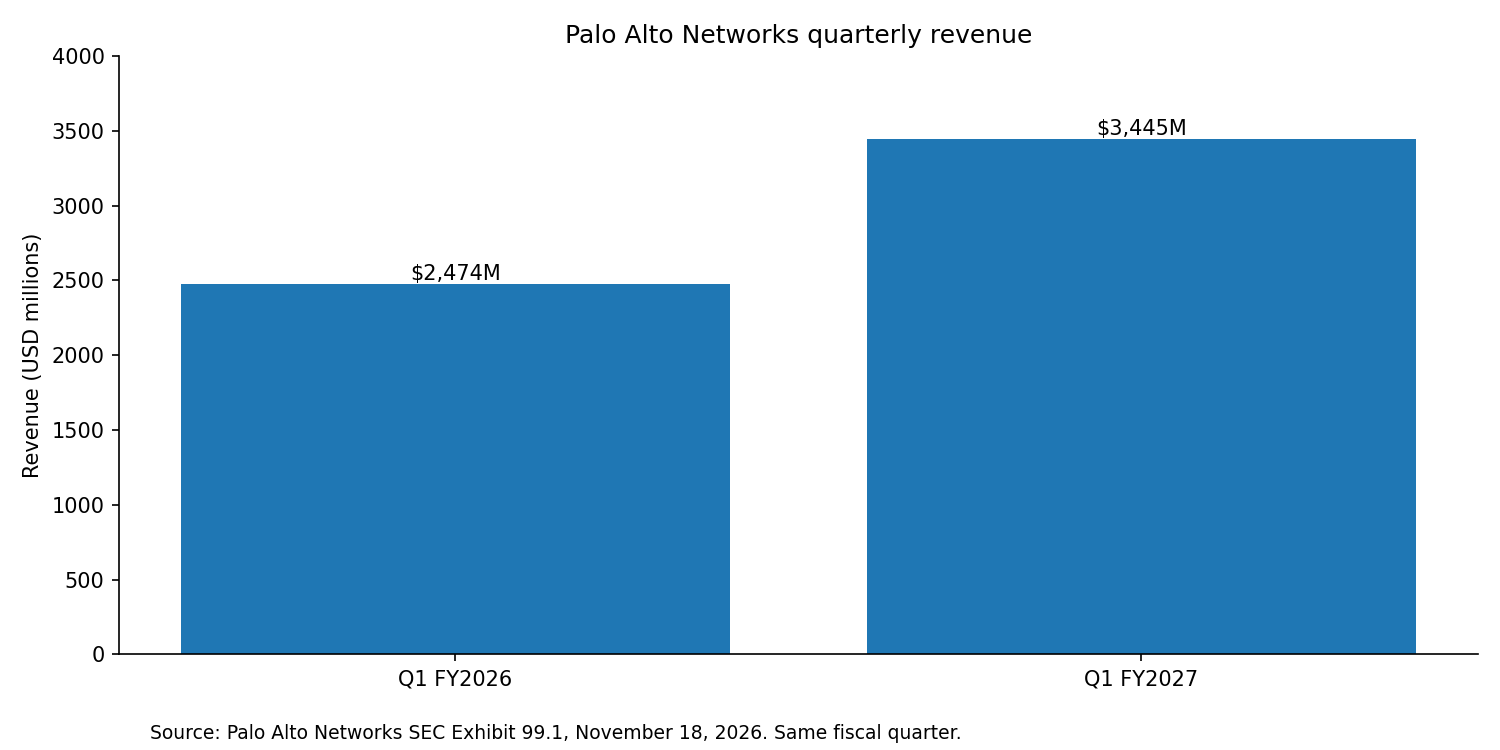
STATS | Cybersecurity. Palo Alto Networks reported $3.445 billion in revenue for its fiscal first quarter ended October 31, 2026, up 39% from $2.474 billion a year earlier. Its November 18 earnings release also showed next-generation security annual recurring revenue of $9.73 billion, an increase of 66%. Demand for security subscriptions and AI-related protection is expanding, but reported profitability tells a more complicated story.
The company’s SEC-filed financial tables show $595 million in product revenue versus $434 million a year earlier, and $2.850 billion in subscription and support revenue versus $2.040 billion. Combined revenue rose $971 million. The calculation ($3,445M − $2,474M) ÷ $2,474M × 100 equals 39.25%, consistent with the reported 39% rounded growth rate.
Cybersecurity revenue grows, but operating income falls
GAAP operating income fell from $309 million to $96 million. That is a decline of $213 million, or approximately 68.9%, despite higher sales. Operating margin decreased from about 12.5% to 2.8%. Non-GAAP operating income rose from $746 million to $1.059 billion, but the adjusted figure excludes substantial costs, including share-based compensation and acquisition-related expenses. Presenting only the adjusted profit would obscure the divergence.
Why recurring security contracts matter
The $9.73 billion next-generation security ARR figure measures annualized allocated revenue from active qualifying contracts as of October 31. It is not revenue recognized during the three-month quarter, and it cannot be added to the $3.445 billion quarterly total. Remaining performance obligations increased 35% to $21.0 billion, representing contracted future obligations rather than cash collected or current-period revenue.
Security platforms increasingly cover cloud workloads, network traffic, endpoint telemetry, machine identities and autonomous agents. AI agents can execute tools and access sensitive systems, creating new identity and policy-enforcement problems. Palo Alto Networks’ Prisma AIRS portfolio targets risks such as prompt injection, malicious tool use and insecure agent behavior, although product claims require deployment-specific validation.
Where the growth is coming from
Subscription and support sales grew by $810 million, accounting for approximately 83.4% of the company’s $971 million total quarterly revenue increase. Product sales grew by $161 million. The recurring-services concentration helps explain why investors follow contract metrics, but subscriptions can also entail ongoing cloud, support and customer-acquisition costs. The company disclosed GAAP research and development expenses of $798 million versus $528 million a year earlier.
Related BitcoinVersus.Tech coverage includes Palo Alto’s proposed Applied Compute acquisition, continuous AI security testing, GlobalProtect exploitation risks, and Anthropic’s software security scanner. Those stories cover different security mechanisms, not comparable financial datasets.
What remains uncertain
Management forecasts $14.52 billion to $14.57 billion in fiscal 2027 revenue, a projection rather than realized sales. The company also announced an intention to acquire Applied Compute; a proposed acquisition is not a completed integration. Acquisition costs, dilution, competitive pricing, cloud infrastructure expenses and evolving AI threats can influence results. Revenue growth alone cannot establish that customers are safer or that security products prevent every attack.
Editor’s note: The quarterly figures are unaudited company-reported observations released November 18, 2026. The two embedded videos provide historical product demonstrations, not verification of the earnings release. The featured cover is original conceptual artwork. Primary source: Palo Alto Networks SEC Exhibit 99.1. Financial information is not investment advice.


Leave a Reply