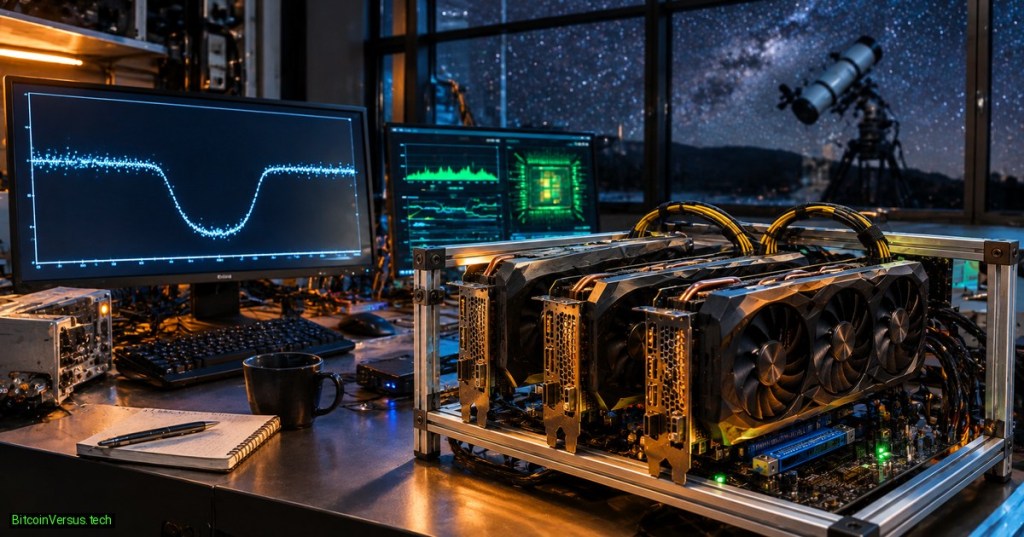
A newly launched cryptocurrency is trying to make graphics-card mining serve astronomy research. NEB, or Neural Engine Byte, began its main network on November 18, 2026, at 14:00 UTC, using small neural networks trained against exoplanet signals associated with NASA’s Kepler and TESS missions. A November 19 software release adds an optional GPU acceleration method. The project’s ambitious scientific claims are developer assertions, not a finding that NASA operates, endorses or independently validated the blockchain.
NASA Goddard’s original explanation of the TESS satellite and planetary transit detection. Archival mission footage, not a demonstration of NEB.
How astronomy data enters a mining ticket
Instead of Bitcoin’s repeated SHA-256 hashing, NEB derives a mining ticket from a deterministic neural-network calculation. The chain fixes the model, weights and public input dataset; a nonce selects 16 samples. The software evaluates clipped gradient contributions, combines them into a digest and hashes the result with BLAKE3. A sufficiently low ticket can qualify as a block or pool share. Network nodes replay the reference computation to validate the result.
The two main-network models classify different types of brightness variations. Kepler data is used to distinguish planet candidates from false positives, while TESS signals are sorted into eclipses and noise, according to the November 17 mainnet update. Earlier promotional descriptions involving medical retinal scans refer to a previous test network, not the newly launched mainnet.
The faster GPU kernel comes with a technical distinction
NEB 1.0.2 lets NVIDIA miners enable --gpu-kernel table. On each new model state, the CPU calculates a gradient row for every input sample and uploads the resulting table. Subsequent GPU attempts read and combine 16 precomputed rows before calculating a ticket. The expensive forward and backward passes therefore happen once per sample and model state, rather than afresh for every nonce.
The developer says all tickets remain bit-for-bit identical to the reference, with self-tests, periodic checks and fallback if a GPU disagrees. The optimization does not change consensus rules, but it complicates the slogan that every attempted hash performs entirely fresh scientific training. It also means a higher reported attempt rate cannot be equated directly with proportional additional neural-network learning.
NASA Ames’ official retrospective on the Kepler mission. Footage establishes the scientific dataset’s origin, not independent verification of NEB’s model outputs.
A 95% simulation needs a baseline
The project README reports approximately 95% simulated TESS classification accuracy after 3,000 blocks on 1,860 held-out signals, with roughly nine in ten eclipses identified. Yet 86.6% of the evaluation signals are noise. A trivial predictor that always selects noise would already score 86.6% accuracy, making the claimed improvement about 8.4 percentage points. The result is meaningful only alongside recall, false positives, dataset independence and replication.
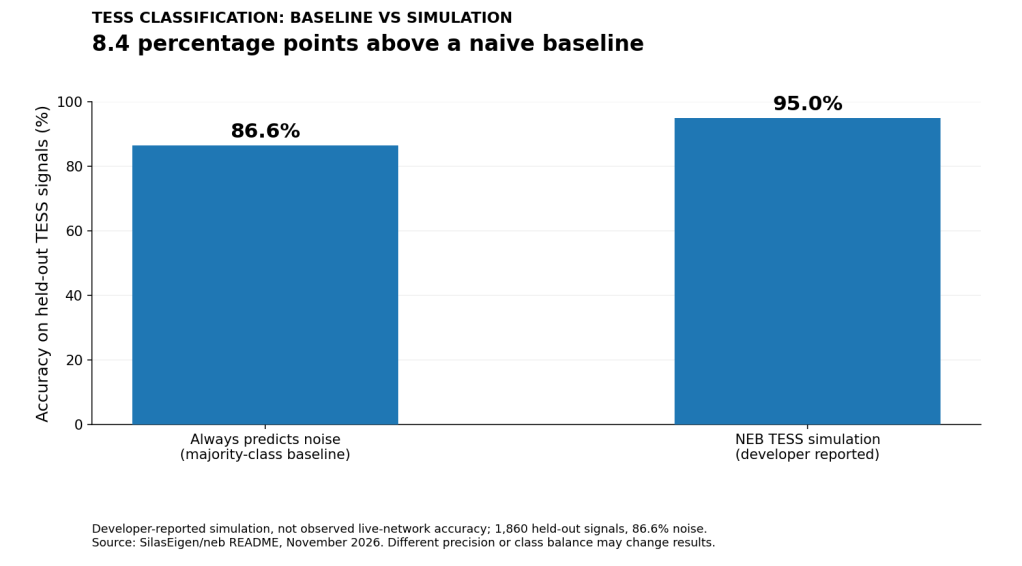
The project also reports 90.8% Kepler accuracy under a separate simulation. Those figures involve different datasets and cannot be treated as a head-to-head GPU benchmark. No comparable independently reproduced live-network accuracy measurements were available in the cited release documentation.
What miners should verify before trying it
The official GPU miner requires an NVIDIA card with compute capability 7.5 or later and a CUDA-compatible driver version 580 or newer. NEB offers CPU mining, Windows and Linux packages, and HiveOS integration. Its release provides signed checksum manifests, which should be verified before running a new executable. The optional table kernel is disabled by default, and operators should complete the built-in self-test before selecting it.
The network is young, its token economics and security have not been established by independent long-duration studies, and experimental performance is not a profitability forecast. Our Bitcoin mining versus cloud computing analysis explains differences in compute workloads, while GPU-based AI mining experiments examine another emerging approach. The ForgeMiner benchmark report covers conventional GPU kernel optimization, and our hashrate and difficulty primer explains why more attempts do not ensure higher earnings.
Primary sources and reporting boundaries
Sources: NEB version 1.0.2, November 19; 1.0.1, November 17; mining engine specification; README and simulation figures; NASA TESS mission. Chart candidates included line, scatter and vertical bars; a zero-baseline vertical comparison best represents two disclosed percentages without fabricating a time series. All network and model performance claims remain preliminary.
Editor’s Note: We volunteer daily to ensure the credibility of the information on this platform is Verifiably True. If you would like to support our work and help further secure the integrity of our research initiatives, please scan the QR code below to donate 5,000 sats.

Disclaimer: BitcoinVersus.tech reports technical developments for education, not financial or cybersecurity certification. Mining revenue, token prices and experimental neural-network claims are uncertain. Download software only from authenticated official sources, verify signatures and restore points, and do not treat research simulations as live scientific validation. The featured photorealistic cover is original conceptual artwork, not photography from the NEB project or NASA.


Leave a Reply