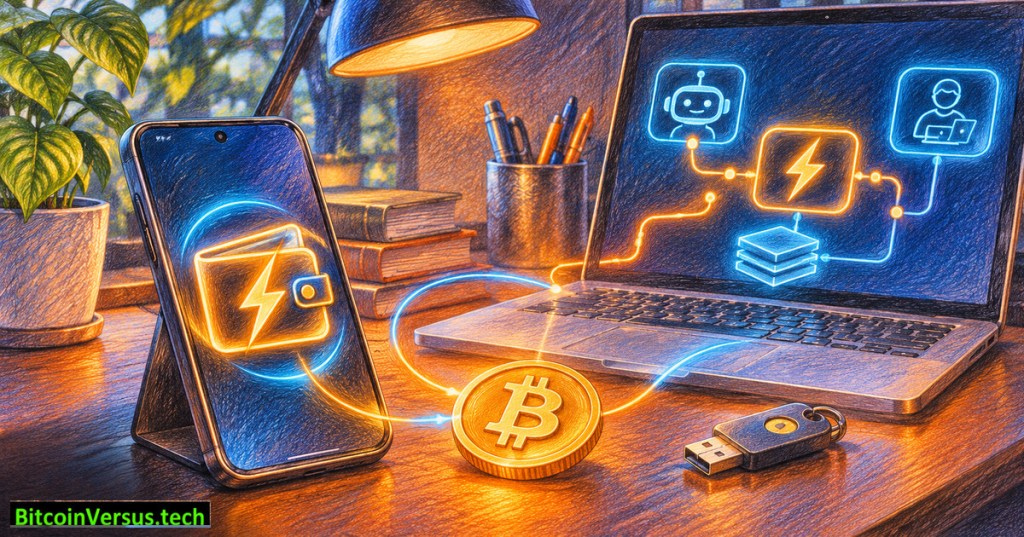
Bitcoin payments no longer require every app developer to operate a Lightning node. Lightning Labs opened its Wavelength software toolkit to the Bitcoin mainnet on October 23, 2026, letting developers create self-custodial wallets that send and receive Lightning payments without managing channels or sourcing inbound liquidity. Bitcoin Optech highlighted the mainnet alpha in its November 20 software roundup.
Wavelength is intended for ordinary applications as well as autonomous software agents. Developers gain a payment interface while users retain their signing keys and a path to reclaim bitcoin on-chain. The trade-off is dependence on a coordination service and a still-experimental wallet design.
Official Lightning Labs demonstration, published November 4, 2026, showing Wavelength’s built-in Model Context Protocol interface. The clip demonstrates wallet commands, not an independent reliability test.
How the Bitcoin wallet works
Instead of opening an individual Lightning channel for every user, Wavelength uses an Ark-like off-chain settlement system. A coordinating service organizes transfers involving virtual transaction outputs, or VTXOs. The wallet can exchange value through the Lightning Network using integrated swapping infrastructure, while its owner controls the keys needed for a unilateral exit back to Bitcoin’s base layer.
The design does not make Lightning channels disappear from the wider network; the integration abstracts channel and liquidity management away from the application. It also differs from a conventional custodial wallet: Lightning Labs says its coordinator cannot unilaterally spend users’ funds.
Three numbers define the initial rollout
Mainnet accounts are currently limited to 300,000 satoshis, and individual VTXOs to 50,000 satoshis. For Lightning payments, the company lists a 0.25% service fee on sending and receiving, plus ordinary Lightning routing charges. At that percentage, a 10,000-satoshi payment corresponds to a 25-satoshi service fee on one payment direction, before routing costs and any rounding rules.
Deposits or withdrawals involving the Bitcoin blockchain may also incur network and service fees. The SDK offers fee estimates before a payment, but quoted costs are not a guarantee against later fee changes. Those limitations matter more for frequent micropayments than for occasional transactions.
Recovery requires understanding the two-week cycle
Because Ark-like outputs have time-sensitive exit conditions, Wavelength’s wallet needs a refresh roughly every two weeks. Lightning Labs says the client automatically refreshes funds at no service charge when opened within the relevant window. If a wallet remains offline past that window, the company says its server can assist with recovery when the client reconnects.
An account can also be restored from a seed phrase after device loss. However, seed protection, operator availability, timeout monitoring and on-chain fee budgeting remain practical considerations. Self-custody describes control over spending authorization; it does not eliminate all operational dependencies.
August 14, 2026 interview with Lightning Labs co-founder Olaoluwa Osuntokun and product executive Michael Levin on Wavelength’s Ark and Lightning architecture. Recorded before public mainnet access opened.
Why app developers—and Bitcoin miners—should care
The included wavecli mcp serve command exposes wallet operations as typed tools to AI applications. Lightning’s pi402 inference-payment extension, reported separately by BitcoinVersus.Tech, uses the broader payment infrastructure for a specific AI service. Wavelength itself is a general-purpose wallet toolkit, not solely an AI-inference product.
Developers can issue limited-permission macaroons so a service may receive money without gaining signing or recovery privileges. The related f2pool Lightning withdrawal rollout demonstrates a different use of the same payment network. Projects such as ArkPool’s tiny miner payouts and the decentralized coinbase payout debate show why small Bitcoin transfers remain technically challenging.
What is not established yet
The public release remains an alpha. Lightning Labs has not provided independent production-scale reliability measurements, proof of broad adoption, or a complete comparison with custodial Lightning services. Running an app without managing channels is a meaningful simplification, but performance, recovery under stress and fee predictability still need field evidence.
Primary sources and technical references
- Lightning Labs, October 23, 2026: mainnet launch, account limits, fees and recovery conditions
- Bitcoin Optech Newsletter #432, November 20, 2026: release roundup
- Wavelength developer documentation: mainnet configuration and network requirements
- Lightning Labs Wavelength source repository
- Official Wavelength MCP demonstration and founder technical interview
Cover disclosure: colored-pencil editorial illustration, not a screenshot of Wavelength or a photograph of Lightning Labs equipment. Both videos are attributed and dated for context.


Leave a Reply