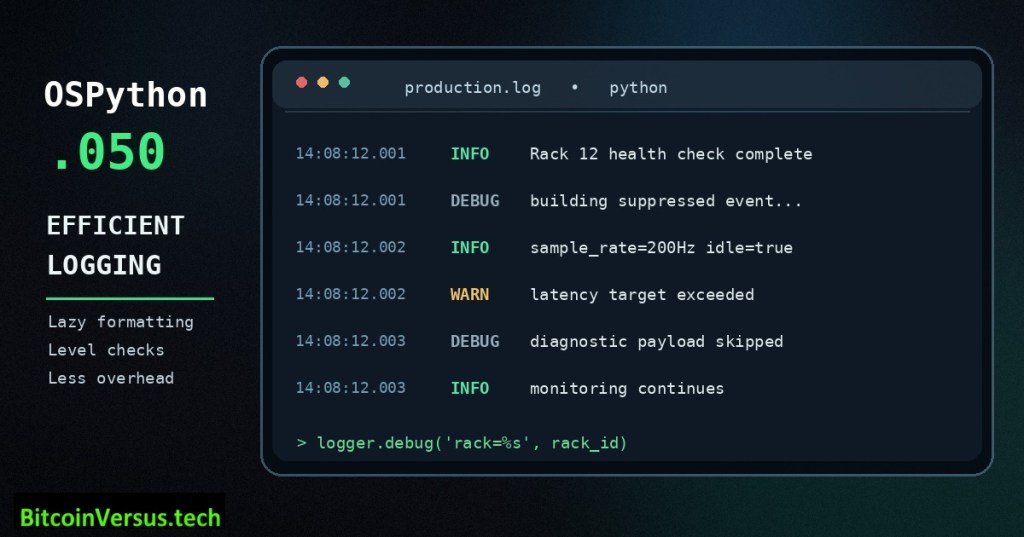
OSPython.050 teaches a small but consequential engineering habit: record useful events without wasting processing time on messages nobody will see. High-frequency services, monitoring agents, and data-center applications may execute logging statements thousands of times per second. The Python Logging HOWTO explains how formatting is deferred, and why expensive argument calculations still require care. The lesson advances our Python series after OSPython.049 on testing log records. No production server is involved.
Learning objective and prerequisites
By the end, learners should distinguish delayed message interpolation from immediate argument evaluation, use Logger.isEnabledFor() appropriately, and explain why a quieter logger does not necessarily mean zero overhead. Prerequisites: Python fundamentals, a working Python 3 interpreter, and basic knowledge of logger levels. Review OSPython.047 on propagation for record routing and duplicated handler output.
Why percent-style logging remains useful
The standard library accepts a message template followed by its arguments: logger.info("rack=%s", rack_id). When the event is filtered below the effective logging level, the logger normally avoids interpolating those values into a final message. By contrast, an f-string is assembled before the logging function receives it. Python’s logging reference documents the message-and-arguments contract. Delayed interpolation does not make arbitrary argument expressions lazy: Python evaluates function-call arguments before invoking logger.debug().
Run a controlled logging experiment
Save the following self-contained program as efficient_logging.py. A simulated diagnostic reader increments a counter; it does not access actual equipment. The active INFO threshold suppresses DEBUG events, yet two unguarded expressions still execute. The guarded third expression never invokes the diagnostic function.
import logging

logger = logging.getLogger("lesson.rack")
logger.setLevel(logging.INFO)
handler = logging.StreamHandler()
handler.setFormatter(logging.Formatter("%(levelname)s:%(message)s"))
logger.addHandler(handler)
logger.propagate = False

calls = 0

def read_diagnostics():
    global calls
    calls += 1
    return "fan=normal"

logger.debug("rack=%s detail=%s", 12, read_diagnostics())
logger.debug(f"rack=12 detail={read_diagnostics()}")

if logger.isEnabledFor(logging.DEBUG):
    logger.debug("rack=%s detail=%s", 12, read_diagnostics())

logger.info("rack=%s operational", 12)
print("diagnostic calls:", calls)
Run python efficient_logging.py. Expected terminal output is INFO:rack=12 operational and diagnostic calls: 2, possibly on separate stdout and stderr streams. The two discarded DEBUG calls evaluated their function arguments anyway. The explicit level check prevented the third call. The example was run locally using the installed interpreter and produced those values; results do not quantify a performance gain.
When the optimization matters
A cheap integer or short string argument rarely justifies additional branching. An expensive database lookup, serialization step, stack inspection, or hardware telemetry read may warrant a guard, especially inside a hot loop. isEnabledFor() also performs work, so benchmark representative traffic rather than assuming every guard is faster. Logging handlers may add substantial I/O cost for emitted records. OSPython.046 on structured JSON logs describes a related output-formatting tradeoff.
Common errors and knowledge check
Avoid putting secrets in log arguments even when DEBUG is currently disabled; future configuration changes can expose sensitive data. See OSPython.041 on log redaction. Avoid disabling all logging merely to improve speed: warning and error records support diagnostics. Exercise: change the logger level to DEBUG. Predict how many diagnostics run, and explain the difference between percent-style formatting and a guarded call.
Answer: all three diagnostics run, so the count becomes three. The DEBUG threshold now passes the guard. Percent placeholders defer conversion to a final string; they never defer the execution of read_diagnostics() itself. For an advanced exercise, time 100,000 iterations with and without an expensive reader, record the environment, and compare measured overhead without claiming universal results.
Practical conclusion
Efficient logging is about preserving operational evidence while avoiding unnecessary computation. Keep stable templates, separate costly diagnostics from basic status events, and measure end-to-end behavior under realistic workloads. The techniques apply to Python services handling network telemetry, equipment alerts, application errors, and software performance monitoring.
Editor’s Note: The example was executed locally and yielded the described two diagnostic calls at INFO level. The guidance comes from the Python Software Foundation’s documentation. Two public YouTube listings were identified, but iframe playback and mobile display were not independently verified. The 1200 × 630 cover is an original editorial console illustration, not a photograph of an active system; the approved watermark asset is reused exactly once.
We volunteer daily to ensure the credibility of the information on this platform is Verifiably True. If you would like to support to help further secure the integrity of our research initiative, please scan the QR code below.

Contributions are optional. Independently confirm the recipient 3C9o19EH5HSiwEPyCTmEKzxhNCbo2X6TTb and 5,000 satoshis before sending. Bitcoin transfers are generally irreversible. Educational examples do not establish production performance, security, or equipment safety certification.


Leave a Reply