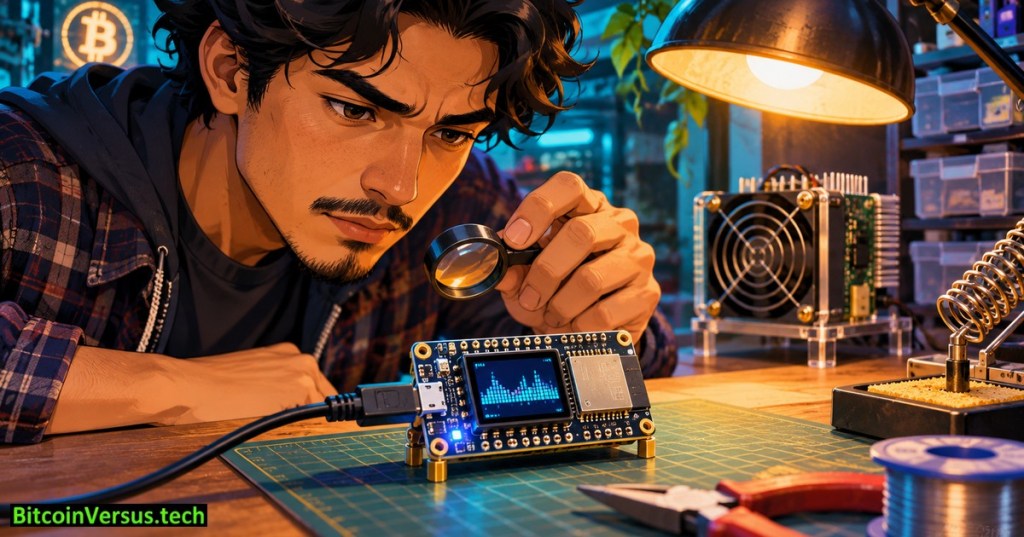
Tiny microcontrollers are gaining software features normally associated with industrial Bitcoin mining equipment. The open-source BDLMiner V2 project shipped a security-focused 2.6.0 update on November 11, 2026, followed by 2.6.1 later the same day and a separate experimental Rust rewrite on November 12. The project turns compatible ESP32 boards into SHA-256d “lottery miners,” with dashboards, pool connectivity and basic management tools. It does not make a miniature computer commercially competitive with a modern ASIC.
The public repository includes firmware for multiple M5Stack, LilyGO and generic ESP32 devices, plus experimental drivers for Bitaxe Gamma 601 and NerdNOS hardware. It supports Bitcoin through Stratum V1 or native Stratum V2, while several other SHA-256d coin profiles use Stratum V1. Configuration must match the selected network, mining endpoint and payout destination.
Background video: DIY EleKtronics demonstrates the NerdMiner V3 installation and ESP32 web dashboard in June 2026. The demonstration is not a BDLMiner benchmark or installation guide.
Why November’s security release matters
Version 2.6.0 strengthened firmware update checks, browser-dashboard host validation and setup-network credentials. A configured device receives a unique randomized setup-network password rather than indefinitely using the initial shared password. Signed updates aim to prevent unauthorized images from being silently accepted, an important safeguard when hardware remains connected to Wi-Fi for months.
The local dashboard still needs careful network isolation. The project’s guide warns that some status pages are unauthenticated by default; setting a web password does not automatically encrypt HTTP basic authentication. Operators should keep devices on trusted networks, avoid exposing their configuration interface to the internet and verify the model-specific update image. Similar maintenance concerns appear in our reports on NerdQAxe’s TLS update and WarpAxe’s networking fixes.
The new stable release and experimental Rust build
BDLMiner 2.6.1 recognizes 16 additional public mining pools in optional anonymous statistics, improving the labeling of pool groups without increasing hashrate. The developer says the release passed software testing but was not physically tested on a miner specifically for that change. The Rust beta separately rewrites pool sessions, its dashboard, hardware SHA engine and experimental ASIC drivers. Normal stable installers do not offer the Rust images.
A megahash is not an ASIC hashrate
The project mentions approximately 1 MH/s for suitable hardware, not every ESP32 board. Performance depends on the chip family, firmware, clock configuration and whether the number comes from physical measurements or internal estimates. Public validation identifies physical testing for the M5StickC Plus2 and Bitaxe Gamma 601; several other supported boards await comparable data. The Gamma uses a dedicated BM1370 ASIC, so its output must never be treated as the microcontroller’s SHA-256 throughput.
Background video: BitMaker explains the practical differences between solo, pooled and group mining in August 2026, using home mining hardware. No BDLMiner performance claim is established by the video.
For a tiny ESP32 device, finding a real Bitcoin block is an astronomically improbable event. A pool-reported share proves some hashing work met a lower pool-selected target; it is not a completed block. Compare our report on a 471 TH/s solo miner or BitaxeBonanza’s open ASIC development to understand the scale gap.
The useful engineering story is verified software maintenance and hands-on education, not sustainable mining revenue. Anyone experimenting should start with the project’s installation and hardware-validation guidance, compare device and pool statistics, then record board temperature and actual power draw before discussing efficiency.
We volunteer daily to ensure the credibility of the information on this platform is Verifiably True. If you would like to support to help further secure the integrity of our research initiative, please scan the QR code below.



Leave a Reply