
A solo Bitcoin miner found block 976,642 on November 19, 2026, collecting a gross block reward of 3.13932037 BTC through Solo CKPool. The block was confirmed at 22:04:57 UTC. Unlike many solo-mining headlines built around anonymous lottery odds, the operator disclosed useful hashrate measurements: approximately 471 terahashes per second (TH/s) across the account, including a winning worker reporting around 95 TH/s.
Bitcoin mining requires specialized ASIC computers to perform repeated SHA-256 hashing until a block header falls below the network target. A solo miner competes for the entire block reward rather than collecting a proportional payout from pooled mining. The pool operator’s November 19 confirmation and worker logs link the successful worker to the block, while the public block record independently establishes its timestamp, difficulty and reward.
Kernow Bitcoin, April 24, 2026: an independent discussion of CK Solo, small miners and mining-pool odds. Archival educational analysis, not footage of the November winner.
What the winning miner actually ran
CKPool administrator Con Kolivas reported a seven-day account rate of roughly 470 TH/s and a one-day rate of 471 TH/s. The worker identified as “jacobi” showed about 95.4 TH/s over the preceding day. Those figures are pool-reported estimates based on submitted shares, not laboratory power measurements or a verified inventory of machines.
The record does not establish the ASIC manufacturer, number of physical units, electricity tariff or whether rented hashrate was involved. One worker name can represent more than one physical miner. Earlier October solo wins provide context, but cannot be used to identify the November hardware.
A roughly 39-year expectation, not a 39-year wait
At block 976,642, difficulty was approximately 134.82 trillion. Holding an individual hashrate of 471 TH/s and the difficulty constant gives an average expected wait of about 39 years. The probability of finding at least one block in one 365.25-day year is about 2.53%. Random outcomes do not follow the average: miners can win quickly, find several blocks or never win.
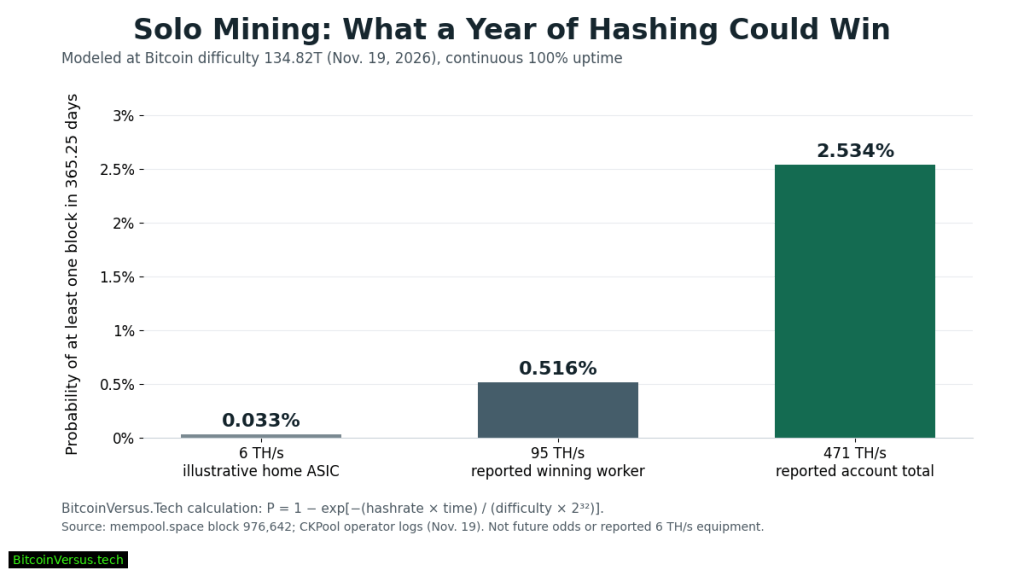
The model uses probability = 1 − exp[−(hashrate × seconds) ÷ (difficulty × 2³²)]. The 6 TH/s example is a hypothetical home miner, not the winning device. Real probabilities change with network difficulty, interruptions and a miner’s effective hashrate. November’s 9.13% difficulty reduction altered the starting conditions for every participant.
Red Panda Mining, May 13, 2026: an independent demonstration discussing rented hashrate and CKPool solo-mining odds. The video does not document the November 19 block.
Why gross reward and miner payout differ
The verified block contained 3.125 BTC in subsidy and 0.01432037 BTC in transaction fees, across 1,003 transactions. Those amounts sum to 3.13932037 BTC before any service charge. Solo CKPool advertises a 2% fee; consequently, the entire gross reward should not be described as a fee-free payout to the winner. Exact distribution requires reading the coinbase outputs.
The event illustrates Bitcoin’s probabilistic mining design rather than a newly efficient machine. Even with large conventional pools dominating block production, independent participants can still win a block through a solo service. Whether doing so makes economic sense depends on power costs, hardware depreciation, network difficulty and how long the operator can tolerate zero revenue. Further context comes from BitcoinVersus.Tech’s analysis of direct-payout limits in decentralized mining pools and its guide to hashrate versus hashprice.
Primary sources and methodology
- Mempool block 976,642: November 19 timestamp, 3.13932037 BTC reward, 134.82T difficulty and 1,003 transactions
- Solo CKPool operator confirmation and share-based hashrate records, November 19, 2026
- Solo CKPool official service documentation and 2% fee
- SoloLuck on-chain block record
- Kernow Bitcoin, April 2026 CK Solo analysis; Red Panda Mining, May 2026 solo-mining demonstration
Editor’s Note: Block height, timestamp, reward and difficulty were cross-checked against the block record; 471 TH/s and the winning worker’s 95 TH/s were reported by the CKPool operator. Probabilities are mathematical scenarios at one fixed historical difficulty. The cover is original cinematic anime artwork, not an actual photograph of the winner or an identified mining facility. Historical video embeds do not depict the reported event.
Editor’s Note: We volunteer daily to ensure the credibility of the information on this platform is Verifiably True. If you would like to support to help further secure the integrity of our research initiatives, please scan the QR code below

For mobile scanning, open the article on another display and scan the QR code with a Bitcoin wallet. The voluntary donation amount is 5,000 sats. Verify the receiving address 3C9o19EH5HSiwEPyCTmEKzxhNCbo2X6TTb before sending.
BitcoinVersus.Tech publishes technology and financial journalism for informational purposes and does not provide financial, investment, or legal advice.


Leave a Reply