
A crystal already studied for decades as an electrically controlled light switch has kept one important engineering secret: exactly how much light it bends and absorbs at different wavelengths. Researchers at KAIST, Caltech and collaborating institutions have now mapped the intrinsic optical behavior of barium titanate (BaTiO₃), a ferroelectric material used in experimental photonic devices. KAIST announced the results on November 8, 2026; the peer-reviewed paper appeared online in ACS Photonics on October 20. The work delivers measurement data, not a newly demonstrated record-speed internet connection.
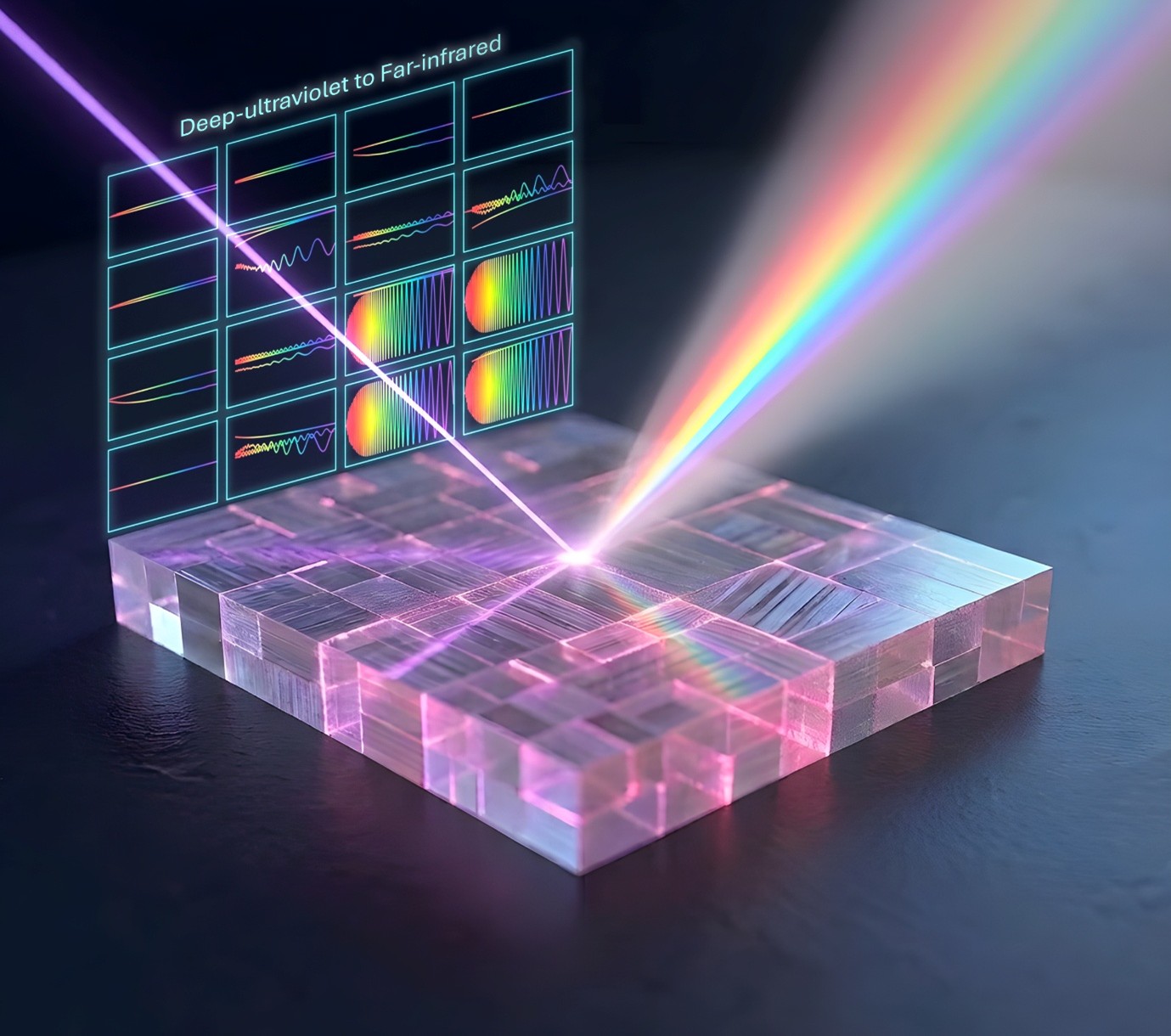
Why a communications chip needs a good map of light
Optical modulators translate electrical information into changes in a light signal. Barium titanate is promising because an applied electric field can change its refractive index, a property called the Pockels effect. Engineers need to know both the refractive index, which governs light’s propagation and phase, and the extinction coefficient, which captures absorption. Without trustworthy values, simulations of waveguides and modulators may disagree with fabricated devices. Our ellipsometry reference and semiconductor metrology lesson introduce the related measurements.
The difficulty was hidden inside crystal domains
Barium titanate can contain microscopic regions with different crystal orientations. Because light interacts differently along different crystal axes, measuring a mixed-domain specimen does not directly reveal the intrinsic optical response of each orientation. Published optical constants therefore varied widely. The team studied two types of comparatively uniform single crystals, used polarization-sensitive reflection and transmission measurements, and reconstructed the material’s response without confusing intrinsic behavior with a sample’s mixture of domains.
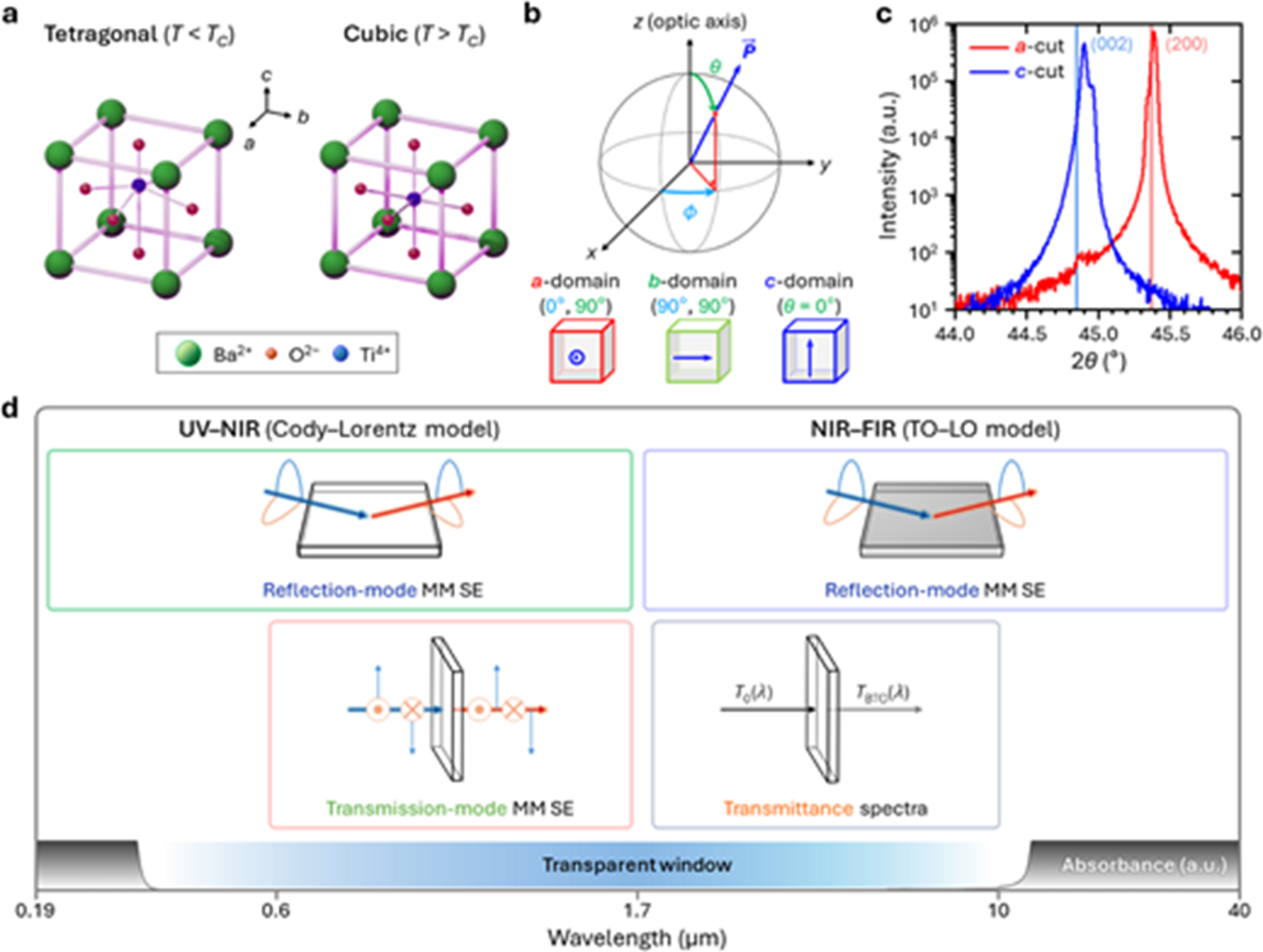
From ultraviolet light to the far infrared
The researchers mapped wavelengths from 190 nanometers to 40 micrometers, equivalent to approximately a 210-fold range in wavelength. They combined Mueller-matrix spectroscopic ellipsometry, which measures the polarization changes caused by a material, with transmission data and spectral models appropriate for different wavelength regions. KAIST reports extinction coefficients as low as approximately 10⁻⁵ between 2 and 10 micrometers, where absorption is exceptionally weak. The result is a measured optical-property dataset; it is not a claimed 10⁻⁵ error rate for a communications system.
A further model predicts the overall response of crystals with multiple domains by using their relative orientation and proportion. The advance matters because realistic photonic chips rarely behave like idealized, uniform textbook crystals. Predictive materials data can help engineers reduce fabrication-and-redesign cycles.
Could the crystal make optical links faster?
The findings may improve future modulators, wavelength-conversion devices and quantum photonic circuits. They do not independently demonstrate faster link speeds, manufacturing yields or lower energy consumption. Other recent experiments, including a 16-channel photonic transmission chip and a 180-Gb/s optical transmitter, report device-level performance under different conditions. Those results cannot be assigned to the new barium-titanate measurements.
Practical systems must still solve thin-film fabrication, domain control, electrode losses, packaging and long-term reliability. The independent Phys.org report likewise describes the study as foundational characterization. For context, long-distance silicon-photonics experiments show how far optical communications already extend. The useful outcome today is a more dependable design reference for devices that manipulate information using light.
Original research and verification
- KAIST News Center: November 2026 primary announcement, official figures and experiment details
- ACS Photonics: Broadband Optical Characterization of Tetragonal Barium Titanate by Mueller-Matrix Spectroscopic Ellipsometry, published October 20, 2026 (DOI: 10.1021/acsphotonics.6c01514)
- Phys.org: November 9 independent research coverage
- Scientific review of thin-film barium titanate photonic devices, September 2026 preprint; separate background research
Media and testing disclosure: The photorealistic featured cover is an original conceptual optics-laboratory illustration, not an image of the researchers or their actual apparatus. The exact approved BitcoinVersus.tech watermark appears once at bottom-left. Both article figures come from the official KAIST release and are credited. No YouTube player is included because actual playback could not be established.
We volunteer daily to ensure the credibility of the information on this platform is Verifiably True. If you would like to support to help further secure the integrity of our research initiative, please scan the QR code below.



Leave a Reply