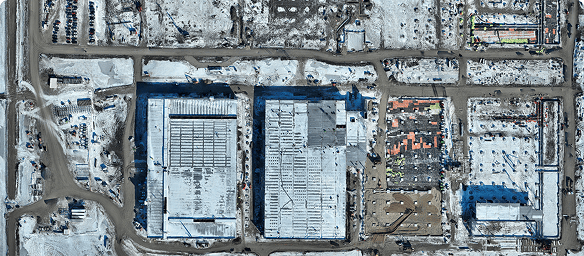
Applied Digital has reached a customer-delivery milestone at its Polaris Forge 2 campus in Harwood, North Dakota. On November 24, 2026, the company reported that its initial 25 MW data hall had achieved Ready for Service following an integrated fit-out. The announcement separates a completed hall from the much larger electrical and mechanical infrastructure supporting it.
The developer also finished commissioning the base building systems for a 75 MW section of the first 150 MW building. The other 50 MW in that section still requires fit-out and customer delivery. Neither the commissioned base infrastructure nor the building’s design capacity should be counted as additional operational computing load.
Why commissioning occurs in stages
A hyperscale computing facility requires more than a completed building and a utility connection. Engineers must validate electrical distribution, protective devices, cooling equipment, control systems and their interactions. Integrated testing can examine how equipment responds to simulated failures, changes in electrical load and transitions between redundant systems. The exact test procedures and acceptance thresholds used in Harwood were not published in the announcement.
Fit-out brings the supporting systems to the point where a particular customer space can be delivered. Individual halls may have separate completion milestones even when they share central infrastructure. Applied Digital’s modular approach divides its 150 MW buildings into two equal commissioning phases, each serving three 25 MW halls. That organization can allow customers to begin receiving capacity while work proceeds elsewhere.
The difference between 25 MW and 75 MW
One delivered 25 MW hall represents one-third of the initial 75 MW phase and one-sixth of the first building’s 150 MW design capacity. At full continuous critical IT load, the hall’s computing equipment would consume 600 MWh per day, or 219 GWh annually. Those figures are arithmetic scenarios rather than meter readings.
Facility demand would be greater than IT demand because cooling, electrical losses and other support equipment require power. With an illustrative power usage effectiveness of 1.20, a fully utilized 25 MW IT load would correspond to 30 MW of total facility demand. The company has not reported measured PUE for the newly delivered hall.
From contracted megawatts to delivered capacity
Applied Digital’s August 31 quarterly filing described two Harwood buildings totaling 300 MW. The new hall is therefore about 8.3% of that planned campus capacity. A separate October earnings update reported that 250 MW had already reached operational status at Polaris Forge 1 in Ellendale. The two campuses represent different development schedules.
The company reports more than $41 billion in contracted base-term lease revenue across its portfolio. That total describes future contractual value, not cash already collected or revenue earned in a single year. Construction completion, customer acceptance, financing and operating costs all affect the economic outcome.
What comes next
The next 50 MW of Harwood deliveries will provide further evidence of execution. Related BitcoinVersus.Tech reporting includes Polaris Forge 1 commissioning, the Louisiana financing and lease update, North Dakota’s 1.2 GW power agreement and Bitdeer’s electrical equipment delays. The milestone illustrates why delivered critical IT capacity, rather than headline project size, is an important measure of AI infrastructure progress.
Featured photograph: Applied Digital’s official aerial view of Polaris Forge 2, depicting earlier construction rather than the newly commissioned hall.
We volunteer daily to ensure the credibility of the information on this platform is Verifiably True. If you would like to support to help further secure the integrity of our research initiative, please scan the QR code below.



Leave a Reply