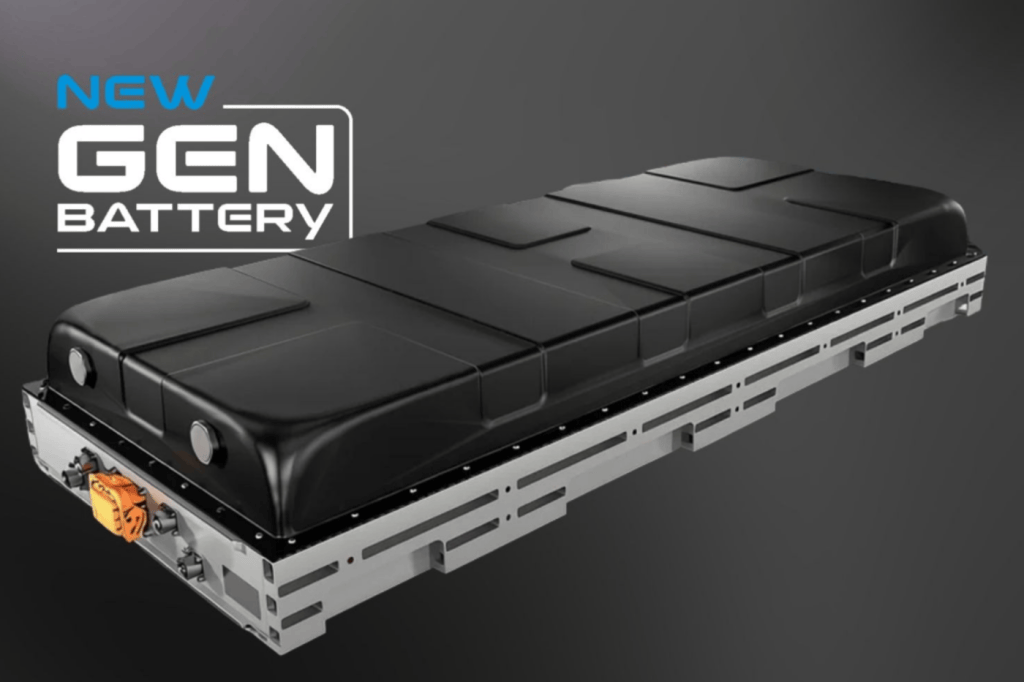
Electric bus operators face a choice between installing more battery capacity and preserving space and payload for passengers. IVECO BUS announced a new generation of nickel-manganese-cobalt (NMC) battery packs on November 24, 2026. The manufacturer’s announcement identifies the E-WAY city buses and CROSSWAY ELEC intercity buses as recipients of the upgrade, with initial deliveries planned for April through June 2027.
The stated capacity rises from 69 kWh to 80 kWh per pack without increasing its footprint. IVECO expects certain configurations to travel as much as 100 kilometers farther between charges. The additional range is a manufacturer projection, not an independently measured result for the new generation.
The engineering advantage of modular batteries
Battery energy density describes the energy that can be stored per unit of volume or mass. The announcement establishes an approximately 15% improvement within the existing physical envelope, but does not provide pack mass or a numerical Wh/kg rating. Using the rounded capacities, the increase is (80 − 69) ÷ 69 × 100 = 15.94%.
As Sustainable Bus reports, FPT assembles the batteries in Turin using cells supplied by Microvast. The new configurations allow different vehicle lengths and route requirements to be matched to battery capacity rather than forcing every operator to purchase the largest available system.
The E-WAY range supports four to nine new packs, corresponding to 320–720 kWh. The CROSSWAY Low Entry ELEC offers 320–560 kWh, while the CROSSWAY ELEC accommodates 240–480 kWh. The figures represent installed storage capacity, not motor output or guaranteed usable energy.
How one fewer pack can change a bus
Consider a hypothetical configuration with seven old packs. Their rounded combined capacity is 483 kWh; six new packs provide 480 kWh, just 3 kWh less. If the vehicle permits the configuration, eliminating a pack may free mounting space or reduce mass. By contrast, six old packs total 414 kWh, so five new packs at 400 kWh would have about 3.4% less nominal energy. Operators must account for those differences before choosing equipment.
Charging infrastructure and lifetime economics
A 480 kWh bus recharged from 20% to 80% state of charge would receive approximately 288 kWh at the battery, assuming the nominal capacity is usable. At a constant battery-side charging rate of 120 kW, the theoretical session lasts 2.4 hours. Conversion losses, temperature controls and charging taper may increase grid energy demand or charging time. Depot scheduling becomes essential when dozens of vehicles share a limited electrical connection.
The company offers an optional warranty extension to 15 years and estimates potential ownership savings of up to 17% for a particular GX 337 ELEC configuration if fewer packs and no midlife replacement are required. Electrive notes that detailed warranty conditions remain undisclosed. Standby thermal-runaway alerts and module-level fire suppression are also described by the manufacturer; neither removes all battery fire risk.
The operational questions extend beyond vehicle range, as examined in our coverage of EV charging architecture, solar-supported charging, second-life battery storage and lithium recovery. A successful deployment will depend on route-specific energy measurements, passenger loading, winter performance and contractual warranty terms, not nominal capacity alone.
Featured image: IVECO manufacturer product rendering, via electrive.
We volunteer daily to ensure the credibility of the information on this platform is Verifiably True. If you would like to support to help further secure the integrity of our research initiative, please scan the QR code below.



Leave a Reply