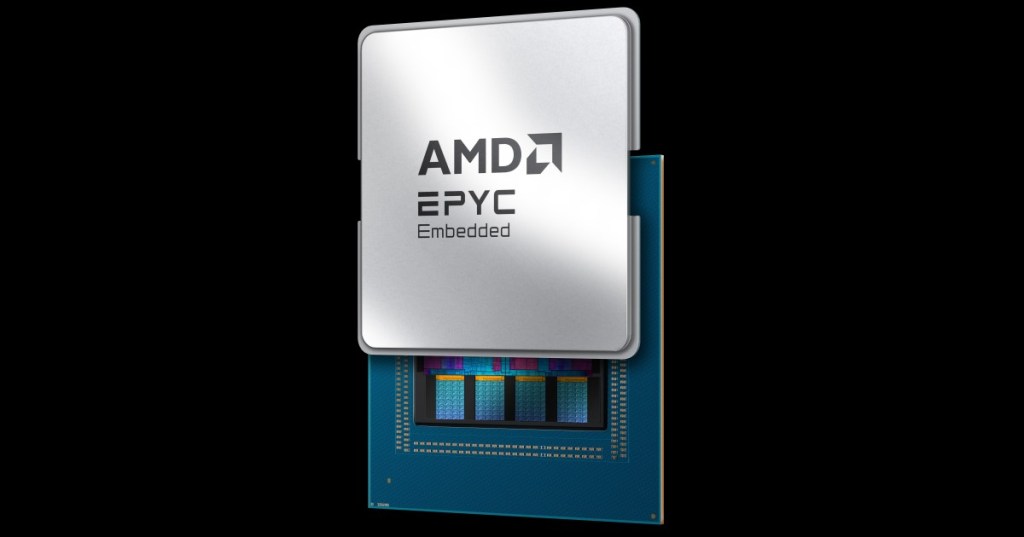
AMD announced the EPYC Embedded 9006 Series SP7 on November 10, 2026, extending its sixth-generation x86 architecture into dedicated industrial and enterprise appliances. The family scales from 64 to 256 physical CPU cores and targets semiconductor manufacturing test equipment, high-speed network security and storage systems. Unlike a conventional microcontroller, the processor is designed to coordinate large amounts of computation and data movement within specialized equipment.
The AMD announcement specifies up to 512 hardware threads, PCI Express 6.0 and Compute Express Link 3.1. AMD also advertises seven years of product availability. The embedded lineup is distinct from the simultaneously introduced general-purpose EPYC server CPUs. Featured product artwork: AMD.
Why chip manufacturers need large CPUs
Automated test equipment verifies whether newly manufactured electronic components satisfy electrical and functional specifications. A high-end storage test system can issue commands to multiple devices, generate data patterns, collect results and record errors concurrently. More CPU execution resources may allow additional independent test processes to run simultaneously. The resulting test throughput also depends on instrumentation, device interfaces and software scheduling.
The embedded product documentation identifies testing of DDR5 modules, CXL memory and PCIe 6.0 SSDs as intended applications. An adequately configured SP7 platform offers as many as 96 PCIe 6.0 lanes. An illustrative allocation of six lane groups at x16 would consume all 96 lanes before accounting for other device requirements. Actual motherboard topology, switches and firmware determine which configurations are supported.
Memory bandwidth becomes a design constraint
The platform supports 16 DDR5 memory channels. As independent technical reporting explains, DDR5-8000 across 16 channels yields a theoretical aggregate data rate of 1,024 GB/s: 16 multiplied by 8 billion transfers per second and eight bytes per transfer. That assumes a fully populated configuration and a 64-bit data path per channel. Application bandwidth will be lower when access patterns, memory controllers and contention introduce overhead.
For network appliances, the CPU can coordinate firewall policies, connection state and exceptions while dedicated accelerators handle appropriate packet-processing work. Storage controllers similarly need compute capacity for compression, caching and redundancy. High CPU density cannot eliminate a bottleneck elsewhere in the data path.
Separating projections from measurements
AMD estimates a 1.8-fold integer throughput improvement using a dual-socket comparison involving 512 new-generation cores and 384 previous-generation cores, alongside differing memory and compiler configurations. The figures compare entire platforms, not equal-core-count performance. AMD also reports gains for selected firewall and storage workloads. Independent testing of embedded products remains necessary to establish their performance and energy consumption in production.
Related coverage includes Dell’s planned 512-core server, Supermicro’s PCIe 6.0 storage platform, PCIe retimers and Synaptics’ memory-integrated edge microcontrollers.
The embedded EPYC launch illustrates how AI infrastructure affects equipment beyond accelerator servers. Faster chips create demand for faster component testing, data transport and network security. A long product lifecycle may be especially valuable when replacing a processor would require costly requalification of an entire appliance.
We volunteer daily to ensure the credibility of the information on this platform is Verifiably True. If you would like to support to help further secure the integrity of our research initiative, please scan the QR code below.



Leave a Reply