Google Research described an experimental method on October 27, 2026, for helping artificial intelligence retain knowledge acquired after initial training. The approach, called Sleep, separates ordinary model operation from periods devoted to learning. Its research paper, revised July 10, 2026, reports experiments in memory retention, translation, classification and mathematical reasoning. The concept addresses a persistent problem in machine learning: improving a system without destroying capabilities it already possesses.
Why language models forget
In a conventional language model, the numerical parameters determine much of its learned behavior. A conversation supplies additional context, but information in the conversation does not necessarily become part of those parameters. Updating weights using only new training examples can also impair previously acquired skills, a phenomenon known as catastrophic forgetting. An organization could therefore face a choice between increasingly outdated model behavior and expensive retraining that requires careful validation.
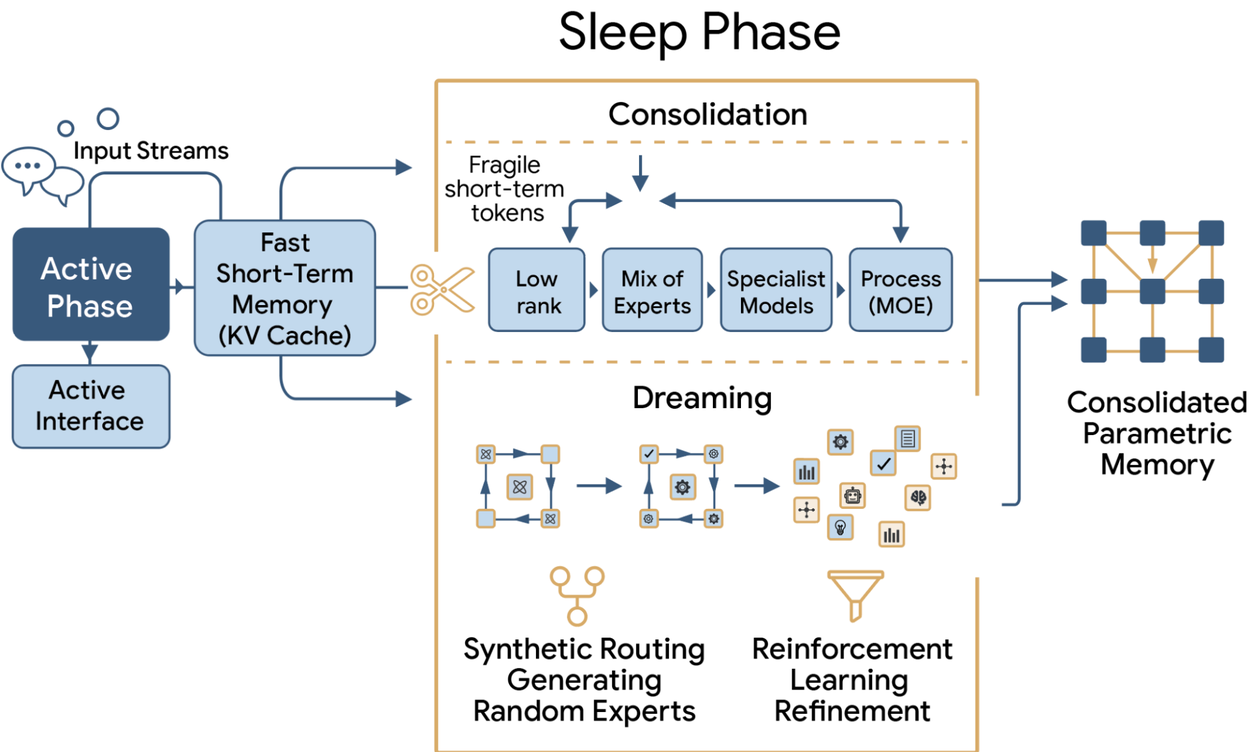
The researchers propose reserving periods for parameter updates rather than attempting to learn permanently from every incoming request. During ordinary operation, the model works with temporary information. During consolidation, additional expert modules provide capacity for selected knowledge to be transferred into longer-lived components. The method uses distillation and reward-based imitation to encourage the expanded model to reproduce useful behavior from its earlier state.
The design also includes a synthetic practice stage. Different expert modules are activated to produce training examples, and candidate examples are selected according to their potential contribution to learning. The resulting updates occur under predetermined optimization rules. The terminology borrows from human sleep, but the mechanism is numerical optimization rather than evidence of consciousness.
What the experiments measured
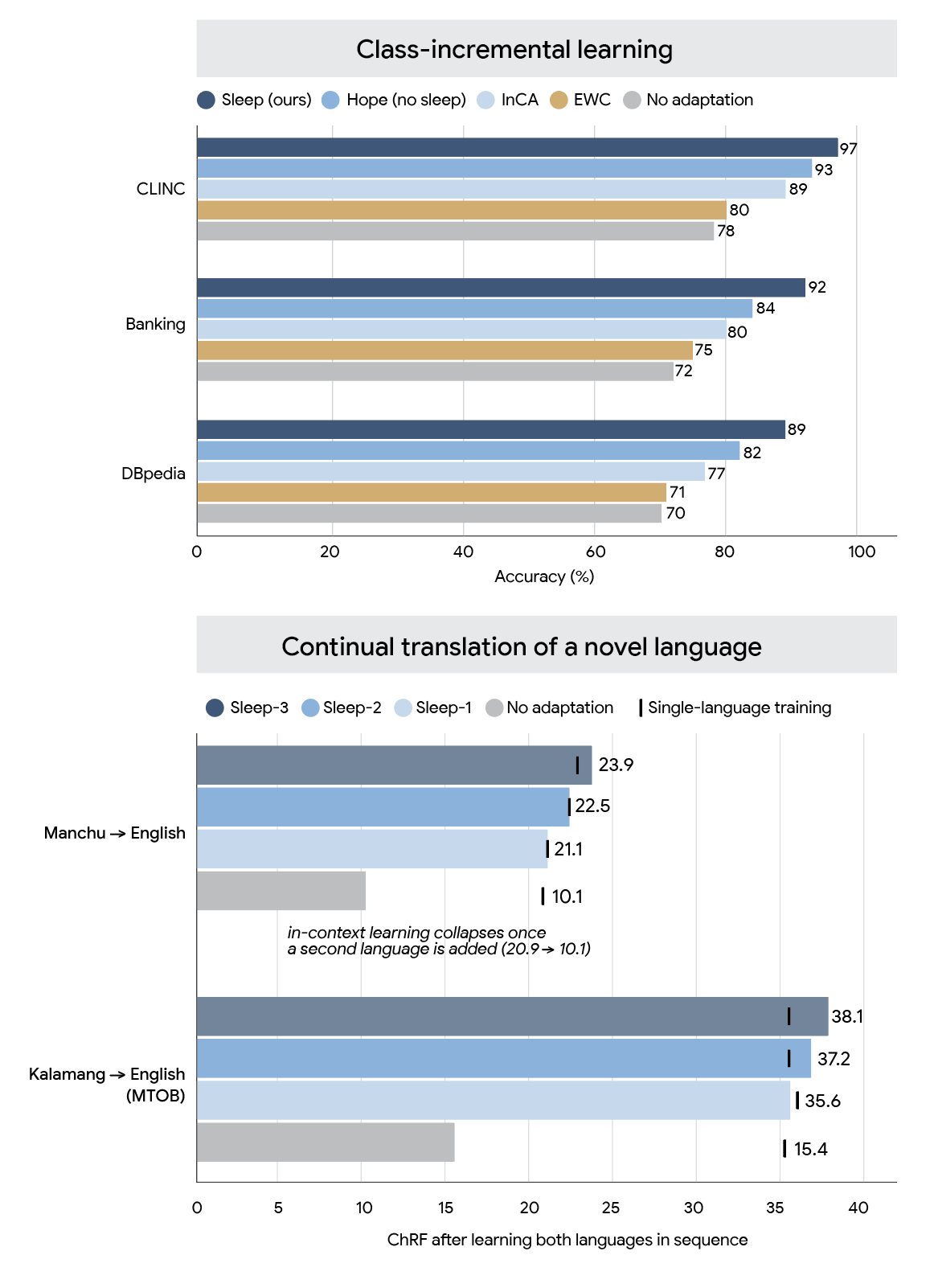
In the classification comparison shown by Google Research, Sleep achieved reported accuracies of 97%, 92% and 89% on CLINC, Banking and DBpedia, respectively. The corresponding Hope baseline without sleep scored 93%, 84% and 82%. The absolute differences were four, eight and seven percentage points. These are task-specific experimental results, not evidence that arbitrary models will improve by the same amounts.
The engineering challenge of continual learning
For a deployed AI system, preserving facts and retaining skills are separate engineering requirements. A model might memorize a new product specification while becoming less accurate at arithmetic or following instructions. Testing both old and new tasks before accepting an update would help detect unintended regressions. Related concerns appear in our coverage of AI reliability testing and robot imitation learning.
The computational costs also matter. Additional model parameters, training iterations, validation workloads and storage consume resources. The trade-off between local inference efficiency, covered in our report on AMD FastFlow, and training efficiency must be evaluated separately. A learning system also needs safeguards against incorporating inaccurate or malicious information, especially when used for sensitive applications such as AI-assisted drug discovery.
The next meaningful milestone would be independent replication over extended operating periods, with transparent reporting of training cost, retention, correction accuracy and safety regressions. The study offers a promising experimental route toward models that learn throughout their lifecycle; it does not establish an unlimited, autonomous ability to improve or a commercial service implementing the method.
We volunteer daily to ensure the credibility of the information on this platform is Verifiably True. If you would like to support to help further secure the integrity of our research initiative, please scan the QR code below.

BitcoinVersus.tech is not a financial advisor. This media platform reports on financial subjects purely for informational purposes.


Leave a Reply