
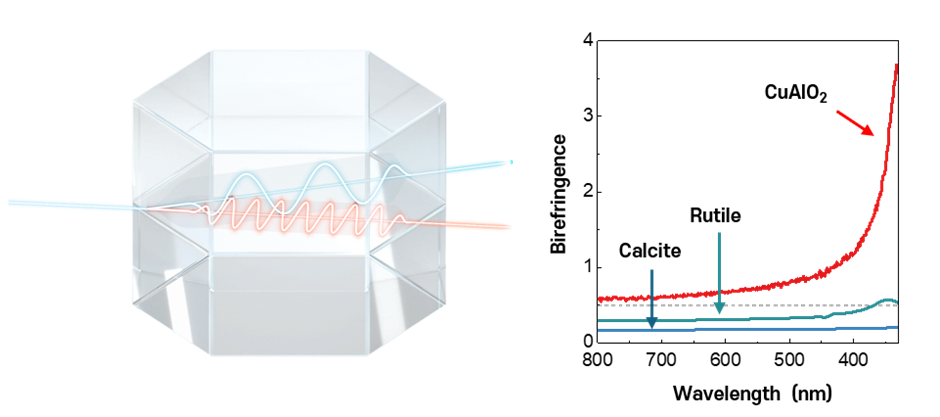
A semiconductor that manipulates the polarization of visible light could help engineers reduce the physical size of optical systems. On November 24, the Korea Advanced Institute of Science and Technology (KAIST) announced research into copper aluminum oxide (CuAlO₂), a crystalline material whose birefringence for violet light is approximately 120 times greater than that of quartz. The research team estimates that a half-wave plate made from the semiconductor could measure just 173 nanometers in thickness.
Why polarization determines component thickness
Light is an electromagnetic wave. Its polarization describes the orientation of its electric field. In an anisotropic crystal, different polarization components experience different refractive indices, which means they accumulate different phases as they travel through the material. A half-wave plate introduces a relative phase shift of π radians, allowing the orientation of linearly polarized light to be manipulated.
For a simple, first-order half-wave plate, thickness d equals the vacuum wavelength λ divided by twice the magnitude of the refractive-index difference Δn: d = λ/(2Δn). If the index difference increases by a factor of 120 at a given wavelength, the required thickness decreases by the same factor. Multiplying the reported 173 nm estimate by 120 gives approximately 20.76 micrometers for the comparison quartz plate. That represents a theoretical thickness reduction of about 99.17% for the polarization-control layer alone.
The researchers attribute the optical response to the directional behavior of linear oxygen–copper–oxygen atomic arrangements. Their Nature Communications paper, published October 13, also reports hyperbolic behavior in the ultraviolet. Optics.org independently reported the November announcement.

What the discovery could mean for smart glasses
Wearable optical systems must fit light sources, lenses, waveguides, sensors and electronics into a compact frame. A thinner polarization-control component could reduce one part of the optical stack, potentially giving engineers additional space for other hardware. Recent commercial developments, including Vuzix’s sub-40-gram smart glasses and XREAL’s Android XR hardware, illustrate the importance of balancing display performance with physical size.
Polarization control also matters in communications and precision instruments. Applications beyond wearables could benefit if the material can be integrated into compact optical assemblies. However, a high birefringence at violet wavelengths does not establish equivalent performance across a full-color display or the infrared wavelengths commonly employed in fiber-optic networks.
The manufacturing challenge
The published result is a materials discovery, not a finished commercial product. Engineers must demonstrate uniform thin films, low optical loss, repeatable crystal orientation, suitable substrates and acceptable manufacturing yields. Film thickness tolerances become especially important when the target optical layer is only hundreds of nanometers thick.
The distinction between a material property and a manufacturable device also applies to KAIST’s recent dual-purpose display research and low-memory graphics processors for wearables. Each solves a different engineering bottleneck. The next milestone for CuAlO₂ is practical thin-film fabrication and optical testing, rather than a claim that entire smart glasses can shrink by a factor of 120.
We volunteer daily to ensure the credibility of the information on this platform is Verifiably True. If you would like to support to help further secure the integrity of our research initiative, please scan the QR code below.



Leave a Reply