A public transit network inspired by a single-celled organism could carry more passengers without following fixed routes. On November 23, 2026, the New Jersey Institute of Technology described Fluid Fleets, a distributed bus-routing research project. Simulations across three New Jersey communities found increases in completed journeys ranging from approximately 56% to 128%. The results come from computer models, not deployed transit services.
A transportation network without a central brain
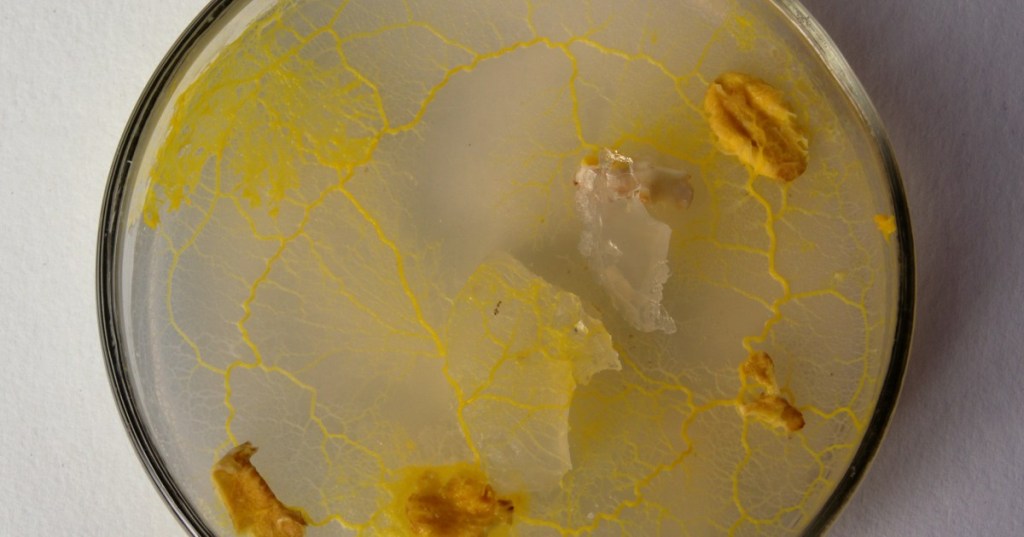
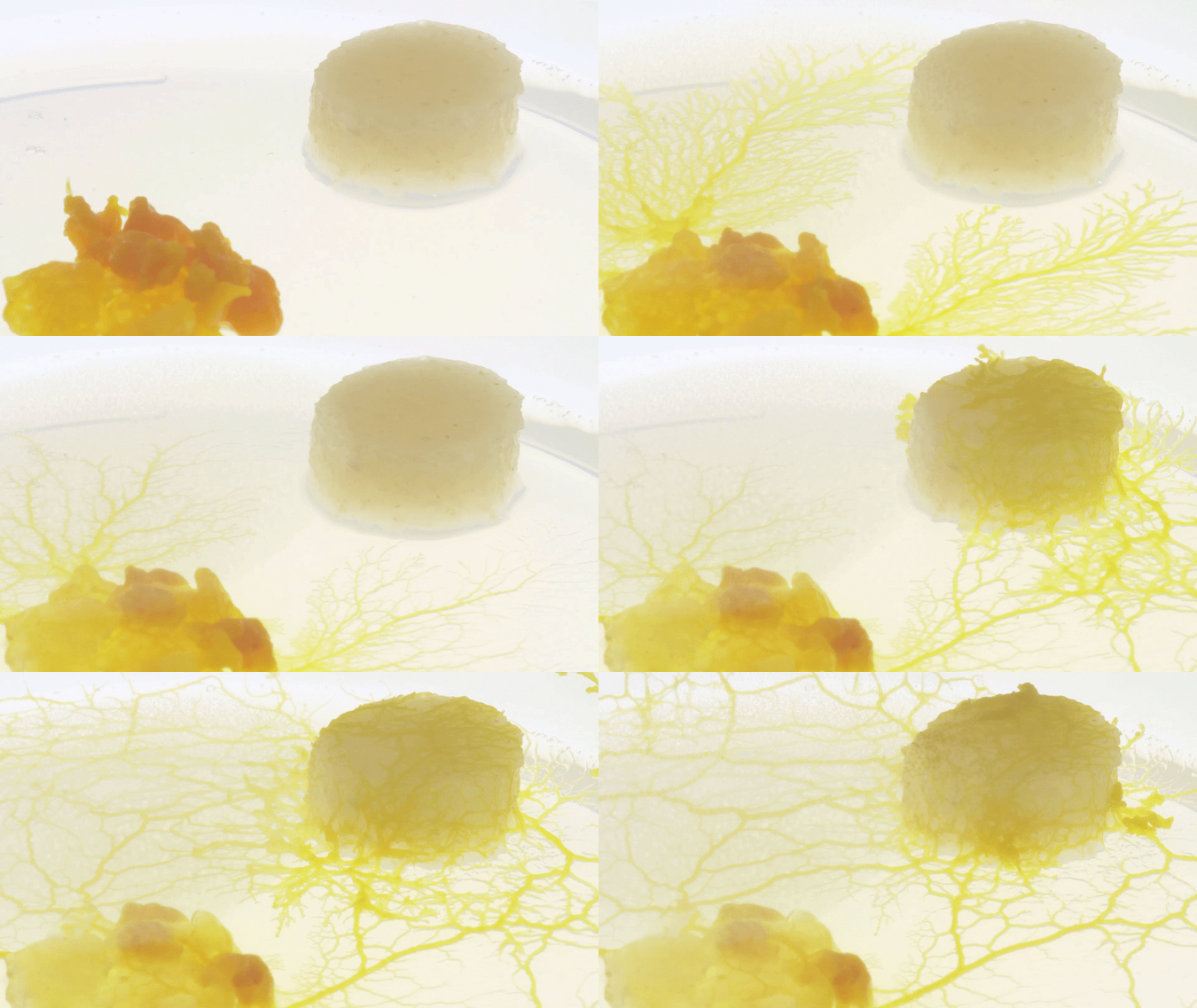
Physarum polycephalum forms tubes through which material moves as the organism grows and explores its surroundings. Its network changes in response to local conditions. In 2010, a study in Science examined how slime mold could form efficient connections among food sources arranged to represent locations around Tokyo. Fluid Fleets draws on a different aspect of the organism: the movement of material through an existing network.
The researchers developed Robust Adaptive Pathfinding for Interconnected Devices, or RAPID, to guide vehicles using demand signals exchanged between neighboring road intersections. Rather than calculate every vehicle’s complete journey in advance, the system repeatedly updates local routing information. A vehicle’s next movement can therefore reflect new passenger requests and the conditions represented by the network.
A prospective passenger requests a ride, nearby vehicles evaluate whether to accept the request, and an assigned vehicle moves toward a meeting point. Transfers between vehicles can be considered when they improve the estimated journeys involved. The algorithm does not mathematically guarantee the shortest possible path. Its objective is practical responsiveness under changing demand rather than exhaustive route optimization.
The numbers behind the simulation
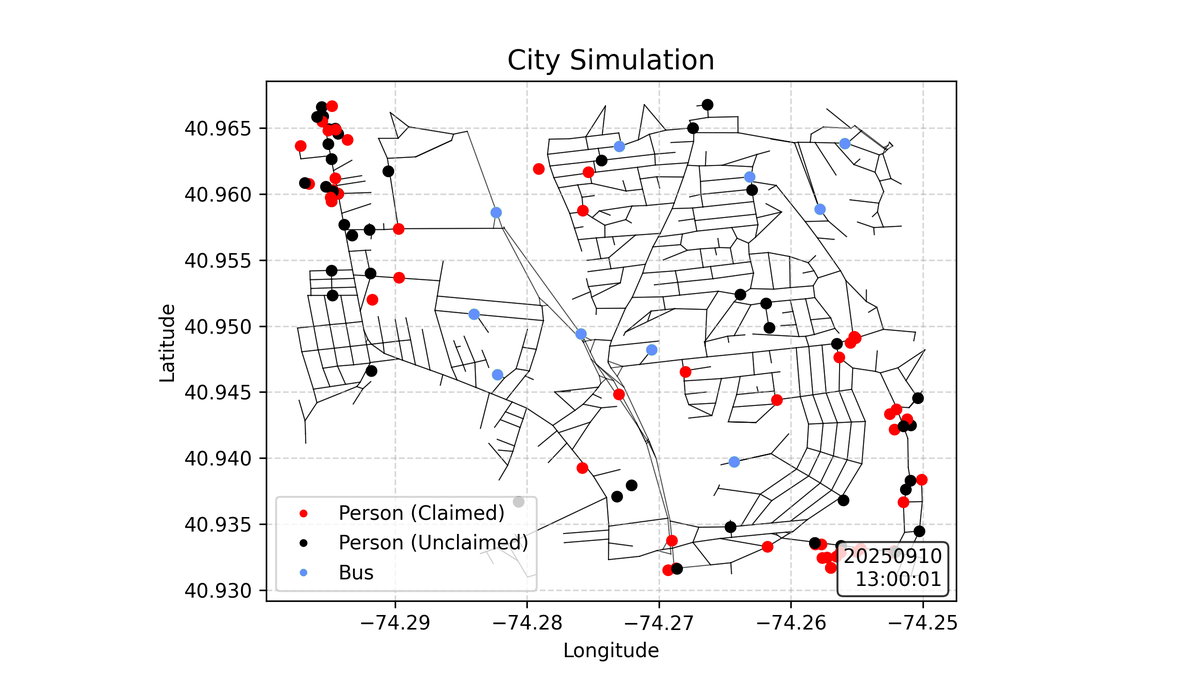
The August 2026 research manuscript compares ten vehicles, each capable of carrying 30 passengers, across ten simulation runs per case. Over 100 simulated minutes, the mean completed deliveries rose from 184.2 to 286.9 in Newark, from 152.3 to 270.6 in Rutherford, and from 110.3 to 251.3 in Wayne. The fractional values reflect averages rather than fractions of individual passengers.
In Wayne, the difference of 141 completed deliveries divided by the fixed-route baseline of 110.3 yields approximately 127.8% improvement. Mean walking time fell from 18.4 to 2.9 minutes. Newark and Rutherford also recorded substantial reductions. The comparison held vehicle capacity constant, but equal seating capacity does not necessarily mean equal vehicle mileage, staffing requirements or operating expenses.
What would happen on real streets?
The manuscript acknowledges several limitations. Traffic congestion was excluded from the reported comparison, vehicles traveled at constant speed, and passenger origins and destinations were randomly selected. Real travel demand often concentrates around schools, employment centers and commuter corridors. The fixed-route benchmark permitted at most one transfer, while every modeled passenger was required to use transit. Those assumptions may favor the adaptive approach relative to actual ridership behavior.
According to Tech Xplore’s November 25 coverage of the NJIT announcement, the research team intends to investigate operating costs with Pennsylvania’s Monroe County Transit Authority. The work has not established lower fares, fuel consumption or commercial viability. Testing against other demand-responsive algorithms, collecting operational data and evaluating accessibility would provide stronger evidence for deployment.
The distributed decision-making concept also connects to our coverage of network path calculation, robots navigating pedestrian flows, autonomous mobile robots and distributed network redundancy. The mechanisms differ, but each illustrates why local coordination and changing network conditions deserve attention.
Fluid Fleets presents an intriguing engineering alternative: instead of making passengers adapt to a timetable, make a transportation network adapt to passenger demand. Whether that approach can complement fixed routes economically remains the next test.
Featured photograph: Rob Cruickshank via Wikimedia Commons, CC BY 2.0; cropped to landscape. The in-body media are credited research visuals. Animation playback and desktop/mobile layout were not independently tested.
We volunteer daily to ensure the credibility of the information on this platform is Verifiably True. If you would like to support to help further secure the integrity of our research initiative, please scan the QR code below.



Leave a Reply