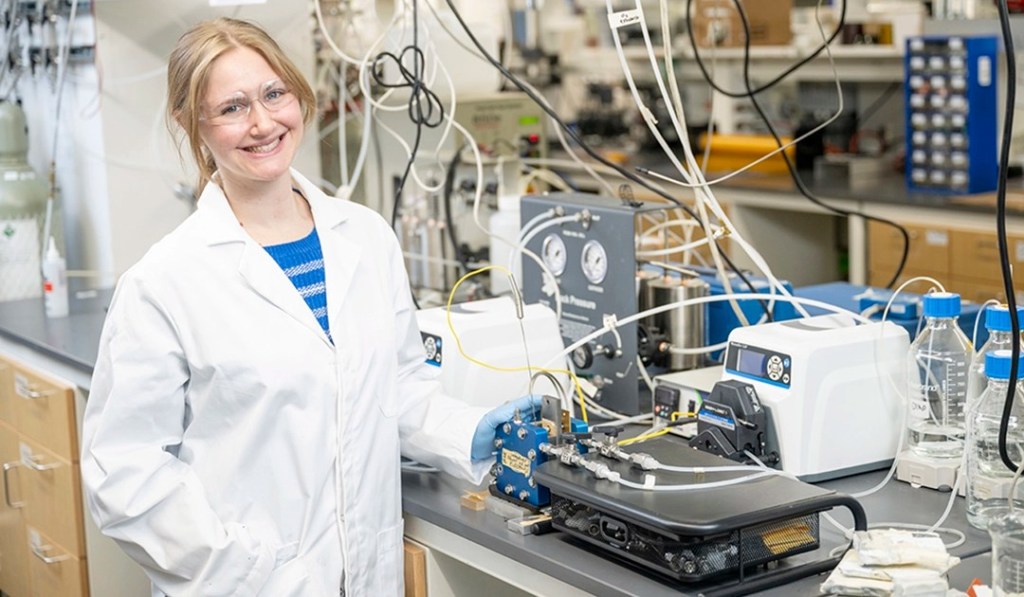
Carnegie Mellon University researchers have demonstrated a compact method for producing hydrogen from simulated seawater by combining purification and electrolysis. In a November 25, 2026 research announcement, the university describes work by Mary Anna Ebbert and mechanical engineering professor Shawn Litster toward a portable, suitcase-sized system. The laboratory demonstration establishes feasibility for the integrated cell; a complete commercial suitcase-sized generator remains a development objective.
Turning waste heat into a useful input
Conventional proton exchange membrane (PEM) electrolyzers require sufficiently purified water to protect their sensitive components. A separate treatment plant can add plumbing, controls, pumps and other auxiliary equipment. Those components matter especially when portability becomes an engineering requirement.
The Carnegie Mellon design integrates a membrane-based separation process with the electrochemical cell. Heat generated during electrolysis helps produce water vapor from a saline feed. Dissolved salts remain on the feed side of the separation membrane while purified vapor enters the electrolyzer. The design recovers heat that might otherwise require removal through a cooling system.
The method does not eliminate electricity consumption. As the U.S. Department of Energy explains, a PEM electrolyzer uses an electrical potential to split water at the anode. Hydrogen ions pass through a polymer electrolyte and combine with electrons at the cathode. Oxygen emerges separately. The separation membrane used for the saline feed and the electrochemical proton-conducting membrane perform different jobs.
Why a kilogram of hydrogen requires about nine kilograms of water
The overall chemical reaction consumes two water molecules for every two hydrogen molecules produced, alongside one oxygen molecule. Using approximate molar masses of 18 grams per mole for water and two grams per mole for hydrogen gives a theoretical water requirement of nine kilograms per kilogram of hydrogen. Real systems can require additional water for purification, cooling and other operations. The calculation represents the chemical minimum, not a measured performance figure for the Carnegie Mellon prototype.
A compact separation system could reduce auxiliary equipment without changing the chemical minimum. Engineering comparisons should measure electricity consumption, rejected saline water, hydrogen purity, usable output per unit volume and operating lifetime over the same test conditions.
From a laboratory cell to a portable system
Ebbert and Litster’s 2024 Scientific Reports study identified membrane dehydration and reduced catalyst activity as limits on high-current operation when supplying water vapor. The newer work, published in Cell Reports Physical Science, investigates integrated purification and electrolysis. The university reports successful hydrogen generation using a simulated marine feed; detailed new-paper performance metrics were not independently accessible for the present report.
A field-ready system would also need to handle variable water quality, mineral accumulation, changing temperatures, hydrogen storage and safe gas separation. Performance with simulated seawater alone cannot establish long-term reliability with natural marine water. Hydrogen is an energy carrier rather than an independent primary energy source, and the environmental impact of production depends partly on the electricity supplied.
Related BitcoinVersus.Tech research coverage includes organic solar materials for water splitting, a 20 MW hydrogen fuel-cell power project, light-driven carbon dioxide conversion and natural gas conversion into battery graphite.
The most valuable idea is not merely shrinking an electrolyzer. It is designing two processes to share energy and equipment, potentially making hydrogen production feasible where a conventional treatment installation would be impractical. The research team is developing a larger version and exploring commercialization.
Featured photograph: Carnegie Mellon University College of Engineering, November 25, 2026.
We volunteer daily to ensure the credibility of the information on this platform is Verifiably True. If you would like to support to help further secure the integrity of our research initiative, please scan the QR code below.



Leave a Reply