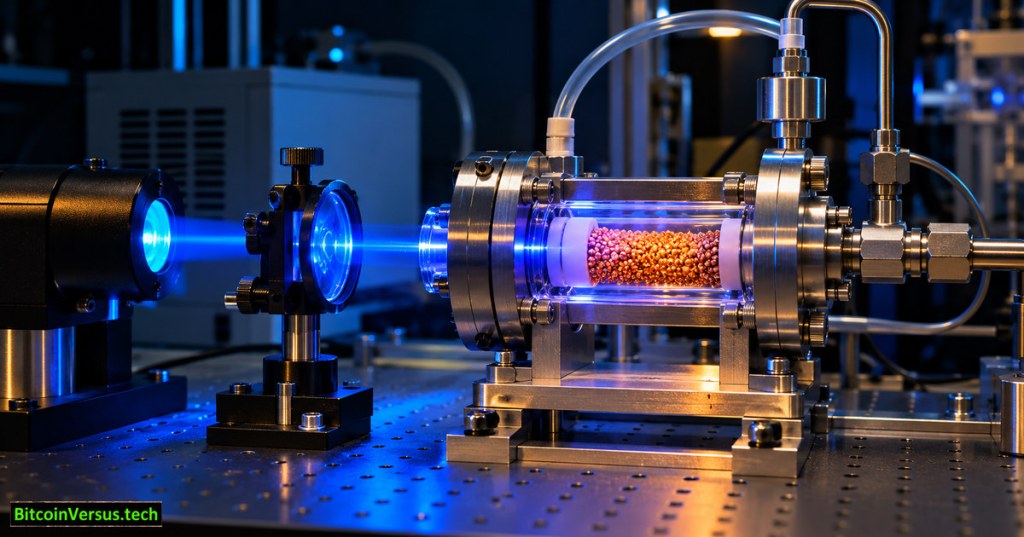
A blue laser shines into a laboratory catalyst, and an exceptionally stable molecule begins breaking apart. Researchers at Rice University reported on November 20, 2026 that a light-powered material converts carbon dioxide into carbon monoxide, a feedstock for synthetic fuels and industrial chemicals. The breakthrough is a demonstration of catalytic chemistry, not a commercially proven system for removing atmospheric carbon or making fuel without energy.
Verified 2024 video from Syzygy Plasmonics, a company licensing Rice’s antenna-reactor technology. It shows related light-powered industrial reactor engineering, not the newly reported 2026 CO₂-splitting experiment.
A copper antenna, a ruthenium reaction site and an oxygen sponge
Ordinarily, carbon dioxide is difficult to split because the carbon–oxygen bonds resist dissociation and the released oxygen can react backward to remake CO₂. Rice combined three functions. Copper nanoparticles absorb visible light and generate energetic charge carriers. Ruthenium sites help activate the target molecules. Cerium oxide, or ceria, accepts oxygen into vacancies in its crystal lattice, reducing the chance of immediate recombination. Researchers describe regeneration with nitrogen gas under illumination. The basic net chemical transformation is CO₂ → CO + ½O₂, although oxygen is temporarily retained by the solid during the working cycle.
The laboratory numbers, converted into practical units
The highest reported carbon-monoxide formation rate occurred under 475-nanometer blue illumination: 15,000 micromoles per hour per gram of catalyst. Converting units gives 15 millimoles of CO, or approximately 0.42 grams of carbon monoxide per hour per gram of catalyst at the peak reported rate. A catalyst-normalized laboratory value is not an industrial reactor throughput or a measure of net energy efficiency.
The light-powered system maintained production for 238 minutes, while the thermal comparison degraded within 35 minutes. Dividing 238 by 35 gives a roughly 6.8-fold longer test duration. Rice also reported nearly three times more CO than a comparable material lacking the ceria oxygen reservoir. Durability over four hours is encouraging, but industrial qualification requires far longer cycling, reliable regeneration and measurements of light-to-chemical efficiency.
Verified 2020 academic lecture by Rice researcher Naomi Halas on the underlying science of plasmonics and sustainability. Historical technical context, not footage of the new Rice experiment.
A critical temperature distinction
The university describes operation without the extreme external furnace temperatures often needed for direct CO₂ splitting. Nevertheless, Rice measured catalyst surface temperatures of 300–386°C under laser illumination. Cooling the surrounding reactor chamber to 10°C increased production, apparently improving gas adsorption. Calling the entire apparatus a room-temperature or heat-free reactor would therefore be misleading. Illumination supplies energy, generates hot carriers and heats local surfaces; an energy audit must count the laser or future light sources along with the remaining plant equipment.
Chemical recycling is not automatically carbon removal
Carbon monoxide is toxic and demands controlled handling, but it is valuable in manufacturing. CO made from captured carbon dioxide may lower fossil feedstock demand if the electricity, capture system, purification and downstream chemistry are sufficiently low-emission. Carbon recycled into a fuel can still return to the atmosphere when burned. For background, BitcoinVersus.Tech previously examined an organic photocatalyst for hydrogen and optical chips that monitor reactions. Both illustrate additional materials and measurement challenges beyond a promising catalyst.
The corporate context also deserves precision. Syzygy Plasmonics has licensed related Rice technology and develops photoreactors, but its older demonstrations of ammonia cracking and reforming do not validate the exact new CO₂-to-CO process at industrial scale. Compare the broader carbon utilization question with our reporting on natural-gas conversion into battery graphite and our explanation of clean versus renewable energy. The next decisive numbers are electrical and optical input per kilogram of CO, catalyst life, regeneration energy, feedstock purity, and plant-level carbon intensity.
Original sources and editorial verification
Research paper: Deneen and colleagues, PNAS, “Direct CO₂ splitting using light-based catalysis and an oxygen reservoir,” DOI 10.1073/pnas.2628340123, online November 16, 2026. University reporting: Rice News, November 20, 2026. The 1200 × 630 featured image is an original photorealistic editorial illustration, not a verified photograph of the research equipment. Both YouTube clips are clearly identified as historical context.
We volunteer daily to ensure the credibility of the information on this platform is Verifiably True. If you would like to support to help further secure the integrity of our research initiative, please scan the QR code below.



Leave a Reply