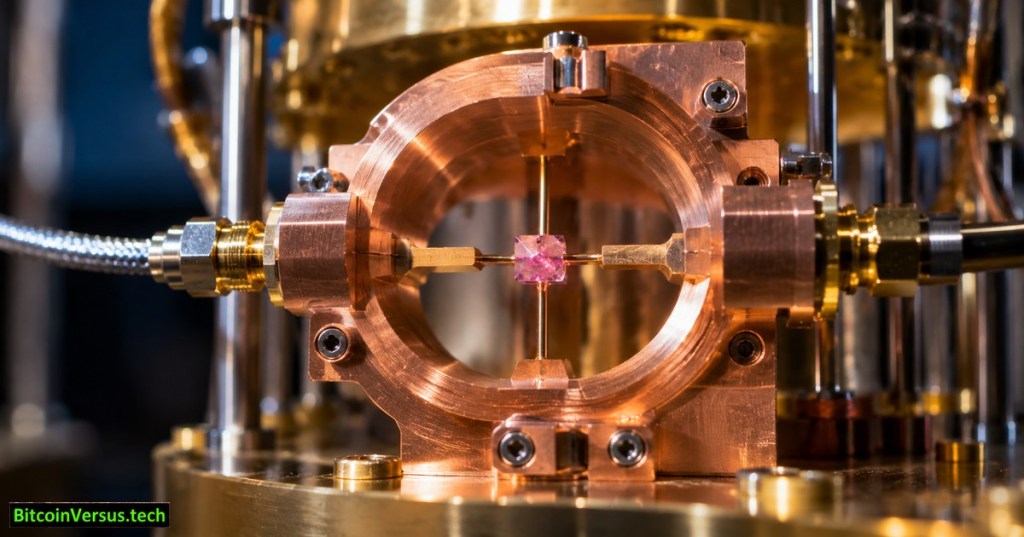
A pink diamond smaller than the copper housing around it has given physicists a new way to hear extremely weak quantum signals. On November 16, 2026, researchers at Japan’s Okinawa Institute of Science and Technology (OIST) reported a cryogenic microwave amplifier with more than 30 decibels of power gain, equivalent to over 1,000 times the input signal power. Rather than relying on superconducting amplifier circuitry, the device uses the magnetic behavior of nitrogen impurities inside diamond.
The result, published in Nature Communications, is a laboratory demonstration, not a finished quantum-computer component. Nevertheless, it addresses a difficult engineering problem: making a faint microwave readout large enough to measure without burying its information in amplifier noise.
Why diamond can amplify microwaves
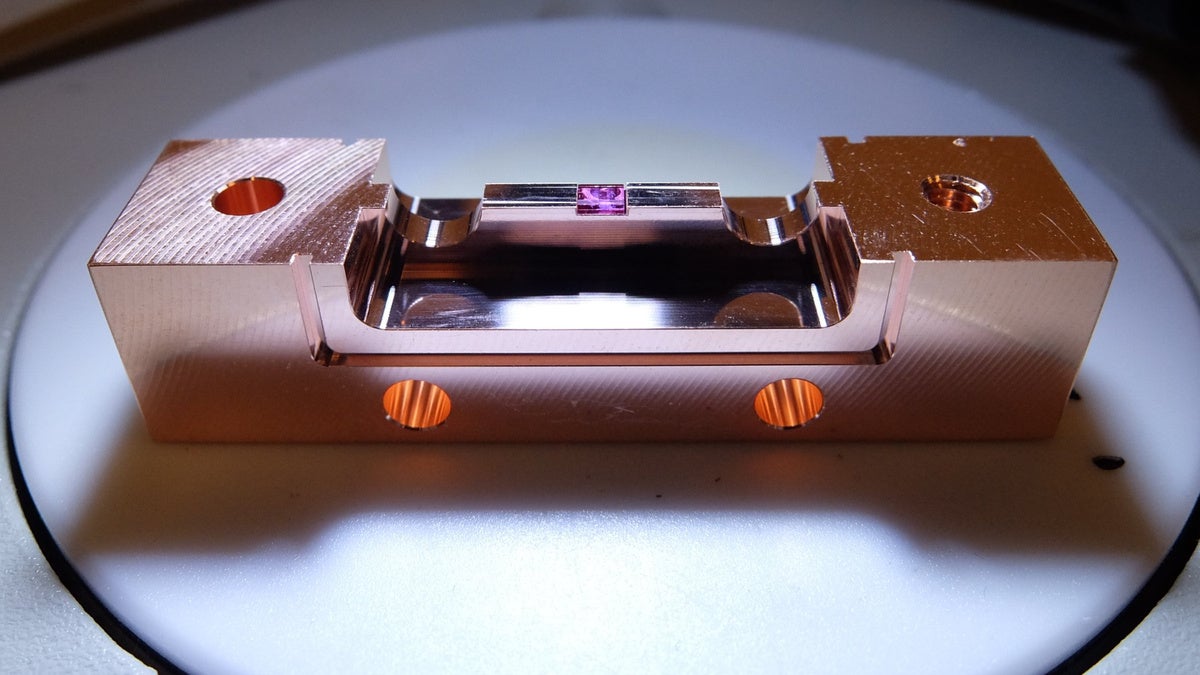
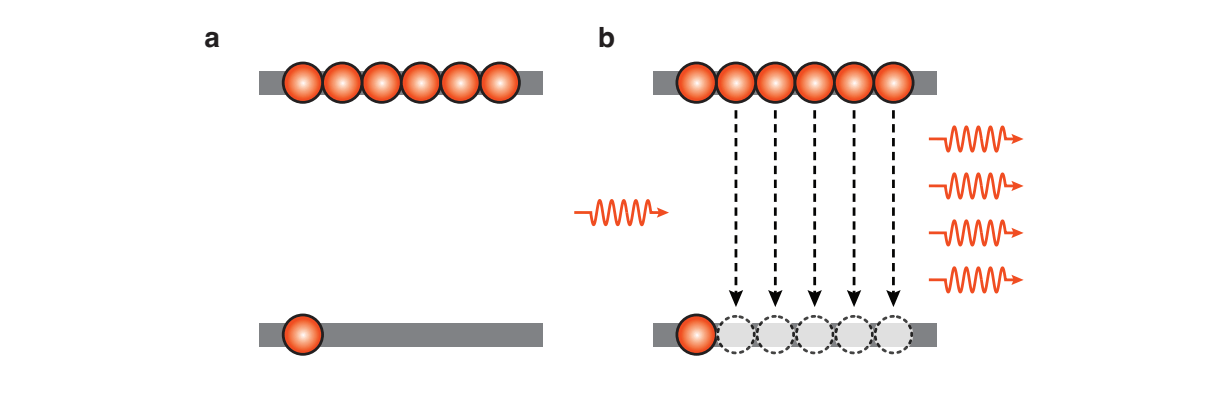
A maser operates like a laser, except its stimulated emission occurs at microwave frequencies. OIST placed a crystal containing substitutional nitrogen impurities, known as P1 centers, inside a copper loop-gap microwave resonator. Their electron spins have energy levels that can be manipulated in a magnetic field. A microwave pump drives a population inversion, increasing the number of spins in an excited state. An incoming microwave signal then induces the spins to emit matching microwave photons, adding energy to the original signal.
The team describes a four-spin cross-relaxation process underlying the inversion. The measured pump requirement was 100 nanowatts or less, according to the research paper. Unlike nitrogen-vacancy-center systems often used for diamond sensing, the active defects in the reported amplifier are substitutional nitrogen P1 centers.
What the measurements actually mean
Power gain in decibels follows G = 10 log₁₀(Pout/Pin). Consequently, 30 dB means 10³, or 1,000 times more output power than input power under the stated operating conditions. Voltage or field-amplitude gain would be about 31.6 times under equal impedance, not 1,000 times. For illustration, a 10-femtowatt input could produce about 10 picowatts at 30 dB gain while the amplifier remains in its linear operating region.
The paper reports a maximum power gain above 30 dB and approximately 2.55 quanta of added noise, compared with the ideal phase-preserving amplifier limit of 0.5 quantum. A maximum 1 dB output compression point of −63 dBm at 6.595 GHz corresponds to about 0.50 nanowatt of output power. A compression measurement identifies where amplification begins departing measurably from its small-signal value; greater gain alone cannot prevent saturation.
A different tool for reading quantum hardware
At millikelvin temperatures, quantum processors produce weak microwave outputs that must be amplified before room-temperature electronics can interpret them. Josephson parametric amplifiers offer excellent noise performance, but magnetic-field sensitivity and saturation can complicate particular designs. The diamond approach is non-superconducting and can work in static magnetic fields, potentially helping spin-qubit platforms. Its laboratory setup used a dilution refrigerator, with a mixing chamber near 13 millikelvin.
Readers exploring the wider field can compare the result with our quantum-computing overview, cryogenic memory research, precision photonic frequency work and quantum-network verification experiment. Each demonstrates a different challenge along the route from quantum phenomena to useful instruments.
Researchers still need to validate long-term stability, integration, readout fidelity, manufacturing repeatability and system-level scaling. The measured 2.55-quanta noise remains higher than the ideal limit. Opportunities in magnetic-resonance spectroscopy, quantum computing and dark-matter sensing are plausible applications rather than commercially established outcomes.
Primary evidence and media
- OIST laboratory announcement, November 16, 2026
- Peer-reviewed study, Nature Communications 17, 11458 (2026)
- Original experimental-device image and license
- Original research figure and license
- OIST 2025 project explainer and official YouTube video
Editorial media note: The featured 1200 × 630 image is an original conceptual photorealistic illustration rather than an image of OIST’s real device. The approved existing BitcoinVersus.tech watermark was copied once at bottom-left. The embedded OIST photograph and research diagram depict the actual 2026 experiment and have CC BY 4.0 attribution.
We volunteer daily to ensure the credibility of the information on this platform is Verifiably True. If you would like to support to help further secure the integrity of our research initiative, please scan the QR code below.



Leave a Reply