Swedish fuel-cell manufacturer PowerCell has won a SEK 440 million order to help turn stored solar energy into dispatchable electricity in the southern United States. Announced November 20, 2026, the agreement with an unnamed U.S. electric cooperative covers a hydrogen fuel-cell installation designed to deliver 20 megawatts (MW) of rated electrical power. Delivery is expected over 18–24 months. An order is a commercial commitment, not evidence of a completed generating station.
The project uses PowerCell’s containerized PowerPod 3000 architecture, with 27 MW of installed fuel-cell capacity and 20 MW of rated output. The company says surplus solar electricity will make hydrogen, which can be stored and later converted back into electricity. It has not disclosed the cooperative’s identity, exact location, hydrogen storage capacity or first commercial operating date.
Official PowerCell Group documentary from March 2025, produced with BBC StoryWorks Commercial Productions. It introduces the company’s fuel-cell technology, not the newly ordered U.S. project.
What does 27 MW installed versus 20 MW rated mean?
The distinction is technical and important. Twenty-seven megawatts describes the aggregate nameplate capacity of installed fuel-cell equipment; 20 MW is the announced rated power the integrated installation is designed to deliver. Dividing 20 by 27 gives approximately 74.1%, but that ratio is not the fuel-cell conversion efficiency. The company has not supplied enough design details to assign the difference among reserves, load management, auxiliaries and other constraints.
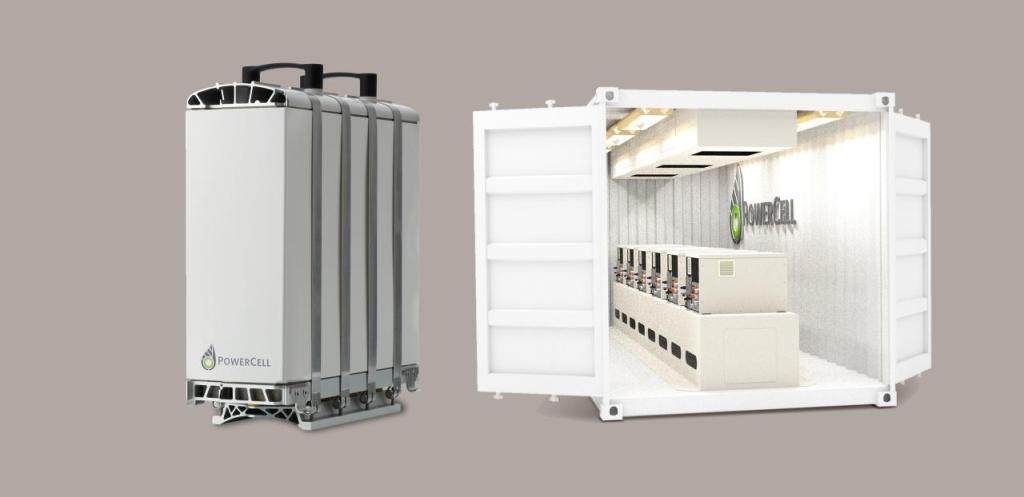
PowerCell’s PowerPod 3000 combines PS190 fuel-cell units, cooling, power-conversion equipment and the Distributed Master Controller (DMC). The DMC coordinates multiple modules as an integrated electricity source. The concept differs from Bloom Energy’s much larger data-center fuel-cell agreement, which uses a different technology and energy-supply model.
How sunshine becomes power after sunset
The cooperative’s broader system will use excess solar power for electrolysis, splitting water into hydrogen and oxygen. Hydrogen then goes into storage. When electricity is needed, proton-exchange-membrane (PEM) fuel cells combine hydrogen electrochemically with oxygen from the air to produce electricity, water and heat. The PowerCell contract covers supply and integration of the fuel-cell generation system; it does not establish that PowerCell is providing every solar panel, electrolyzer or hydrogen tank.
Hydrogen stores chemical energy, not megawatt-hours inside the fuel cells themselves. The project’s discharge duration depends on usable hydrogen inventory, operating conditions and demand. As an illustrative calculation only, 20 MW sustained for ten hours equals 200 MWh of electrical output; PowerCell has not announced that the plant can run for ten hours. Our explanation of round-the-clock solar electricity examines the requirement for storage beyond daylight.
The trade-off: longer storage, lower energy efficiency
Hydrogen can be stored for extended periods, but converting electricity into hydrogen and then back into electricity costs energy at every step. A U.S. Department of Energy storage assessment models 31% round-trip efficiency for one baseline hydrogen system. That figure is a scenario assumption from an earlier national study, not a measured result or forecast for PowerCell’s installation. It is one reason electrochemical batteries are often favored for shorter-duration cycling.
Duration, hydrogen storage cost and the value of firm capacity could change the economics. A contrasting design appears in our report on a proposed ten-hour non-lithium battery, while U.S. battery deployment data show how rapidly competing storage options are scaling.
PowerCell Group’s August 2024 product film provides additional visual context. It is historical company footage and not a demonstration of the announced 20 MW installation.
Can the fuel cells recycle water?
PowerCell says the fuel-cell reaction creates water that might be recovered for reuse after appropriate treatment. Recovery rates and uses depend on equipment design and operating conditions. The claim does not mean the overall solar-to-hydrogen process produces water from nothing: electrolysis consumes water upstream. For comparison, our coverage of sunlight-driven hydrogen research explains a different route to producing hydrogen from water.
The next meaningful milestones are equipment delivery, interconnection, commissioning and independently measured dispatchable output. Operators will also need to document hydrogen supply, safety systems, water balance, availability, maintenance cost and round-trip performance. Until those results arrive, the verified news is a SEK 440 million equipment-and-integration order, not 20 MW of operating capacity.
Sources and supporting materials
- PowerCell Group, November 20, 2026 official order announcement
- PowerCell Group, PowerPod and fuel-cell generation product details
- U.S. Department of Energy, bidirectional hydrogen storage assessment (2023), Table 1
- Renewables Now, November 20 independent industry coverage
- PowerCell Group documentary (2025) and PowerCell product film (2024)
- MAQS, archived photograph of earlier PowerCell hardware
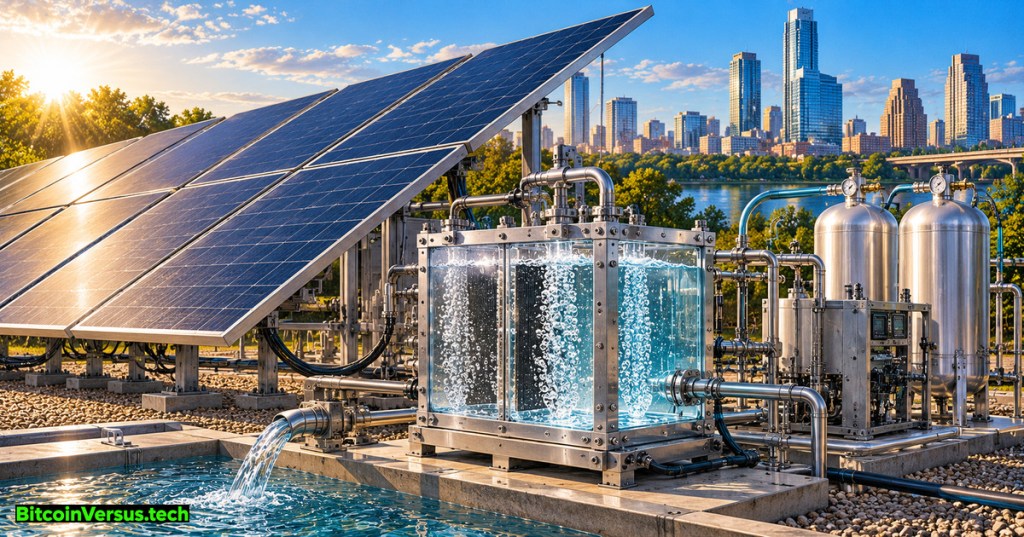
Editorial verification: The featured cover is a conceptual hydrogen-and-solar illustration adapted from BitcoinVersus.Tech’s original artwork, not a photograph of PowerCell’s undisclosed U.S. project. In-story hardware photography and videos show earlier company technology, with their original dates identified.


Leave a Reply