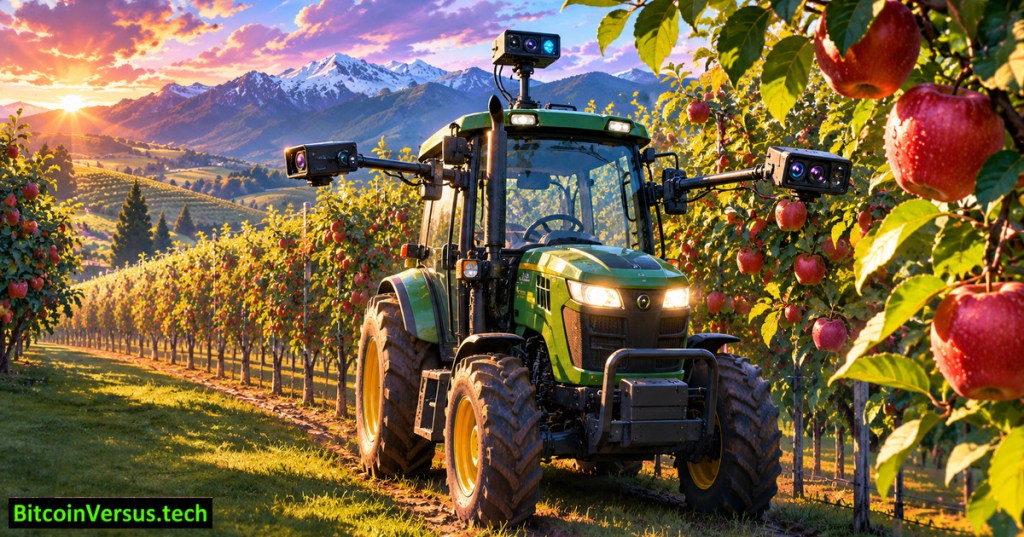
John Deere announced on November 19, 2026, that it acquired Orchard Robotics, operating as Orchard AI, a San Francisco company developing camera-based intelligence for orchards and vineyards. The equipment maker gains a system capable of collecting hundreds of images per tree during field passes and turning them into fruit counts, size measurements, crop-health indicators and yield forecasts. Deere disclosed no purchase price or timetable for integrating the software with its machinery.
How the cameras build a map of every plant
Orchard’s FruitScope Vision system mounts to tractors, all-terrain vehicles and existing farm equipment. The company specifies operating speeds of 1–12 mph, allowing growers to collect imagery as they travel through rows. Its FruitScope OS software organizes detected fruit, canopy conditions and locations into plant-level maps that can inform thinning, irrigation, harvesting and targeted treatments.
Speaking to AgFunder, Wu said cameras process imagery on an onboard NVIDIA Jetson computer because farms may lack enough connectivity to upload enormous raw-image collections. Orchard says normal scans can become actionable results by the following morning. That is a practical edge-computing design choice: local preprocessing reduces backhaul requirements while preserving measurements from thousands of plants.
What the accuracy and savings figures really show
Orchard advertises 95% or better yield-estimate accuracy and cites customer examples including a 63% reduction in certain input costs and chemical savings of 33–50% for applicable thinning passes. Those figures originate from Orchard’s commercial materials and customer accounts, not from a publicly documented independent trial spanning every crop and season. Actual results depend on orchard layout, imaging conditions, sampling, crop variety and the actions growers take after receiving data.
The distinction matters economically. A more accurate forecast can help estimate staffing, packaging and storage needs, but fruit-count measurements do not automatically reduce expenses. Managers must connect a reliable prediction to a specific operational decision and then measure the outcome.
Deere is buying a sensing layer, not a finished robot
John Deere already sells precision equipment and is extending autonomous farm operations. Orchard brings closer observation of individual plants, an information source that could eventually guide variable-rate spraying, pruning or other site-specific work. The official announcement describes a strategic connection between crop intelligence and equipment, but offers no confirmed integration architecture, product availability date or autonomous deployment target.
The challenge differs from autonomous driving. Crops change as fruit grows, light moves, leaves overlap and disease develops. Models must separate fruit from foliage, maintain tree identity across repeated scans and provide useful uncertainty estimates. Reliable location matching matters as much as detecting an apple in one image.
Why the acquisition matters beyond the orchard
Orchard’s approach combines sensing, on-device computation and field execution. BitcoinVersus.Tech recently examined satellite mapping of farm water use, NXP’s robotics development platform, AI control of heavy industrial machinery, and robotic vehicle manufacturing. Orchard occupies a related but distinct point: the sensing system can already help human crews decide where to work before full automation arrives.
The best evidence of progress will be a measured field result: consistent plant-level accuracy, documented savings across growers, reliable compatibility with machinery and clear safeguards for farm data. Until then, the acquisition is a meaningful addition to Deere’s technology portfolio, not proof that farms can operate themselves.
Sources: John Deere, November 19, 2026; Orchard AI, FruitScope product information; AgFunderNews, November 20, 2026. Editorial cover art is illustrative.
We volunteer daily to ensure the credibility of the information on this platform is Verifiably True. If you would like to support to help further secure the integrity of our research initiative, please scan the QR code below.


Leave a Reply