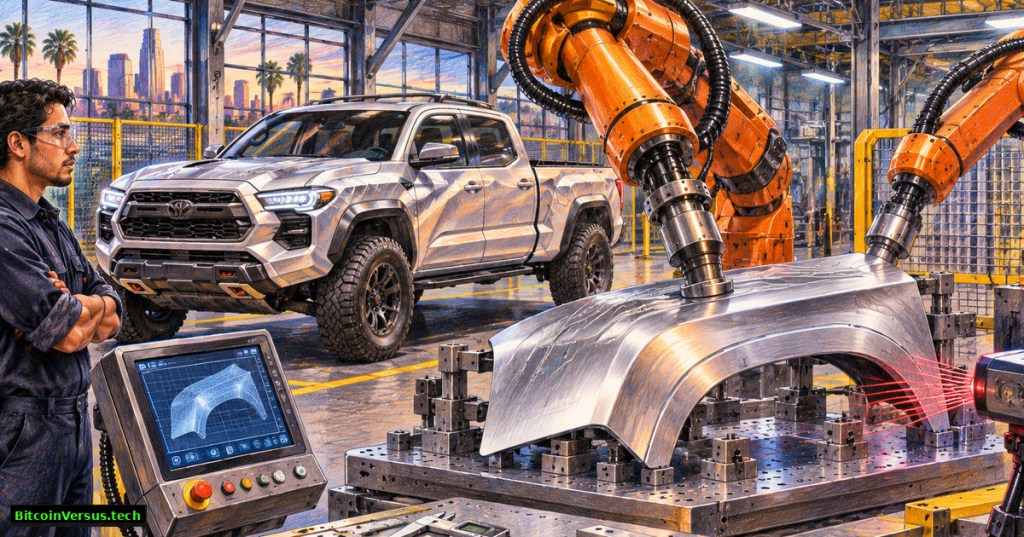
A California robotics company has shown a customized Toyota Tacoma whose metal body panels were formed without building new stamping dies, taking the project from digital design to finished bodywork in roughly three weeks. Machina introduced its automotive brand, Rebellis, alongside the Lassen show truck in November 2026. Design firm CALLUM developed the styling, while Machina’s paired industrial robots shaped and modified metal panels for the Los Angeles Auto Show.
The launch is an example of software-controlled manufacturing aimed at limited production and specialty vehicles, not proof that complete pickups can roll off a robot-only assembly line every three weeks. Machina’s announcement is dated November 18 and appeared on its site November 19; the public auto show runs November 20–29.
Machina Labs, June 11, 2026: the company’s own RoboCraftsman demonstration shows how digital geometry becomes formed metal. Historical machinery footage, not a recording of the November Lassen reveal.
Why the robots do not need a custom stamping die
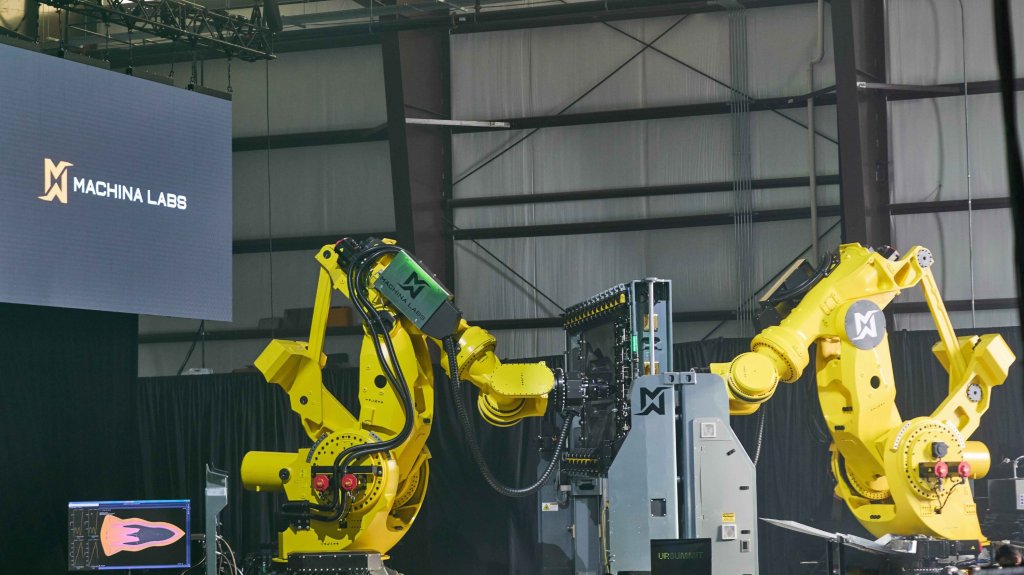
Conventional automotive factories press large metal sheets between expensive matched tooling. The process is fast and repeatable once a high-volume production run begins, but changing the geometry of a hood or fender generally requires major tool design and validation. Machina’s original Rebellis announcement describes a different approach: its RoboCraftsman cell incrementally forms sheet metal using programmable robotic tooling rather than a dedicated die for each shape.
The platform combines robotic metal forming with laser scanning. A scanner maps the actual surface, software compares the result with a CAD model, and the next toolpath can compensate for deviations. The company says its equipment can handle parts as long as 12 feet, or about 3.7 meters, and structural sheet up to one-quarter inch thick in supported conditions. Those figures describe platform capabilities, not independently measured performance for every automotive material.
What changed on the Lassen pickup
The Lassen is a customized interpretation of an existing Toyota Tacoma, not a new Toyota factory model. CALLUM’s design references the volcanic terrain around Lassen in California. The show truck received distinctive body panels including a hood, front fenders, bedsides and tailgate. Some pieces were fully formed; others, such as the stamped hood and tailgate, were modified with raised designs.
Machina describes a roughly three-week design-to-bodywork process. At a factory presentation, the company gave journalists an approximately two-and-a-half-week timeline for the demonstrated parts. Both are project-specific claims rather than universal guaranteed lead times. An independent factory visit reported that visible surfaces still needed finishing, with about a week spent refining appearance, sanding and painting in the example discussed.
Machina Labs’ original “Anvil: Your Unique Car, Handcrafted by Robots” video documents an earlier customized pickup concept. Archival automotive proof of concept, not the Lassen vehicle.
Where robotic forming may fit in real car factories
The potential market is strongest where customers want varied shapes in small batches. Bespoke trucks, replacement parts and short-run vehicle editions can struggle to justify a dedicated stamping tool. For those programs, eliminating new dies could shorten design iterations and reduce upfront equipment requirements. Yet high-volume stamping still offers an important per-piece speed advantage once the tooling has been paid for.
Machina says it plans to serve automakers and aftermarket builders from its own facilities, with deployable manufacturing cells possible at customer plants after qualification. Commercial-scale costs, production yields, vehicle crash compliance and warranty performance have not been independently established by the Lassen reveal.
The automotive work differs from the company’s earlier drone-airframe factory project. More broadly, Toyota’s factory-robot planning, GM’s automation targets, and the global industrial-robot installation figures reflect different stages of manufacturing adoption. The key test for Rebellis is whether its rapid custom-panel demonstrations become repeatable, profitable production programs.
Sources and verification
- Machina official November 18–19, 2026 Rebellis and Lassen announcement
- Machina RoboCraftsman capabilities and forming/scanning specifications
- 2026 LA Auto Show official exhibition listing for Lassen
- Car and Driver, November 19, 2026 factory presentation and body-panel details
- The Autopian, November 20, first-hand report on forming and surface finishing
- Machina’s original video directory for both historical demonstrations
Editor’s Note: Three weeks describes the reported custom-body project, not complete truck manufacturing or independently benchmarked production throughput. Original colored-pencil cover artwork depicts a fictional engineer and an illustrative factory scene. The two company videos and official demonstration photo predate the Lassen reveal. Figures attributed to Machina are identified as company claims.
Editor’s Note: We volunteer daily to ensure the credibility of the information on this platform is Verifiably True. If you would like to support to help further secure the integrity of our research initiatives, please scan the QR code below

For mobile scanning, open the article on another display and scan the QR code with a Bitcoin wallet. The voluntary donation amount is 5,000 sats. Verify the receiving address 3C9o19EH5HSiwEPyCTmEKzxhNCbo2X6TTb before sending.
BitcoinVersus.Tech publishes technology and financial journalism for informational purposes and does not provide financial, investment, or legal advice.


Leave a Reply