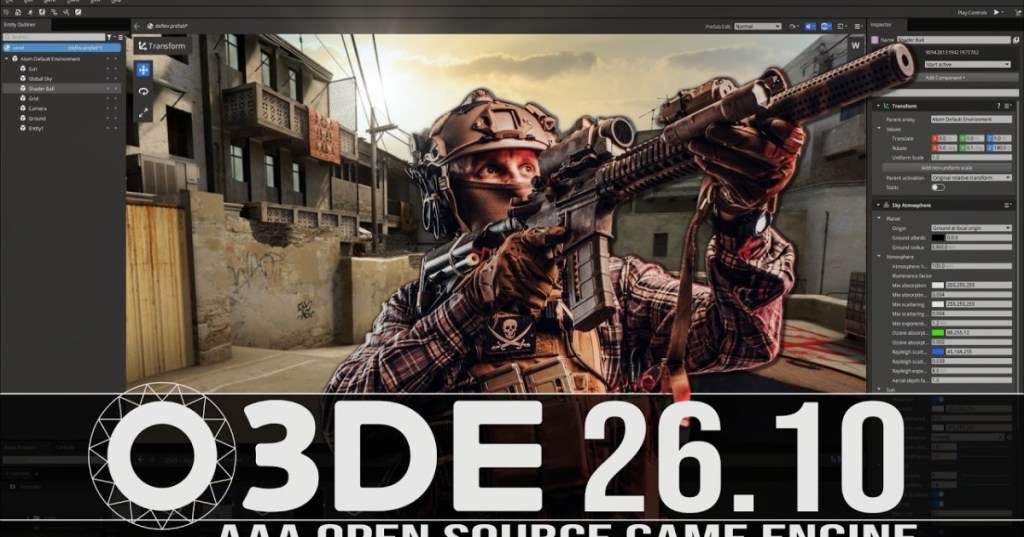
Open 3D Engine (O3DE) has released version 26.10.0, advancing an open-source platform used for game development and robotics simulation. The project’s release index dates the Windows and Linux packages to November 20, 2026. The update modernizes the development environment, expands robot simulation interfaces and introduces preliminary support for additional computing platforms. For developers evaluating engines alongside projects such as Godot 4.8, the release demonstrates how open-source engines continue to extend their capabilities beyond entertainment.
GameFromScratch examines the O3DE 26.10 release in a November 23, 2026 video. Watch directly on YouTube.
Modernizing the development environment
According to the official technical changelog, O3DE now builds its editor and associated tools against Qt 6.10.2 rather than its older Qt 5 dependency. Changes include improved entity inspection, more consistent keyboard shortcuts and undo functionality for asset editing. Such improvements matter because developers spend substantial time modifying scenes, inspecting components and correcting configuration errors.
Platform support requires careful interpretation. Native ARM64 compilation for Apple Silicon remains experimental. On Linux, initial Wayland support applies to the game launcher, while the editor continues to rely on X11 or XWayland. The project documents startup failures when forcing native Wayland operation in the editor. The WebAssembly work is also preparatory, not a finished browser deployment system. Those boundaries distinguish O3DE’s progress from other browser-oriented engine developments, including Unreal Engine’s WebAssembly work.
Robotics simulation and repeatable experiments
The engine now supports ROS 2 Lyrical Luth across its robotics extensions. The simulation interface can create several entities in a single service request, and simulated objects are explicitly removed before a level unloads. Camera components can publish compressed image streams. Robot importing also incorporates improvements in how inertial properties are interpreted from robot descriptions.
Open 3D Engine’s official December 2024 presentation explains the engine from a simulation engineer’s perspective. It provides historical context rather than a demonstration of the new release. Watch directly on YouTube.
These changes can help engineers develop repeatable scenarios. A simulated warehouse, for example, needs consistent starting conditions when comparing navigation algorithms. If objects survive an environment reset, subsequent tests may not reproduce the original conditions. Camera compression can reduce communication demand, although encoding introduces computational costs and potentially changes the information available to downstream perception algorithms. Real-world tests are still necessary before deploying autonomous equipment, as illustrated by our coverage of DHL’s warehouse robotics infrastructure.
Physics and rendering converge across applications
O3DE completes its transition away from PhysX 4 toward PhysX 5 and introduces optional enhanced determinism at the scene level. Determinism helps reproduce simulation behavior under controlled conditions, but the option does not establish identical results across every platform or hardware configuration. The engine also adds an alternative ambient-occlusion technique and integrates its shader compiler into the source tree. Our reporting on EVE Frontier’s open-source ambient-occlusion work explores a related rendering challenge.
The official download page provides the released software. Prospective users should test their own assets, plugins, graphics drivers and simulation workloads before migrating production projects. O3DE’s release is a practical step toward shared tooling for interactive graphics and virtual engineering environments, rather than evidence that every experimental feature is ready for deployment.
Featured image: GameFromScratch video thumbnail, November 23, 2026; cropped for editorial presentation.
We volunteer daily to ensure the credibility of the information on this platform is Verifiably True. If you would like to support to help further secure the integrity of our research initiative, please scan the QR code below.



Leave a Reply