Runway and Meta’s PyTorch team have reduced the inference latency of a 27-billion-parameter robot-control model without requiring the full PyTorch framework on the deployment machine. Their November 25, 2026 announcement describes an implementation of Praxis-1 using ExecuTorch and NVIDIA TensorRT. The companies report similar accuracy and approximately 20% lower GPU memory consumption than Runway’s reference implementation.
Praxis-1 became available on November 11 under an Apache 2.0 license, including model weights and code for inference and adaptation. The November 25 development focuses on executing the model more efficiently, rather than increasing its parameter count or establishing a new robot task-success record.
Predicting what a robot will do next
Traditional robot policies can map camera observations and instructions directly to movements. Praxis-1 additionally predicts visual consequences of its actions. Its technical report describes a video model paired with a separate action-prediction transformer. Each inference produces a sequence of 24 action rows representing 1.6 seconds of movement at 15 Hz. Subsequent observations provide feedback for the next prediction.
The mixture-of-experts architecture activates approximately 2.8 billion of the 26.9 billion backbone parameters for each token. That reduces the arithmetic required relative to activating all weights, but the system still needs memory for model parameters and intermediate data. Specialized inference runtimes can improve how those resources are used.
Measuring the latency improvement
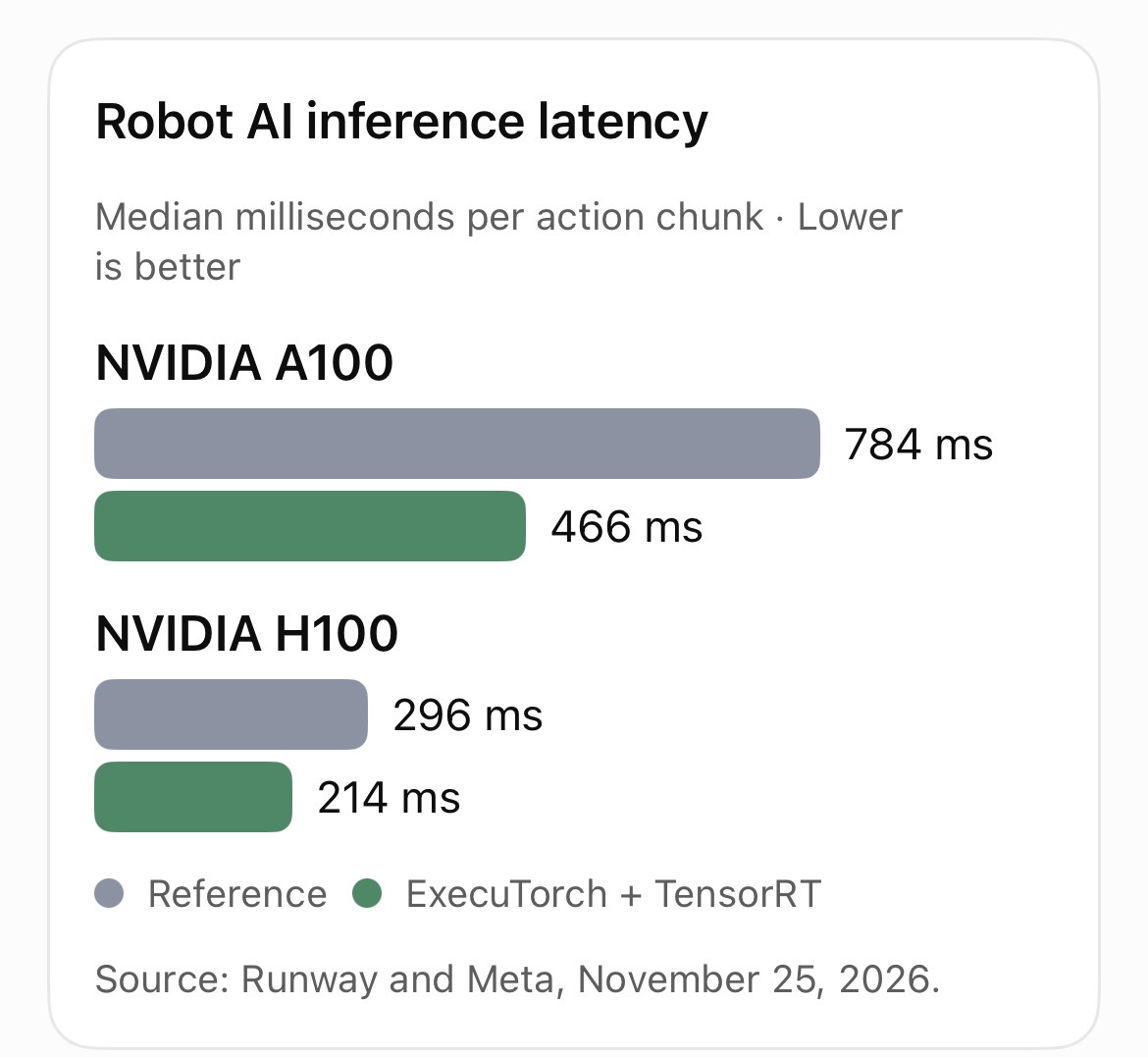
Runway reports that median action-chunk inference latency on an NVIDIA A100 fell from 784 milliseconds to 466 milliseconds. On an H100, latency declined from 296 to 214 milliseconds. The respective reductions are 40.6% and 27.7%, equivalent to speedups of 1.68× and 1.38×. The A100 result does not establish a 68% reduction in latency; speedup and elapsed-time reduction are different measurements.
The PyTorch engineering report published November 24 explains how the compiler partitions operations between TensorRT and an ExecuTorch CUDA backend. Operations remain on the GPU rather than repeatedly transferring intermediate tensors to the host processor. Ahead-of-time compilation also removes the requirement to load the general PyTorch runtime on the robot.
From benchmarks to robot deployments
Lower inference latency gives a robot more opportunity to incorporate fresh observations, but physical responsiveness also depends on sensor acquisition, communication, trajectory generation and motor control. The reported GPU benchmark measures one component of that chain. It does not establish hard real-time guarantees, energy savings or safety certification.
Our coverage of Genesis AI’s dexterous robotics, MIPS robot-joint processors, ASRock’s local robot-training platform and NVIDIA’s motion-generation research illustrates the separation between learned movement, computing infrastructure and physical actuation.
Developers can access the base checkpoint after accepting its access conditions, and reproduce the deployment workflow using the published engineering instructions. The base checkpoint requires robot-specific adaptation before operating as a policy. Independent hardware measurements and representative deployment trials remain important next steps.
Sources: Runway and Meta, November 25; PyTorch, November 24; Runway Research, November 11; Hugging Face model documentation. Featured image: Runway’s November 11 Praxis-1 release announcement.
We volunteer daily to ensure the credibility of the information on this platform is Verifiably True. If you would like to support to help further secure the integrity of our research initiative, please scan the QR code below.



Leave a Reply