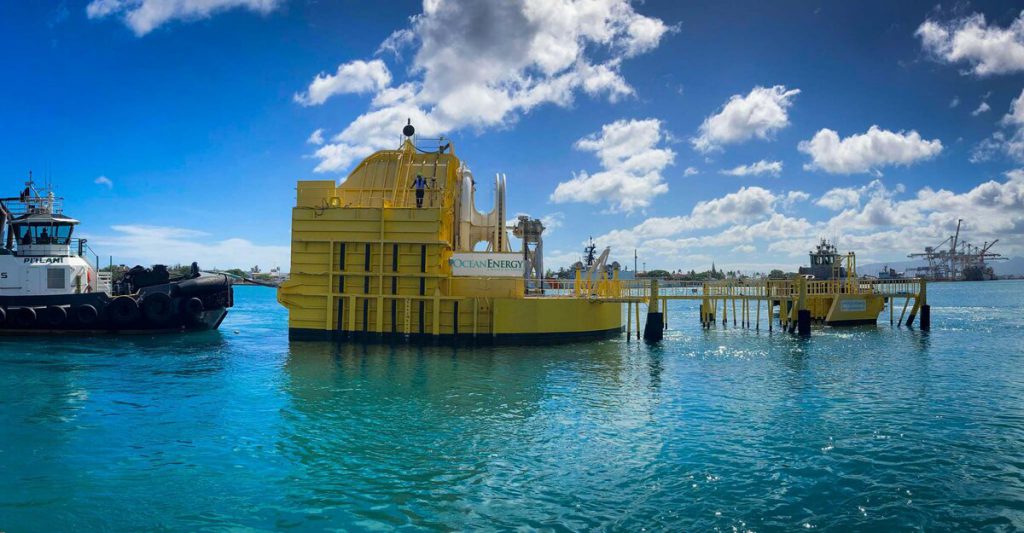
Scotland has cleared another regulatory hurdle in the development of utility-scale wave energy. The European Marine Energy Centre (EMEC) announced on November 20, 2026 that the WEDUSEA consortium had secured a marine licence to install OceanEnergy’s 1 MW floating wave energy converter and its moorings at Berth 5 of the Billia Croo test site in Orkney. The authorization permits installation; it does not establish that the equipment has been deployed or begun exporting electricity. The project complements Scotland’s separate EURO-TIDES tidal energy development, which harvests moving seawater rather than surface-wave motion.
Generating electricity from alternating airflow
The Irish developer uses an oscillating water column inside a floating steel structure. Water can enter a chamber through an opening beneath the surface. As the surrounding waves raise and lower the water column, air within the chamber moves through a turbine. A Wells turbine can maintain its direction of rotation even when airflow reverses, allowing a generator to extract useful mechanical energy during both portions of the wave cycle.
According to the project’s technology description, the rotor remains above the water, reducing direct exposure of moving machinery to seawater. Moorings constrain the floating platform while a subsea electrical connection carries generated power ashore. The design faces different mechanical loading conditions from those of fixed offshore wind foundations, where the supporting structure transfers loads into the seabed.
Rated capacity versus energy delivered
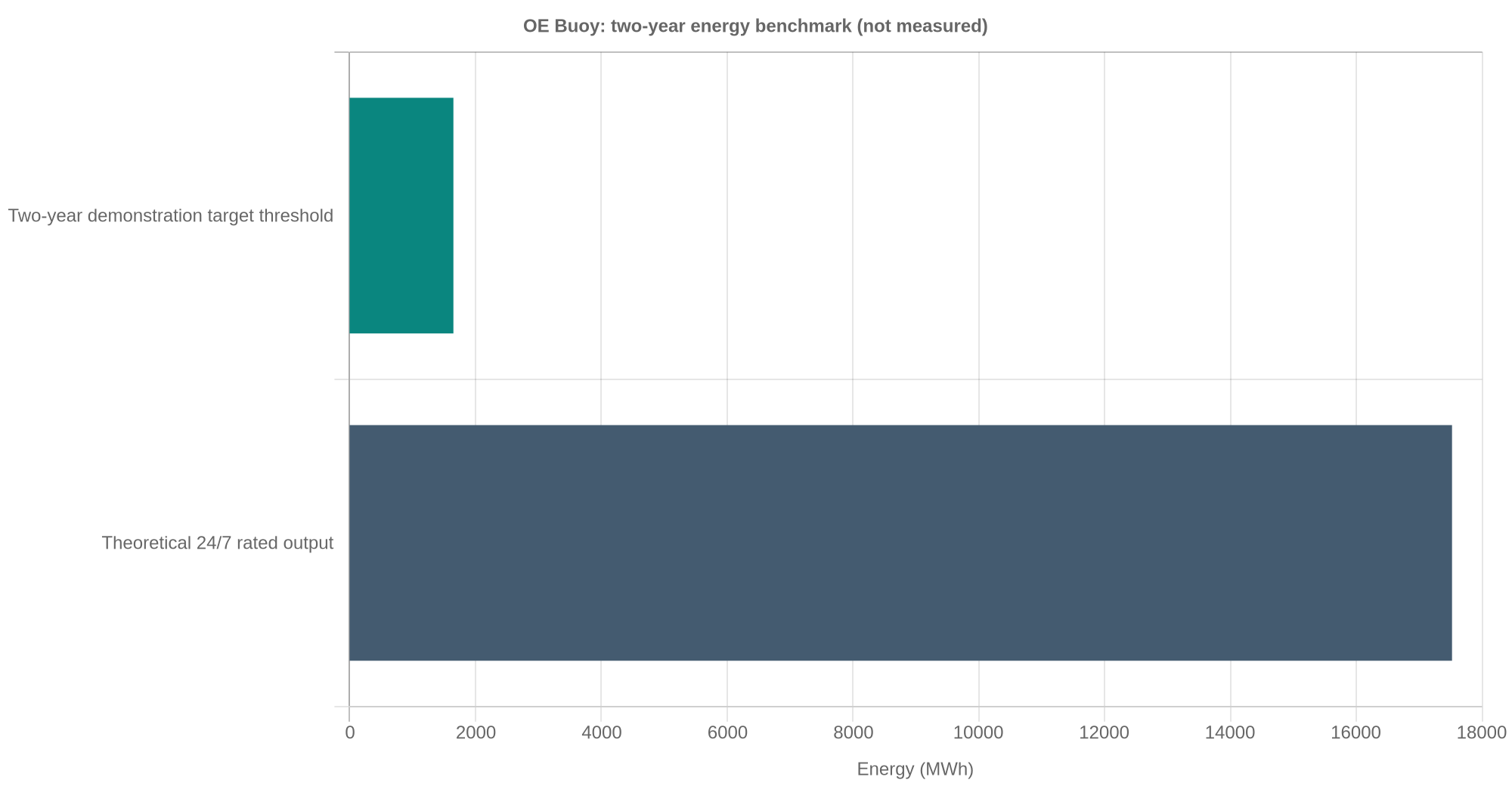
The demonstration plan anticipates more than 1,650 MWh of cumulative production over a two-year deployment. A continuously operating 1 MW generator would theoretically deliver 17,520 MWh over two 365-day years. The stated threshold therefore corresponds to approximately 9.4% of uninterrupted nameplate output, or roughly 94 kW averaged across the period. It is a project benchmark rather than a measured capacity factor, commercial performance forecast or upper limit. Commissioning, maintenance, environmental conditions and testing schedules can affect the result.
The distinction between power and cumulative electricity production also matters for conventional renewable infrastructure. For example, the 46 MW Biovéa biomass plant in Côte d’Ivoire uses a fundamentally different fuel and conversion process. Nameplate ratings alone cannot establish the annual energy supply or financial performance of either technology.
Testing commercial readiness
The €19.6 million WEDUSEA programme brings together 14 partners with European Union and Innovate UK support. Its planned demonstration includes environmental monitoring and autonomous operation. Engineers must assess the energy conversion equipment, cable reliability, storm survival, maintenance access and the ecological consequences of installing a large floating structure. Baseline monitoring before installation provides a reference for interpreting subsequent changes.
Grid connection and dependable electricity delivery are separate milestones, as demonstrated by the planned Tina River hydropower project in the Solomon Islands. For the OE Buoy, the next evidence will be completed installation, electrical commissioning and documented energy output across varying sea states. The marine licence advances the demonstration toward those milestones without establishing commercial viability.
Featured photograph: OceanEnergy, via the WEDUSEA project website. Historical OE35 equipment photograph.
We volunteer daily to ensure the credibility of the information on this platform is Verifiably True. If you would like to support to help further secure the integrity of our research initiative, please scan the QR code below.



Leave a Reply