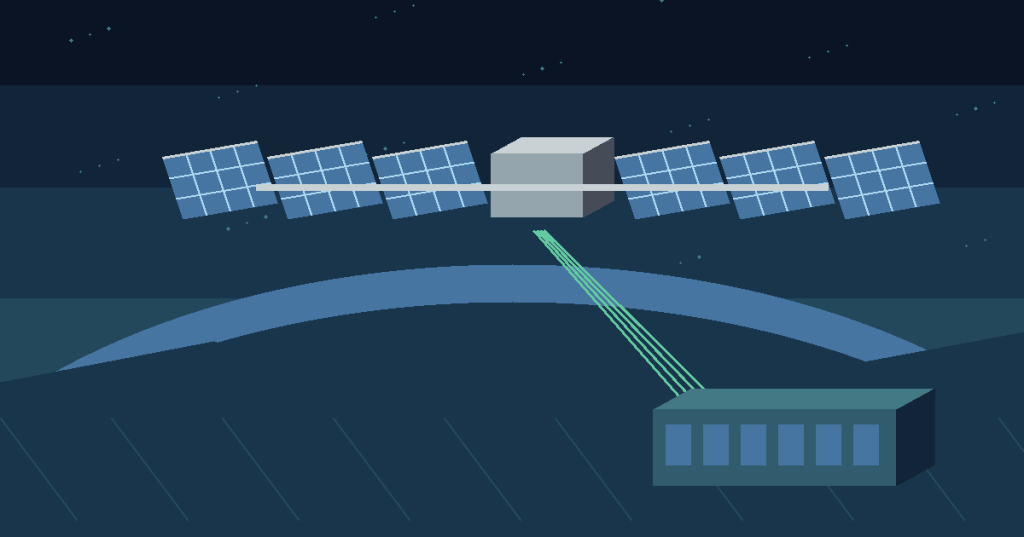
A proposed electricity supply chain for AI computing would begin in orbit and end underwater. On September 30, Virtus Solis announced a 20-year power purchase agreement with Brae Systems. The agreement specifies an initial 100 MW supply from a planned space-based solar installation, with an option to expand to 250 MW within three years of initial commercial operations. Neither the commercial orbital generator nor the customer’s proposed submerged computing deployment has been demonstrated at the contracted scale.
The concept extends earlier proposals for underutilized energy resources into a prospective commercial arrangement. A solar collector in orbit would convert sunlight to electricity, then use radio-frequency transmitters to direct electromagnetic energy toward receiving antennas on Earth. Rectifying antennas would convert received radio-frequency energy into direct-current electricity for downstream power conversion and distribution.
The conversion chain determines delivered energy
A 100 MW continuous delivered supply would provide 876,000 MWh during a non-leap year, consistent with the contract announcement. An expanded 250 MW continuous supply would correspond to 2.19 TWh annually. Those figures are contractual arithmetic, not measured generation.
Every conversion stage introduces potential losses. If a hypothetical system converted 50% of collected electrical energy into usable electricity at the receiver, delivery of 100 MW would require 200 MW of orbital electrical output. The 50% value is an illustrative engineering assumption, not a verified performance figure for Virtus Solis. Solar cell efficiency, transmitter conversion, beam capture, rectification, spacecraft availability and ground equipment all influence the final energy balance.
From a ground station to submerged computing
Latitude Media reported that the developer intends to establish a receiving station in Illinois, where Brae plans an initial underwater installation in the cooling ponds of a retiring coal plant. A submerged computing enclosure could transfer heat through engineered heat exchangers, but underwater placement does not eliminate pumps, thermal resistance, equipment failures or maintenance requirements.
Related efforts include renewable-powered offshore GPU systems and wave-powered AI nodes. A separate floating solar GPU demonstration illustrates why small demonstrations and utility-scale commercial systems must be evaluated separately.
Virtus Solis identifies a public wireless-power demonstration in March 2027 as its next major technical milestone. Independent reporting also identifies financing and orbital pilot requirements. A signed purchase agreement signals prospective demand, but launch capacity, deployment reliability, spectrum and land approvals, end-to-end conversion efficiency and a successful commercial installation remain decisive uncertainties. The engineering challenge is to demonstrate reliable power delivery across the complete system rather than merely individual components.
We volunteer daily to ensure the credibility of the information on this platform is Verifiably True. If you would like to support to help further secure the integrity of our research initiative, please scan the QR code below.

For mobile scanning, open the article on another display and scan the QR code with a Bitcoin wallet. The voluntary donation amount is 5,000 sats. Verify the receiving address 3C9o19EH5HSiwEPyCTmEKzxhNCbo2X6TTb before sending.
BitcoinVersus.tech is not a financial advisor. This media platform reports on financial subjects purely for informational purposes.


Leave a Reply