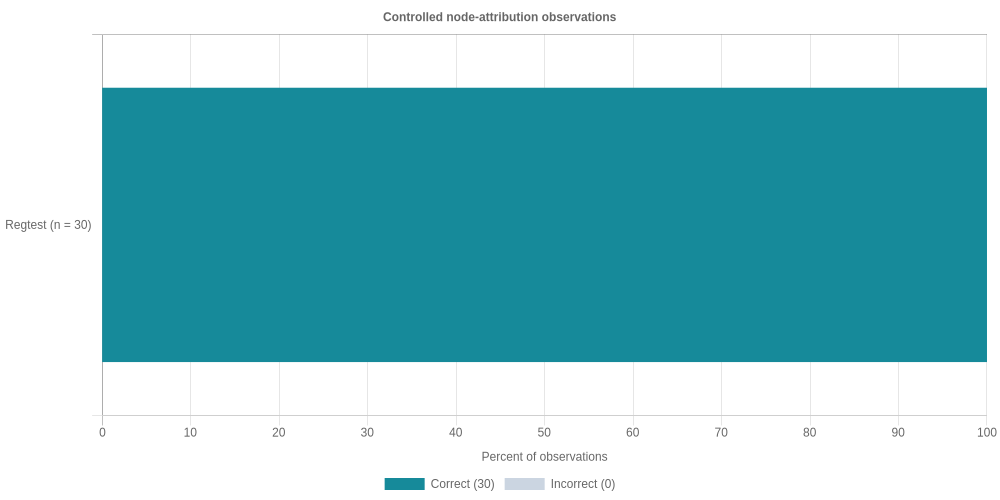
Bitcoin Core contributor Abubakar Sadiq Ismail published a wallet privacy analysis on November 25, 2026, demonstrating that automatic transaction rebroadcasting can expose an association between a monitored Bitcoin address and the node tracking it. A controlled local-network experiment produced 30 correct attributions across 30 observations. The finding concerns network metadata rather than a failure of Bitcoin’s signature verification or monetary consensus. Our recent Sparrow Wallet coverage provides complementary context about wallet connectivity and transport privacy.
The distinction between wallets and nodes
A Bitcoin wallet manages keys or monitors addresses, while a full node independently checks blockchain data and transactions against consensus rules. Wallets may share a machine with a full node or communicate with one through an external service. The network endpoint associated with a node is not necessarily the location of the private keys, the identity of the wallet owner or the physical location of a particular person.
Bitcoin’s peer-to-peer network distributes transaction announcements to other nodes. Rebroadcasting helps transactions remain available for eventual confirmation, but a wallet-specific announcement may carry an observable signal beyond the public blockchain record. Research into transaction origin privacy has explored reducing such distinguishing behavior. Our coverage of Floresta’s lightweight node implementation illustrates another architectural choice for independently checking blockchain data.
What the controlled experiment establishes
The researcher tested five target wallets over six trials on a private Bitcoin regression-test network, known as regtest. All 30 observations returned the correct node attribution under the experimental conditions. The result establishes that the behavior exists in the controlled configuration. It does not demonstrate a 100% success rate across the public Bitcoin network, where topology, connectivity, wallet software and network conditions differ.
Privacy improvements are layered
A hardware signing device can isolate private keys without necessarily hiding the network behavior of a wallet that monitors its addresses. Likewise, an encrypted connection protects data in transit but does not automatically prevent every inference by a participating peer. Separating these risks helps explain the motivation behind our coverage of watch-only silent payment scanning.
Andreas M. Antonopoulos discusses wallets, full nodes and monetary sovereignty in a January 2019 educational video. Historical background, not a demonstration of the November 2026 study.
Developers are discussing changes to wallet rebroadcast behavior. As of the published analysis, proposed modifications should not be mistaken for a deployed fix. CryptoSlate’s November 27 reporting also distinguishes the laboratory findings from broader network risk.
The research reinforces a broader principle: protecting signing keys, reducing address reuse and limiting network metadata leakage are different goals. Our reporting on silent payments in the Breez SDK highlights why privacy requires evaluation across multiple software layers. Users should follow maintained wallet documentation and avoid changing transaction-relay settings without understanding their effects. Independent validation under realistic network conditions remains important.
Featured image: historical Bitcoin Core 0.10.0 screenshot, Bitcoin Developers, 2015, MIT license, cropped. Not the test environment.
We volunteer daily to ensure the credibility of the information on this platform is Verifiably True. If you would like to support to help further secure the integrity of our research initiative, please scan the QR code below.



Leave a Reply