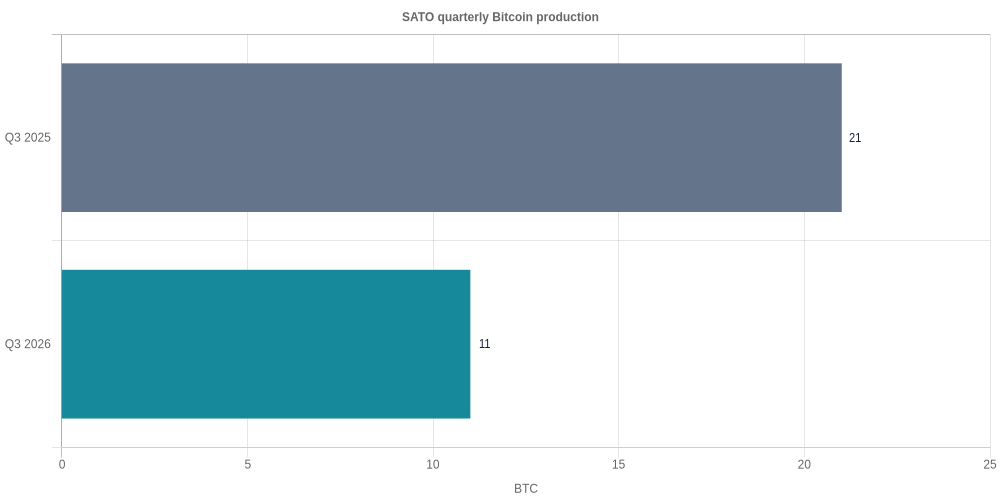
SATO Technologies reported mining 11 BTC during the quarter ended September 30, 2026, compared with 21 BTC a year earlier. The company’s November 25 quarterly announcement attributes the decline to operational reductions and higher network computing power. The financial results provide new context for our earlier reporting on the first AI deployment at SATO’s Québec mining facility.
Bitcoin output and revenue declined
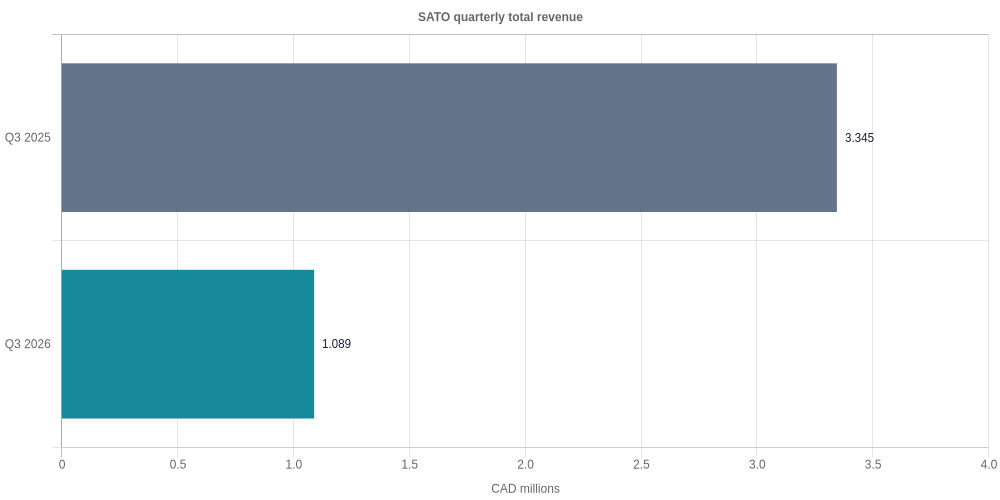
Quarterly production fell by 10 BTC, or approximately 47.6%. Total revenue declined from C$3,344,866 to C$1,089,353, a reduction of roughly 67.4%. Bitcoin production and Canadian-dollar revenue measure different outcomes. Revenue reflects the value of mined coins and accounting treatment as well as production volume, so the percentage changes need not match.
The operating decision behind lower production
Management reported reducing the clock speed of up to approximately half of its mining fleet during periods when machines were not profitable. Lower frequencies can reduce electrical consumption, depending on the voltage and firmware settings, but they also reduce computing output. Optimal operation depends on machine-level efficiency, pool compensation, electricity tariffs and network difficulty. Our November difficulty-adjustment analysis explains why higher network difficulty reduces the expected gross output of an unchanged amount of hashrate.
The company also sold approximately 150 older-generation mining machines after quarter-end. That disposal does not quantify the current operating fleet or its remaining hash capacity. SATO’s reported results included a gross loss of C$293,009, while a gain associated with settling secured debt helped produce positive net income. A nonrecurring accounting gain should not be interpreted as improved mining unit economics.
A changing role for powered infrastructure
Center One has approximately 20 MW of hydroelectric-powered capacity in Joliette. SATO’s first AI hosting customer has begun deploying equipment in part of the facility, while mining continues elsewhere. Management has commissioned conceptual engineering work for broader AI and high-performance computing use. Neither the existing power connection nor the first hosting agreement establishes that all 20 MW have been converted to AI.
Blockspace interview with SATO CEO Romain Nouzareth, July 2026, discussing the separate Bhutan AI infrastructure proposal. Historical strategic context, not evidence of operating capacity in Québec.
Similar decisions appear in our reporting on Bitdeer’s proposed Norwegian AI conversion. Reusing electrical infrastructure can shorten some development stages, but GPU hosting introduces different cooling, networking, availability and customer-service requirements.
SATO’s quarterly results demonstrate why capital allocation requires more than a comparison of nominal mining and AI revenue. The engineering and commercial milestones must be evaluated separately, as discussed in our Rockdale expansion coverage. Future reporting should track actual mining production, contracted hosting capacity, conversion expenditure and recurring operating margins.
Featured image: SATO corporate website representative server photograph, not a photograph of Center One.
We volunteer daily to ensure the credibility of the information on this platform is Verifiably True. If you would like to support to help further secure the integrity of our research initiative, please scan the QR code below.



Leave a Reply