Cognition released SWE-2.1 on November 24, 2026, reporting substantial improvements in autonomous software engineering over SWE-2. The developer’s announcement describes further reinforcement learning on the Kimi K3 foundation model, with emphasis on sustained engineering tasks. The model is available through Devin’s cloud, desktop and command-line environments. Earlier developments in autonomous programming, including Claude Code agent loops, illustrate the transition from individual code suggestions to systems that repeatedly inspect, modify and test repositories.
Benchmark performance
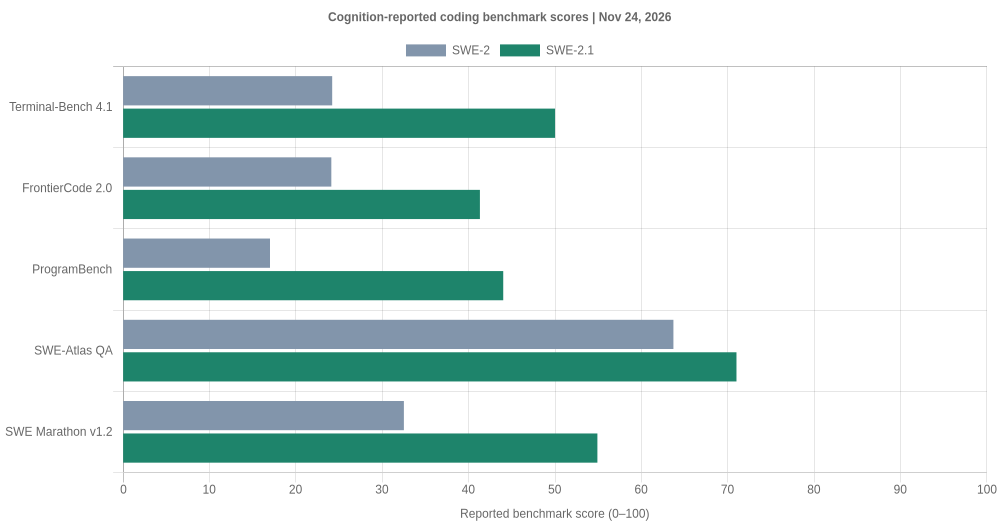
Terminal-Bench 4.1 rises from 24.2 to 50.0, a gain of 25.8 points and approximately 2.07 times the earlier score. FrontierCode 2.0 improves from 24.1 to 41.3; ProgramBench from 17 to 44; SWE-Atlas QA from 63.7 to 71; and SWE Marathon v1.2 from 32.5 to 54.9. The tests measure different tasks and should not be averaged into a single performance multiplier. Cognition’s methodology mixes reported and internally evaluated scores across competing models, limiting direct cross-vendor comparisons.
Reinforcement learning and execution budgets
Reinforcement learning adjusts model behavior using feedback associated with completed actions. For software engineering, an evaluation environment may expose a repository, a terminal and a test suite. The reward can depend on whether a change meets requirements rather than whether the generated source merely looks plausible. The process differs from training solely on examples of human-written code. A working interpreter and reproducible project configuration remain essential, as discussed in our Positron development environment coverage.
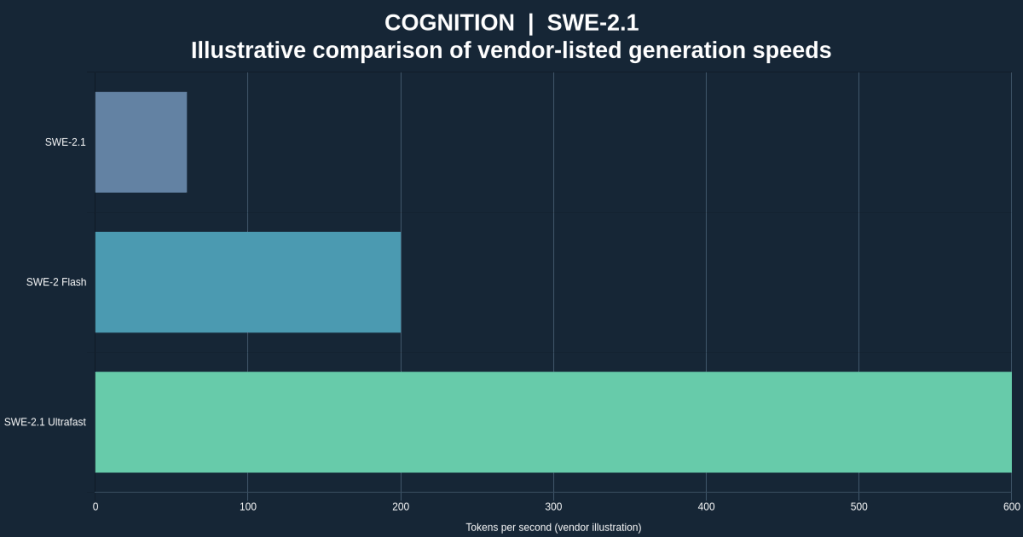
Cognition also advertises an Ultrafast configuration served through Cerebras. Its launch-page illustration lists 60 tokens per second for SWE-2.1, 200 for SWE-2 Flash and 600 for the Ultrafast variant. Those values describe advertised generation speed rather than independently measured end-to-end completion time. Tool execution, context processing, compilation and tests may still consume much of the elapsed time. The distinction between throughput and latency is explained in our Little’s Law technical explainer.
Production validation remains necessary
Cognition reports additional security monitoring during training and a separately configured defensive security product. Organizations deploying coding agents should restrict repository privileges, isolate execution environments and review proposed changes before merging. The recent Hex.pm registry compromise demonstrates why credentials and software supply chains deserve independent security controls.
Independent coverage by Coding Is Love also confirms the release. The meaningful next measurements are accepted patches, regression rates, completion cost and reliability on unfamiliar production repositories. A higher benchmark score provides evidence of progress within a defined evaluation; it does not establish that unsupervised code changes are safe in every environment.
We volunteer daily to ensure the credibility of the information on this platform is Verifiably True. If you would like to support to help further secure the integrity of our research initiative, please scan the QR code below.



Leave a Reply