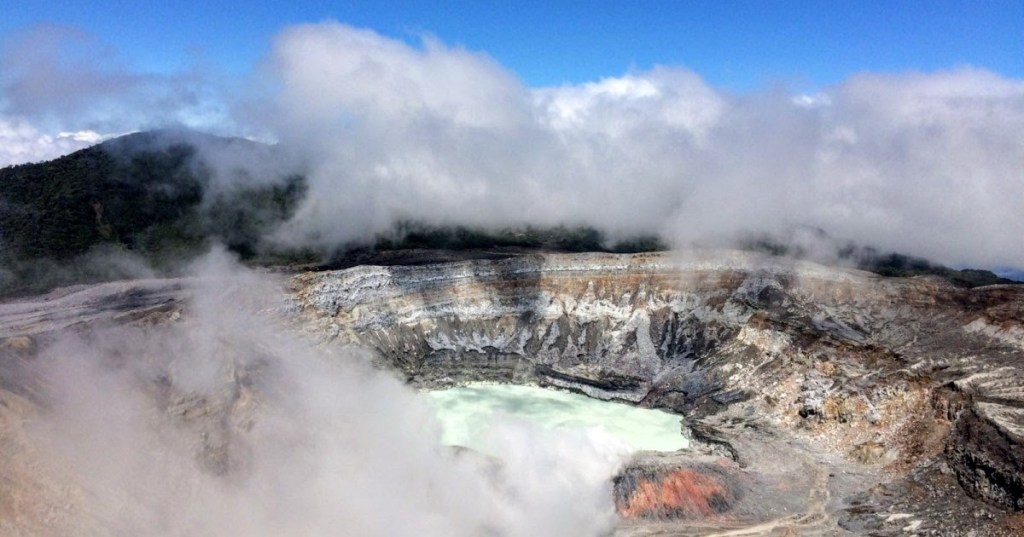
A team of international scientists, including researchers from Costa Rica’s Observatorio Volcanológico y Sismológico (OVSICORI) at Universidad Nacional, has examined rocks expelled from three active volcanoes to investigate why some steam-driven eruptions are difficult to forecast. The original scientific research, first published October 31, 2026 in the Journal of Geophysical Research: Solid Earth, combines laboratory measurements and numerical simulations. The study concerns the movement of fluids through volcanic rock, a process also relevant to subsurface engineering investigations such as geothermal exploration at Karthala in Comoros.
Why porous rock can prevent fluid movement
Porosity measures how much of a material’s volume consists of void space. Permeability measures its ability to transmit fluid through connected pathways. A rock may contain abundant pores yet transmit very little fluid if narrow connections between them become blocked. Mineral precipitation can progressively restrict those passages.
Michael J. Heap, Geoffroy Avard and colleagues examined altered lava and cemented fragments originating from Turrialba, Poás and Rincón de la Vieja. The tested samples had permeabilities spanning approximately 10⁻¹⁸ to 10⁻¹¹ square meters and tensile strengths of 0.41 to 6.19 megapascals. Alunite-group minerals frequently bound fragments together. Such measurements describe individual laboratory specimens, not a uniform property of an entire volcanic conduit.
Pressure accumulation and mechanical failure
Hot fluids originating below a volcano may flow through fractured rock toward the surface. When mineral deposits restrict the available pathways, the surrounding rock can experience increased fluid pressure. Tensile strength describes resistance to failure when a material is pulled apart. Rock failure is influenced by stress, geometry, temperature, fractures and fluid pressure, so the laboratory strength of an isolated sample does not define a universal eruption threshold.
The study’s hydromechanical simulations suggest that changes in permeability, fluid supply and rock strength can influence whether a seal ruptures. An eruption driven mainly by heated water or steam is termed phreatic. Direct interaction between magma and external water can produce phreatomagmatic activity. Neither process requires the same sequence of warning signals at every volcano.
Detecting small changes in ground orientation
A tiltmeter measures variations in the angle of a surface relative to a reference orientation. A microradian is one millionth of a radian; one microradian corresponds geometrically to about one millimeter of elevation difference across a horizontal kilometer. Instruments installed at suitable sites may detect small deformation signals that are difficult to resolve using conventional positioning measurements.
The authors suggest combining deformation observations with seismic monitoring, gas measurements and laboratory evidence. Drone-based remote sensing can add information without requiring routine personnel access to hazardous terrain. Different sensing methods have different measurement boundaries, as illustrated by satellite-based geological mapping in the Democratic Republic of the Congo and thermal observations from Sentinel-3C.
The study did not establish a validated real-time eruption warning system. Its value is in connecting measured material properties to physical mechanisms that monitoring networks can investigate. The researchers have also released the underlying laboratory dataset, enabling independent examination of the reported rock properties. As with experimental oxygen-production research, laboratory results and modeled behavior must remain distinct from validated operational performance.
Featured photograph: Poás crater, July 2022, by Mdelt via Wikimedia Commons, CC0 1.0; cropped for the cover. Historical scene, not a photograph of the October 2026 study.


Leave a Reply